Gauntlet Gallery
What is Shepard Fairey’s piece called “Sid Jocoy”?
Artist Statement
"This Sid image is a stencil I made from a portrait by Jim Jocoy. The portrait was taken at a party after the Sex Pistols final show at Winterland in San Francisco. Jim was kind enough to give me permission to use this recently published photo as a reference. "The interesting thing about Sid is that he did not really do much to shape Punk music, yet he remains one of its most enduring images. Sid really had the fashion image down, but he only actually plays on two songs on Never Mind the Bollocks. Sid is a classic example of style over substance. I was a sucker for his image. At age 15, one of the first stencils I ever made was Sid with the spiky hair, lock chain, and snarled lip Billy Idol copied. I guess the press really helped blow his image out of proportion when he allegedly killed his girlfriend and then overdosed. I look at Sid as less cool and more tragic these days, but he still sold more tee shirts than anyone else in Punk Rock. Sprite was wrong...image is everything!"
Summary
Sid Jocoy is a 2003 screen print published by Obey Giant in a first edition of 93, measuring 36 x 48 inches. Fairey created the image as a stencil based on a photograph of Sid Vicious taken by Jim Jocoy after the Sex Pistols' final show at Winterland in San Francisco, used with the photographer's permission. The print depicts the punk icon in Fairey's high-contrast graphic style. In the accompanying text, Fairey reflects on Sid Vicious as a figure of style over substance, recalling that one of the first stencils he ever made as a teenager was of Sid.
Why It Matters
Sid Jocoy is one of Fairey's most personally revealing music portraits, accompanied by an unusually candid statement. He recounts that at age 15 one of his first-ever stencils was of Sid Vicious, making this 2003 print a direct echo of his teenage origins as a stencil artist. The work is built from a Jim Jocoy photograph shot after the Sex Pistols' final Winterland performance, and Fairey notes he obtained the photographer's permission, underscoring his attention to source attribution. In the text he frames Sid as a study in 'style over substance' and 'image is everything,' a self-aware meditation that doubles as commentary on Fairey's own image-driven practice. The large 36 x 48 inch format and small edition of 93 distinguish it from his standard 18 x 24 runs of 300, marking it as a more ambitious, scarcer release. For collectors of punk and music memorabilia, the print fuses an iconic subject, a documented photographic source, and Fairey's personal narrative into a single statement piece.
Collector Perspective
This large-format print appeals strongly to punk-music collectors, Sex Pistols and Sid Vicious devotees, and Fairey enthusiasts who value works with rich artist commentary. The edition of just 93 and the imposing 36 x 48 inch scale make it a centerpiece rather than a filler piece, suited to a prominent wall. Its documented Jim Jocoy photographic source and Fairey's personal account of making his first stencil of Sid add narrative depth that collectors prize. It anchors a collection focused on punk iconography or on Fairey's music portraiture, and pairs naturally with his other musician tributes.
Historical Context
Sid Jocoy fits within Fairey's early-2000s Obey Giant period and his ongoing series of music portraits, but its accompanying text reaches back to his teenage beginnings, when one of his first stencils depicted Sid Vicious. The work thus connects his mature practice to its origins in punk-inspired street stenciling. By building the image from Jim Jocoy's Winterland-era photograph with permission, Fairey demonstrates the appropriation-with-attribution approach common to his portraits. The larger format and small edition of 93 set it apart from his routine portrait runs, signaling a more deliberate, statement-scale release within this era.
FAQ
What photograph is Sid Jocoy based on?
Fairey made the image as a stencil from a portrait of Sid Vicious taken by photographer Jim Jocoy at a party after the Sex Pistols' final show at Winterland in San Francisco. Fairey states Jocoy gave him permission to use the recently published photo as a reference.
How does this print connect to Fairey's beginnings?
In the accompanying text, Fairey recalls that at age 15 one of the first stencils he ever made was of Sid, with the spiky hair, lock chain, and snarled lip. The 2003 print directly echoes those teenage origins as a stencil artist.
How large is the edition and the print?
The source lists a first edition of 93 at 36 x 48 inches. Both the small run and the large format set it apart from Fairey's more common 18 x 24 inch editions of 300 from the same period.
What does Fairey say about Sid Vicious?
He frames Sid as 'a classic example of style over substance,' noting Sid played on only two songs on Never Mind the Bollocks yet remains an enduring punk image, and closes with 'image is everything,' a reflection on image-driven fame.
Related Works
About the Artist
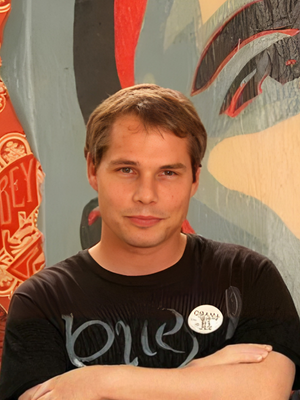
Shepard Fairey (b. 1970, Charleston, South Carolina) is an American street artist, graphic designer, and activist, and a graduate of the Rhode Island School of Design. His 1989 “André the Giant Has a Posse” sticker grew into the global OBEY GIANT campaign — an ongoing experiment in propaganda, obedience, and visual culture. He reached worldwide recognition with the 2008 “Hope” portrait of Barack Obama, now held by the Smithsonian National Portrait Gallery. Across screen prints, stencils, murals, and collage, Fairey channels propaganda aesthetics toward themes of peace, justice, environmentalism, and civil rights. His work is in the collections of the Museum of Modern Art, the Victoria & Albert Museum, and LACMA.