Gauntlet Gallery
What is Shepard Fairey’s piece called “Prince (First Edition)”?
Artist Statement
I was doing a show in Minneapolis, and I decided to use the opportunity to create a web of puns with this poster. Prince is one of the most famous figures from Minneapolis, and I create screen prints, often of pop icons; his band in the -˜80s was called the Revolution, and my work uses a lot of revolutionary material like the Che Guevara image; so it all seemed to fit together nicely. Signed edition of 100. 18 x 24 inch screen print.
Summary
Prince (First Edition) is a 2003 screen print published by Obey Giant in a signed edition of 100, measuring 18 x 24 inches. Fairey created the poster while doing a show in Minneapolis, building what he describes as a web of puns: Prince is one of the city's most famous figures, Fairey works in screen-printed pop icons, Prince's 1980s band was called the Revolution, and Fairey's work draws heavily on revolutionary imagery like the Che Guevara portrait. The print renders the musician in his graphic pop-poster style, tying subject, place, and Fairey's own visual vocabulary together.
Why It Matters
Prince (First Edition) is a witty, layered tribute that shows Fairey thinking through the conceptual puns that often underpin his portraits. In the source statement he explains the poster was made for a Minneapolis show and deliberately links Prince, the city's most famous figure, to his own practice of screen-printing pop icons and to the language of revolution: Prince's 1980s band the Revolution rhyming with Fairey's frequent use of revolutionary imagery like the Che Guevara portrait. This self-aware layering of meaning distinguishes the print from a straightforward likeness and reveals how Fairey weaves place, subject, and his signature iconography into a single image. The small signed edition of 100 makes it scarcer than his typical runs of 300, and its 18 x 24 inch format suits its event-poster origin. For collectors, it bridges Fairey's pop-culture portraiture and his music-and-counterculture interests, capturing a beloved musician through the lens of Fairey's revolution-themed graphic language and his habit of building conceptual connections into his work.
Collector Perspective
This print appeals to Prince fans, music portrait collectors, and Fairey enthusiasts who value works with strong conceptual backstories. The signed edition of 100 is smaller than many of his early-2000s runs, adding scarcity appeal. At 18 x 24 inches it frames easily and works well in a music-focused grouping or alongside Fairey's other pop-icon portraits. Its Minneapolis show origin and the documented pun linking Prince to revolutionary imagery give it narrative depth that collectors prize. It fits a collection centered on Fairey's music portraiture or on his pop-culture icon series.
Historical Context
Prince (First Edition) sits within Fairey's early-2000s Obey Giant period and his run of pop-icon screen prints, here tied to a specific Minneapolis exhibition. The source statement shows Fairey connecting the subject to his broader revolutionary visual vocabulary, including the Che Guevara imagery that recurs in his work, illustrating how he layers conceptual meaning into event posters. The signed edition of 100 is smaller than his common runs of 300, reflecting its show-specific production. The print exemplifies how Fairey used regional exhibitions to generate works rooted in local cultural figures during this period.
FAQ
Why did Fairey make the Prince poster?
Per the source, he created it while doing a show in Minneapolis. He built a web of puns linking Prince, the city's most famous figure, to his own practice of screen-printing pop icons and to revolutionary imagery, since Prince's 1980s band was called the Revolution.
How large is the edition?
The source describes a signed edition of 100. This is smaller than many of Fairey's early-2000s runs of 300, giving the print added scarcity within his output from this period.
What are the print's dimensions?
It is an 18 x 24 inch screen print, a standard size for Fairey's early-2000s portraits, well suited to its origin as an event poster for a Minneapolis exhibition.
What connection does Fairey draw to revolution?
He notes Prince's 1980s band was called the Revolution, and that his own work uses revolutionary material like the Che Guevara image, so the subject and his iconography fit together as a deliberate conceptual pun.
Related Works
About the Artist
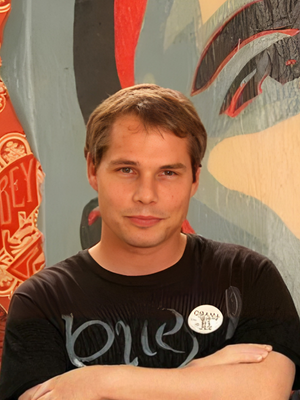
Shepard Fairey (b. 1970, Charleston, South Carolina) is an American street artist, graphic designer, and activist, and a graduate of the Rhode Island School of Design. His 1989 “André the Giant Has a Posse” sticker grew into the global OBEY GIANT campaign — an ongoing experiment in propaganda, obedience, and visual culture. He reached worldwide recognition with the 2008 “Hope” portrait of Barack Obama, now held by the Smithsonian National Portrait Gallery. Across screen prints, stencils, murals, and collage, Fairey channels propaganda aesthetics toward themes of peace, justice, environmentalism, and civil rights. His work is in the collections of the Museum of Modern Art, the Victoria & Albert Museum, and LACMA.