Gauntlet Gallery
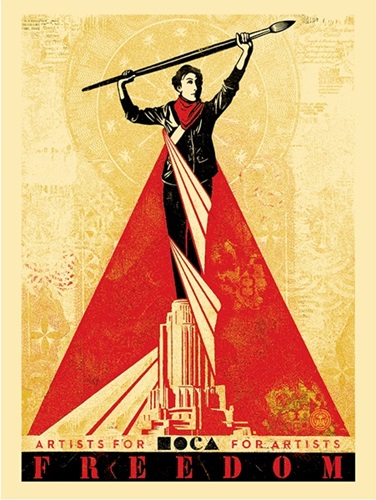
What is Shepard Fairey’s piece called “Freedom (First Edition)”?
Artist Statement
FREEDOM Screen Print 18 x 24 inches Edition of 300
Summary
Freedom (First Edition) is a 2004 screen print published by Obey Giant in a first edition of 300, measuring 18 x 24 inches. The work centers on the theme of freedom, rendered in Fairey's graphic poster style, and the source associates it with both pop-culture and political-democracy themes. With only the title, medium, dimensions, and edition size supplied, the record offers limited descriptive detail. It belongs to Fairey's early-2000s Obey Giant output, where he frequently used charged words and political concepts as the basis for bold graphic compositions.
Why It Matters
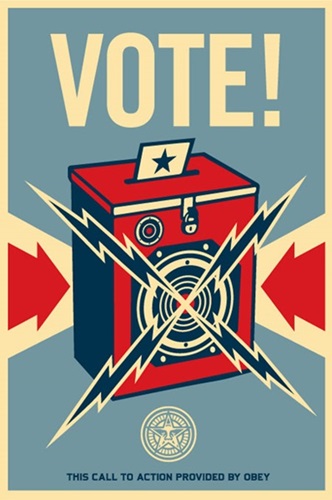
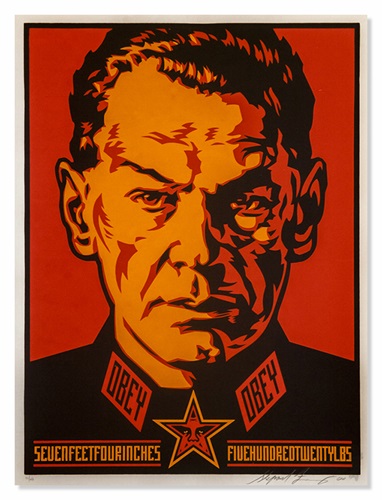
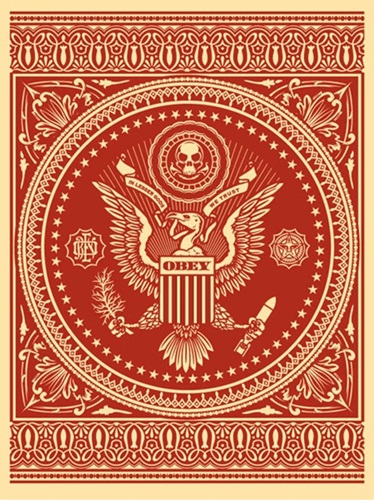
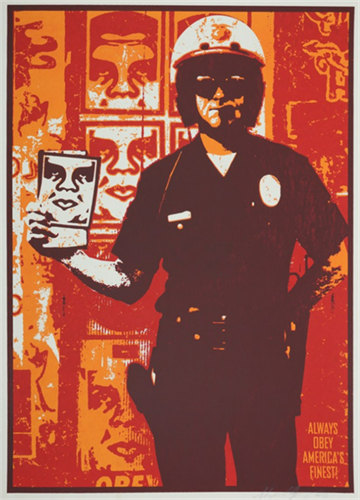
Freedom (First Edition) channels one of the most loaded words in political language into Fairey's graphic poster idiom, where slogans and concepts carry the same weight as portraits. The source ties the print to both pop-culture and politics-and-democracy themes, reflecting Fairey's habit of treating civic ideas as design subjects in their own right. Across his work, single words and emblematic phrases function as propaganda-style statements that prompt the viewer to question how such language is deployed. This print sits within a cluster of related works ranging from patriotic and authoritarian imagery to voting-themed pieces, situating 'freedom' within Fairey's broader interrogation of American political rhetoric. The 300-piece first edition is typical of his standard early-2000s runs. Because the source description is brief, the work is best understood through its thematic placement and Fairey's recurring use of charged civic language rather than through a documented narrative. For collectors, it represents the politically engaged, text-and-concept strand of his output, appealing to those drawn to his commentary on freedom, democracy, and American iconography.
Collector Perspective
This print appeals to collectors of Fairey's political and Americana-themed work and to those drawn to his text- and concept-driven graphic statements. Its bold treatment of a single charged word frames cleanly at 18 x 24 inches and groups well with his patriotic, authoritarian, and voting-themed prints. The edition of 300 places it among his standard early-2000s runs. Buyers building a collection around Fairey's commentary on American politics and democracy will value it as part of that thematic set, pairing naturally with related civic-language pieces from his catalog.
Historical Context
Freedom (First Edition) belongs to Fairey's early-2000s Obey Giant period, when he frequently built graphic compositions around charged political words and concepts. The source's association with both pop-culture and politics-and-democracy themes reflects his blending of accessible iconography with civic commentary. The print connects to a wider body of work probing American political rhetoric, from patriotic and authoritarian imagery to later voting-themed pieces. The edition of 300 is typical of his standard releases from this window, and with limited source detail the work is best placed within that broader thematic lineage.
FAQ
When was Freedom released?
It was released in 2004 and published by Obey Giant. The work is a screen print measuring 18 x 24 inches, produced as a first edition in Fairey's graphic poster style of the period.
How large is the edition?
The source lists a first edition of 300, consistent with Fairey's standard early-2000s screen-print release sizes from his Obey Giant output.
What themes does it engage?
The source associates the print with both pop-culture and politics-and-democracy themes, reflecting Fairey's habit of treating charged civic words like 'freedom' as graphic design subjects. The source provides limited further description of the specific imagery.
How does it fit Fairey's work?
It belongs to his early-2000s body of work built around charged political words and American iconography, connecting to related patriotic, authoritarian, and voting-themed prints in his catalog.
Related Works
About the Artist

Shepard Fairey (b. 1970, Charleston, South Carolina) is an American street artist, graphic designer, and activist, and a graduate of the Rhode Island School of Design. His 1989 “André the Giant Has a Posse” sticker grew into the global OBEY GIANT campaign — an ongoing experiment in propaganda, obedience, and visual culture. He reached worldwide recognition with the 2008 “Hope” portrait of Barack Obama, now held by the Smithsonian National Portrait Gallery. Across screen prints, stencils, murals, and collage, Fairey channels propaganda aesthetics toward themes of peace, justice, environmentalism, and civil rights. His work is in the collections of the Museum of Modern Art, the Victoria & Albert Museum, and LACMA.