Gauntlet Gallery
What is Shepard Fairey’s piece called “Chinese San Francisco”?
Artist Statement
CHINESE SAN FRANCISCO Screen Print 18 x 24 inches Edition of 300
Summary
Chinese San Francisco is a 2004 Shepard Fairey screen print published by Obey Giant as a first edition of 300, measuring 18 x 24 inches. The work draws on Chinese visual motifs and a San Francisco setting, extending Fairey's interest in propaganda-poster aesthetics and place-specific imagery. Rendered in his flat, high-contrast graphic style, the print folds Asian-inflected design elements into the OBEY visual vocabulary. As a first-edition 18-by-24 screen print, it sits within Fairey's prolific mid-2000s Obey Giant output while standing apart for its city-and-culture-specific subject drawn from San Francisco's Chinatown context.
Why It Matters
Chinese San Francisco reflects Fairey's recurring engagement with Chinese and Asian visual motifs, an aesthetic strand he drew on for its bold graphic propaganda heritage, here anchored to a specific place, San Francisco. The pairing of a city with culturally inflected imagery gives the print a documentary, location-rooted character that distinguishes it from his portrait and brand editions. Fairey has long borrowed from the formal language of Chinese revolutionary posters, using their flat color, strong silhouettes, and commanding compositions to power his own propaganda-influenced style; this print appears to align with that lineage while tying it to an American urban setting with deep Chinese-American history. For collectors, place-specific Fairey prints have appeal as regional artifacts and as evidence of how he localizes his global visual sources. The first edition of 300 keeps it accessible within the 2004 run. Its significance rests on this fusion of cultural motif and civic specificity, showing Fairey treating a city and its cultural fabric as subject matter rather than abstracting it into pure branding. The result is a print that reads as both design exercise and place-based homage within his broader Obey Giant catalog.
Collector Perspective
This print appeals to collectors drawn to Fairey's culturally and geographically specific work, including San Francisco and Bay Area collectors and those interested in his use of Chinese poster aesthetics. Its place-based subject gives it a regional collecting hook that portraits lack, making it a natural anchor for a city- or theme-organized grouping. At 18 x 24 inches in a first edition of 300, it frames cleanly and pairs well with Fairey's other San Francisco and Chinese-motif prints. Buyers who value the design-source lineage, how Fairey adapts revolutionary-poster style, will appreciate it more than those seeking marquee imagery. Display impact is strongest in a set that highlights Fairey's place-specific output, where its cultural motifs and civic title read as deliberate homage.
Historical Context
Chinese San Francisco dates to 2004 and belongs to Fairey's Posters and Propaganda phase, when he issued numerous 18-by-24 first-edition screen prints under Obey Giant. The work continues his sustained borrowing from Chinese revolutionary-poster aesthetics, a formal source he mined throughout his career for its bold graphic authority, while grounding it in a specific American city with significant Chinese-American history. It relates to his other place-based prints referencing San Francisco and Chinese visual motifs. The era follows his foundational street-art period, rooted in the late-1980s Andre the Giant campaign, and precedes his 2008 national breakthrough. Within his arc, the print shows Fairey localizing his global design sources, fusing cultural motif with civic specificity in his mid-2000s output.
FAQ
What is the subject of this print?
The title, Chinese San Francisco, points to a fusion of Chinese visual motifs and a San Francisco setting. It draws on the city's Chinese-American context and Fairey's long use of Chinese poster aesthetics, falling within his Collaborations and pop culture themed 2004 output.
What are the size and edition?
It is an 18 x 24 inch screen print published by Obey Giant as a first edition of 300. That standard format and edition size match many of Fairey's mid-2000s releases, keeping the work accessible while remaining a defined limited edition.
How does it relate to Fairey's other work?
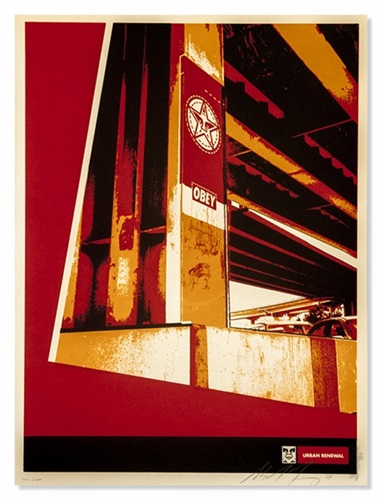
It connects to his place-based prints referencing San Francisco and to his Chinese-motif works, such as Chinese Building. The print continues his borrowing of revolutionary-poster aesthetics, here tied to a specific American city rather than abstracted into pure branding.
What medium is used?
The work is a screen print, the technique behind most of Fairey's Obey Giant editions. Screen printing supports the flat color and bold contrast that let him adapt propaganda-poster styling to a place-specific, culturally inflected subject.
Related Works



About the Artist

Shepard Fairey (b. 1970, Charleston, South Carolina) is an American street artist, graphic designer, and activist, and a graduate of the Rhode Island School of Design. His 1989 “André the Giant Has a Posse” sticker grew into the global OBEY GIANT campaign — an ongoing experiment in propaganda, obedience, and visual culture. He reached worldwide recognition with the 2008 “Hope” portrait of Barack Obama, now held by the Smithsonian National Portrait Gallery. Across screen prints, stencils, murals, and collage, Fairey channels propaganda aesthetics toward themes of peace, justice, environmentalism, and civil rights. His work is in the collections of the Museum of Modern Art, the Victoria & Albert Museum, and LACMA.