Gauntlet Gallery
What is Shepard Fairey’s piece called “Tupac (Blue)”?
Artist Statement
Screen Print 18 x 24 inches Edition of 300
Summary
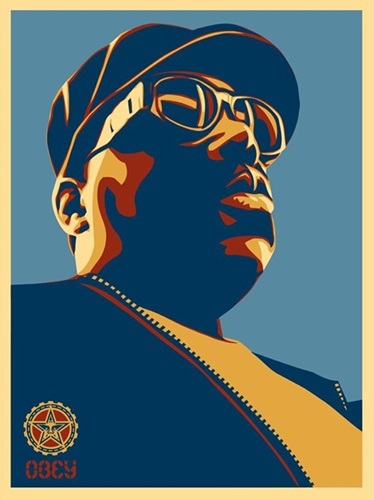
Tupac (Blue) is a 2004 Shepard Fairey screen print published by Obey Giant in an edition of 300, measuring 18 x 24 inches and originally priced at $30. Part of a two-color release available in Blue and Red, this Blue variant depicts the late rapper Tupac Shakur in Fairey's flat, high-contrast portrait style. The print belongs to his recurring series of music-figure portraits, rendering one of hip-hop's most iconic artists in the graphic, poster-influenced vocabulary he used across his mid-2000s Obey Giant editions. As a standard 18-by-24 screen print, it reflects the accessible format of the period.
Why It Matters
Tupac (Blue) portrays Tupac Shakur, among the most mythologized figures in hip-hop, within Fairey's broader project of translating music icons into emblematic graphic portraits. By rendering Tupac in the same flat, high-contrast style he applied to punk and rock figures, Fairey grants him a place in his visual pantheon, an act of homage that carries strong resonance for hip-hop's vast collector base. The two-color Blue and Red release reflects Fairey's pattern of issuing colorway variants, encouraging paired collecting and offering each subject two visual registers. At an edition of 300 and an original $30, the print kept a portrait of a beloved, posthumously revered artist accessible. For collectors, Tupac carries extraordinary cultural weight, and a Fairey portrait of him bridges fine-art print collecting with deep music fandom and memorial significance. It appears to align with Fairey's use of portraiture to elevate and commemorate countercultural and music figures with iconographic seriousness. Its importance rests on that crossover appeal and on Tupac's enduring legend, which lends the image a memorial dimension that extends beyond its bold graphic surface.
Collector Perspective
This print is highly sought by collectors who span fine-art prints and hip-hop culture, particularly those honoring Tupac Shakur's legacy. The Blue and Red variants invite paired acquisition, with many collectors pursuing both colorways. At 18 x 24 inches in an edition of 300, it frames cleanly and serves as a centerpiece in a grouping of Fairey music portraits. Its accessible original price made it a popular acquisition, and it fits collections organized around music, portraiture, or the 2004 Obey Giant run. Display impact is strongest amid other Fairey musician prints, where the consistent portrait treatment unifies diverse figures, and Tupac's stature gives the wall a powerful cultural and emotional focal point.
Historical Context
Tupac (Blue) dates to 2004 and belongs to Fairey's series of music-figure portraits issued under Obey Giant during his Posters and Propaganda phase. Across the early-to-mid 2000s, Fairey repeatedly translated musicians into his flat, high-contrast graphic style, building a recurring pantheon spanning punk, rock, and hip-hop. This portrait of Tupac Shakur, who died in 1996, carries a memorial dimension within that pattern. The era follows Fairey's foundational street-art period, rooted in the late-1980s Andre the Giant campaign, and precedes his 2008 national breakthrough. Within his arc, the print shows him extending his iconographic portrait language to commemorate hip-hop figures alongside his political and brand-driven work.
FAQ
Who is depicted in this print?
The print depicts Tupac Shakur, rendered in Fairey's flat, high-contrast portrait style. It is part of his run of music-figure portraits and falls under his Collaborations and pop culture themed output from 2004, published by Obey Giant.
What color variants exist?
The source lists Blue and Red variants. This is the Blue version. Issuing multiple colorways of a single subject was a recurring practice for Fairey, giving collectors a choice between distinct visual registers and encouraging paired collecting of both editions.
What are the size, edition, and price?
It is an 18 x 24 inch screen print in an edition of 300, originally priced at $30 and published by Obey Giant. That format, edition size, and low release price match Fairey's mid-2000s music portraits and kept them accessible to a wide audience.
What medium is used?
The work is a screen print, the technique behind most of Fairey's Obey Giant editions in this period. Screen printing produces the flat color fields and bold contrast that define his iconographic portrait style.
Related Works
About the Artist

Shepard Fairey (b. 1970, Charleston, South Carolina) is an American street artist, graphic designer, and activist, and a graduate of the Rhode Island School of Design. His 1989 “André the Giant Has a Posse” sticker grew into the global OBEY GIANT campaign — an ongoing experiment in propaganda, obedience, and visual culture. He reached worldwide recognition with the 2008 “Hope” portrait of Barack Obama, now held by the Smithsonian National Portrait Gallery. Across screen prints, stencils, murals, and collage, Fairey channels propaganda aesthetics toward themes of peace, justice, environmentalism, and civil rights. His work is in the collections of the Museum of Modern Art, the Victoria & Albert Museum, and LACMA.