Gauntlet Gallery
What is Shepard Fairey’s piece called “Make Art Not War”?
Artist Statement
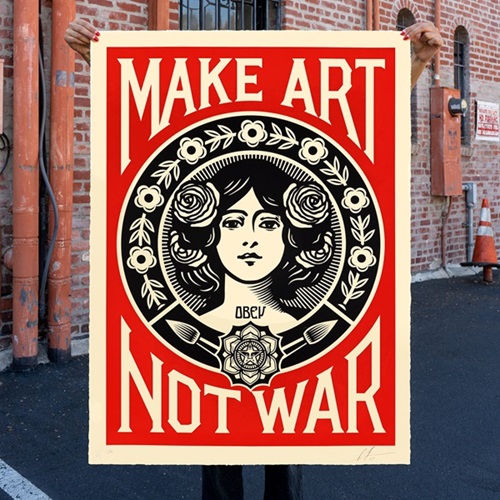
MAKE ART NOT WAR Screen Print 18 x 24 inches Edition of 300
Summary
Make Art Not War is a 2004 Shepard Fairey screen print, published by Obey Giant in a First Edition of 300 and measuring 18 x 24 inches. The title adapts the classic 1960s antiwar slogan "make love not war," substituting art for love to position creative practice as an act of resistance. The work uses Fairey's propaganda-poster style: bold flat color, strong typography, and graphic emphasis. As a mid-2000s Obey Giant edition, it pairs his peace-and-antiwar messaging with his enduring belief in art as a tool for social change.
Why It Matters
Make Art Not War distills one of Fairey's core convictions into a single line: that making art is itself a form of activism. By rewriting the iconic "make love not war" peace slogan, he places himself within a lineage of countercultural protest while asserting the creative act as the answer to violence. The phrase became a recurring motif across his career, reappearing in later large-format and painted versions, which makes this 2004 first edition a foundational statement of the idea. For collectors, that lineage matters: owning the early screen print connects to the origin of a slogan Fairey would return to for two decades. The edition of 300 keeps it accessible, while its dual themes of peace and the power of art give it broad appeal beyond a single political moment. The source marks both a primary pop-culture theme and a secondary peace-and-antiwar theme, supporting its reading as a bridge between Fairey's design practice and his activist messaging. As a clear, optimistic call to creative resistance, it is one of his most quotable and enduring statements.
Collector Perspective
Make Art Not War appeals to a wide range of collectors, from those focused on Fairey's antiwar messaging to buyers who simply respond to its uplifting, quotable slogan. At 18 x 24 inches in an edition of 300, it is accessible and displays well in studios, creative spaces, and homes where its message resonates. Because the phrase recurs in later large-format and painted editions, this 2004 print holds appeal as the early, foundational version for collectors who like to trace a motif across an artist's career. It groups naturally with Fairey's other peace-themed prints and rewards owners who value art that doubles as a personal credo.
Historical Context
Make Art Not War arrives in the mid-2000s, after Fairey's 1989 Andre the Giant sticker campaign and amid the post-9/11, Iraq-war political climate that pushed much of his output toward explicit antiwar and peace messaging. The slogan adapts 1960s counterculture protest language, situating Fairey within a longer tradition of activist art. This 2004 first edition predates his 2008 Obama "Hope" breakthrough and establishes a phrase he would revisit for years, including later large-format and painted versions noted among related works. It marks the convergence of his propaganda design vocabulary with a sincere belief in creativity as resistance, a theme that runs through his subsequent activist career.
FAQ
What does Make Art Not War mean?
It adapts the 1960s antiwar slogan "make love not war," replacing love with art to position creative practice as a form of resistance to violence. The record tags it with both a pop-culture primary theme and a peace-and-antiwar secondary theme, supporting that reading.
When was it released and in what edition?
The source confirms a 2004 release by Obey Giant as a First Edition screen print in an edition of 300. That edition size places it among the accessible mid-2000s Obey Giant releases on paper.
Has Fairey reused this slogan?
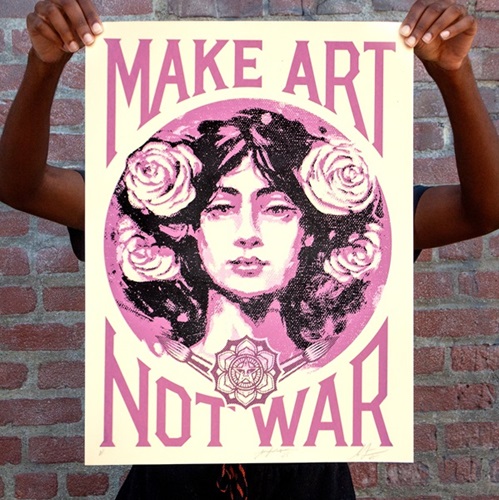
Yes. Related records show later versions, including a 2019 large-format Make Art Not War (Peace Girl) and a 2025 painted version, indicating the phrase recurs across his career. This 2004 print is among the early appearances of the motif.
What are the dimensions and medium?
It is a screen print measuring 18 x 24 inches, as stated in the record's description, executed in Fairey's signature flat-color, typography-forward poster style.
Related Works
About the Artist
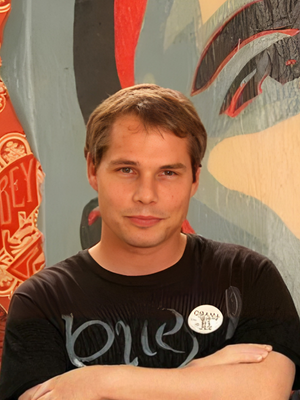
Shepard Fairey (b. 1970, Charleston, South Carolina) is an American street artist, graphic designer, and activist, and a graduate of the Rhode Island School of Design. His 1989 “André the Giant Has a Posse” sticker grew into the global OBEY GIANT campaign — an ongoing experiment in propaganda, obedience, and visual culture. He reached worldwide recognition with the 2008 “Hope” portrait of Barack Obama, now held by the Smithsonian National Portrait Gallery. Across screen prints, stencils, murals, and collage, Fairey channels propaganda aesthetics toward themes of peace, justice, environmentalism, and civil rights. His work is in the collections of the Museum of Modern Art, the Victoria & Albert Museum, and LACMA.