Gauntlet Gallery
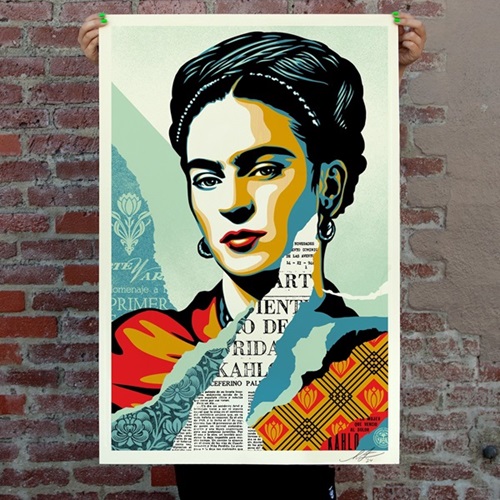
What is Shepard Fairey’s piece called “Zapatista Woman (First Edition)”?
Artist Statement
ZAPATISTA WOMAN Screen Print 30 x 42 inches Edition of 50 $400
Summary
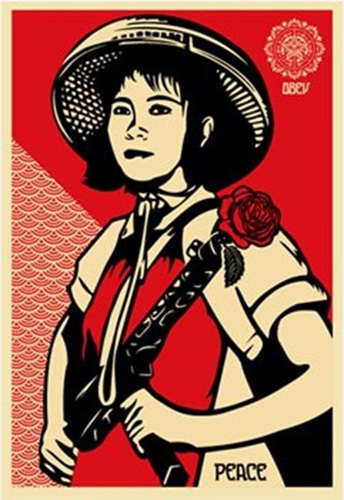
Zapatista Woman (First Edition) is a 2005 Shepard Fairey screen print published by Obey Giant in a first edition of 50, measuring 30 x 42 inches. Released at an original price of $400, it is a large-format work depicting a woman associated with the Zapatista movement, rendered in Fairey's high-contrast portrait style. The print engages themes of civil rights, justice, and revolutionary struggle, foregrounding a female figure of resistance. With its sizable dimensions and small edition, it sits among Fairey's premium large-format screen prints of the mid-2000s, combining bold portraiture with his propaganda-influenced graphic vocabulary.
Why It Matters
Zapatista Woman stands out within Shepard Fairey's catalog for combining a small large-format edition with explicitly political subject matter centered on a woman of resistance. The Zapatista movement, rooted in indigenous and agrarian struggle in Mexico, gives the image a specific revolutionary charge that fits Fairey's long-standing engagement with protest iconography. At 30 x 42 inches in an edition of just 50, the print belongs to the more ambitious, higher-priced tier of his output, distinct from the broadly available 18 x 24 inch editions of 300. That scale and scarcity make it a more significant collector object and reflect Fairey's intent to treat the subject monumentally. The work also exemplifies his recurring focus on women as agents of revolution rather than passive symbols, a thread that runs through several companion prints. For collectors, it offers both visual impact, owing to its size and bold graphic treatment, and thematic depth tied to international solidarity movements. Its appeal rests on the convergence of strong subject matter, large presentation, and a genuinely limited edition size of 50, which the source explicitly documents.
Collector Perspective
This print appeals to collectors drawn to Shepard Fairey's politically charged, women-centered works and to those seeking large-format statement pieces. At 30 x 42 inches it commands a wall and anchors a room, making it suited to collectors who want a focal work rather than a grid filler. The small edition of 50 and higher original price position it as a more serious acquisition than his standard editions, attracting buyers focused on his revolutionary-woman series and international-solidarity themes. It pairs naturally with Revolution Woman and other female-resistance portraits, allowing collectors to build a thematic grouping around women and activism in Fairey's catalog.
Historical Context
Zapatista Woman fits within Shepard Fairey's mid-2000s body of large-format, politically driven screen prints, a tier distinct from his accessible 18 x 24 inch editions. Sharing a September 2005 date with Revolution Woman and Angela Davis, it belongs to a cluster of 30 x 42 inch, edition-of-50 works that foreground revolutionary and civil-rights subjects. The Zapatista imagery reflects Fairey's engagement with international resistance movements and his recurring treatment of women as figures of struggle, themes he revisited across later prints. Released before the 2008 Obama "Hope" image, it documents the ambitious, message-driven strand of his practice as he expanded beyond street posters into larger studio editions.
FAQ
What is the edition size of Zapatista Woman?
It was published by Obey Giant in 2005 as a first edition of 50. This is a small run compared with Fairey's standard 18 x 24 inch editions of 300, placing it among his more limited large-format works.
What are the dimensions?
Zapatista Woman is a large-format screen print measuring 30 x 42 inches. The substantial scale makes it a statement piece, distinct from the more common 18 x 24 inch format used for many of Fairey's editions.
What was the original price?
The source lists an original release price of $400, reflecting its large format and small edition of 50, well above the $30 typical of Fairey's standard 18 x 24 inch screen prints of the period.
What does the imagery reference?
The print depicts a woman associated with the Zapatista movement, an indigenous and agrarian resistance movement in Mexico. It aligns with Fairey's recurring focus on women as figures of revolution and his engagement with international justice themes.
Related Works

About the Artist

Shepard Fairey (b. 1970, Charleston, South Carolina) is an American street artist, graphic designer, and activist, and a graduate of the Rhode Island School of Design. His 1989 “André the Giant Has a Posse” sticker grew into the global OBEY GIANT campaign — an ongoing experiment in propaganda, obedience, and visual culture. He reached worldwide recognition with the 2008 “Hope” portrait of Barack Obama, now held by the Smithsonian National Portrait Gallery. Across screen prints, stencils, murals, and collage, Fairey channels propaganda aesthetics toward themes of peace, justice, environmentalism, and civil rights. His work is in the collections of the Museum of Modern Art, the Victoria & Albert Museum, and LACMA.