Gauntlet Gallery
What is Shepard Fairey’s piece called “This Machine Kills Fascists (First Edition)”?
Artist Statement
THIS MACHINE KILLS FASCISTS Screen Print 18 x 24 inches Edition of 300 The source image for this print is a Peter Webb photo of Denny Laine (Moody Blues, Wings) taken in 1967. Reference photo by Peter Webb
Summary
This Machine Kills Fascists is a 2007 Shepard Fairey screen print, published by Obey Giant in a first edition of 300 at 18 x 24 inches. Its title references the famous anti-fascist slogan Woody Guthrie wrote on his guitar, while the source image is a 1967 Peter Webb photograph of Denny Laine (Moody Blues, Wings). Fairey reworks the musician portrait in his graphic, high-contrast poster style, pairing a music-culture figure with a politically charged motto. The result fuses portraiture, music heritage, and slogan-driven messaging characteristic of his mid-2000s output.
Why It Matters
This print sits at the intersection of two threads Fairey returns to often: music counterculture and anti-authoritarian politics. By appropriating Woody Guthrie's anti-fascist guitar slogan and grafting it onto a portrait of Wings/Moody Blues guitarist Denny Laine, Fairey connects the protest-folk lineage to rock history, letting the slogan reframe the musician image as an instrument of resistance. The acknowledged Peter Webb reference photo from 1967 is notable: it shows Fairey's habit of building prints on documented source imagery, a practice that later became central to debates around his work. For collectors, the piece is appealing because it carries a legible message and a recognizable cultural quotation, giving it more narrative weight than a purely decorative print. The edition of 300 keeps it accessible while the music-and-politics crossover broadens its audience beyond OBEY completists to those drawn to anti-fascist and music-themed art. It rewards buyers who value the way Fairey layers borrowed iconography, political slogans, and music history into a single graphic statement, and it pairs naturally with his other portrait-based screen prints from the same period.
Collector Perspective
Collectors drawn to this print typically value the meeting of music history and political messaging, or seek Fairey portraits built on identifiable photographic sources. The anti-fascist slogan gives it appeal to buyers who want art with an explicit stance, while the Denny Laine connection attracts music-history enthusiasts. At an edition of 300 it remains attainable for collectors building a themed grouping rather than chasing scarcity. Its 18 x 24 format and bold poster treatment make it easy to display alongside other Obey Giant portraits and slogan prints, and it fits well within a politically themed or music-leaning Fairey collection from the 2006-2007 release window.
Historical Context
Released in January 2007 through Obey Giant, the print belongs to Fairey's Posters and Propaganda era, a stretch in which he issued steady editioned screen prints blending portraiture, music, and political slogans. The title borrows Woody Guthrie's well-known anti-fascist guitar inscription, tying Fairey's work to a deep protest-music tradition, while the use of a credited 1967 Peter Webb photograph of Denny Laine reflects his documented practice of working from existing source imagery. It sits among his mid-2000s output that increasingly fused counterculture music figures with politically charged text, a tendency that would intensify as his career moved toward the more overtly political Obama-era work.
FAQ
What does the title 'This Machine Kills Fascists' refer to?
The phrase is the famous anti-fascist slogan Woody Guthrie wrote on his guitar. Fairey applies it to a portrait, linking the protest-music tradition to his graphic poster style. The print was released in 2007 by Obey Giant.
Who is pictured in the print?
The source image is a 1967 Peter Webb photograph of Denny Laine, known from the Moody Blues and Wings. Fairey reworks this reference photo, credited to Peter Webb, into his high-contrast graphic treatment.
What are the edition size and dimensions?
It is a first edition of 300, screen printed at 18 x 24 inches. The original Obey Giant release price was listed at $35.
Does it relate to other Fairey prints?
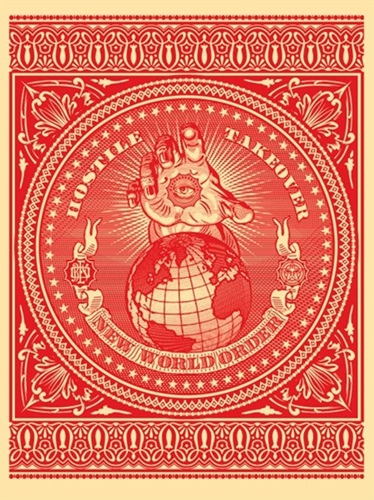
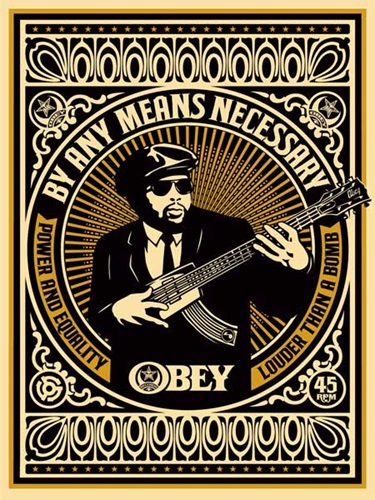
It sits among his 2006-2007 Obey Giant screen prints that combine portraiture with political slogans, alongside works such as Hostile Takeover and By Any Means Necessary from the same year.
Related Works
About the Artist

Shepard Fairey (b. 1970, Charleston, South Carolina) is an American street artist, graphic designer, and activist, and a graduate of the Rhode Island School of Design. His 1989 “André the Giant Has a Posse” sticker grew into the global OBEY GIANT campaign — an ongoing experiment in propaganda, obedience, and visual culture. He reached worldwide recognition with the 2008 “Hope” portrait of Barack Obama, now held by the Smithsonian National Portrait Gallery. Across screen prints, stencils, murals, and collage, Fairey channels propaganda aesthetics toward themes of peace, justice, environmentalism, and civil rights. His work is in the collections of the Museum of Modern Art, the Victoria & Albert Museum, and LACMA.