Gauntlet Gallery
What is Shepard Fairey’s piece called “Lenin”?
Artist Statement
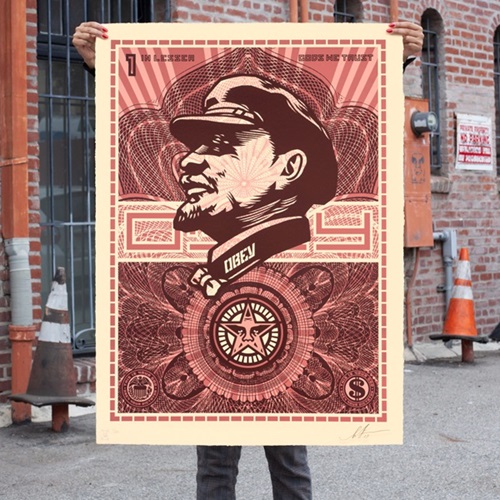
Lenin Screen Print 18 inches by 24 inches Edition of: 100 This portrait of Lenin was the first image where I tonally superimposed the Obey star behind a portrait so that the two lined up, and it actually works really well, where you almost feel like the star is part of the Lenin portrait. The power of suggestion, once the two are superimposed over each other, is just another form of manipulation: after a lot of people saw this poster, they assumed that the Obey star was an original aspect of the Lenin portrait. Part of what I'm trying to do is get people to question their assumptions. Since they make assumptions through associations, I try to create new associations incongruous with these assumptions.
Summary
Lenin is a 1997 screen print by Shepard Fairey, published by Obey Giant in a First Edition of 100, measuring 18 x 24 inches on paper. Per Fairey's own statement in the record, it was the first image in which he tonally superimposed the OBEY star behind a portrait so the two aligned, making the star feel like part of the Lenin portrait. He describes this as a deliberate exercise in the power of suggestion and manipulation, designed to make viewers question the assumptions and associations they bring to an image. It pairs portraiture with consumerism/power and OBEY iconography themes.
Why It Matters
Lenin is a pivotal early Fairey print because, by his own account, it was the first time he tonally superimposed the OBEY star behind a portrait so the two lined up, a technique that became foundational to his portrait work. The record quotes his explanation: many viewers later assumed the star was an original element of the Lenin portrait, which he frames as a demonstration of the power of suggestion and 'just another form of manipulation.' This makes the print a stated turning point in his method, the moment he formalized how the OBEY mark could be embedded into appropriated portraiture to alter perception. His commentary, getting people to 'question their assumptions' by creating 'new associations incongruous with these assumptions,' articulates the conceptual engine behind much of his later political portraiture. With an edition of 100, it is a limited early work, and its importance rests not on rarity alone but on the documented role it plays in his technical and conceptual development. The combination of a clear artist statement, a named first-use of a signature technique, and an iconic political subject gives this print unusually strong grounding for collector significance among the 1997 cohort.
Collector Perspective
Lenin appeals to collectors who prize works with documented art-historical significance, since Fairey himself identifies it as the first portrait to use his tonally superimposed OBEY star. That stated first-use, paired with an edition of 100, makes it a standout early acquisition for anyone building a serious Fairey collection or focusing on his portrait method. The iconic political subject and the artist's own commentary give it strong narrative and display value. The 18 x 24 format frames cleanly and anchors a wall of early OBEY work. It fits collections centered on Fairey's conceptual development, his political portraiture, and the evolution of the OBEY star as a perceptual device.
Historical Context
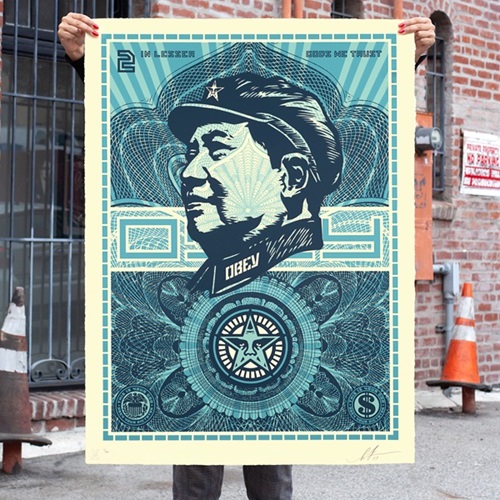
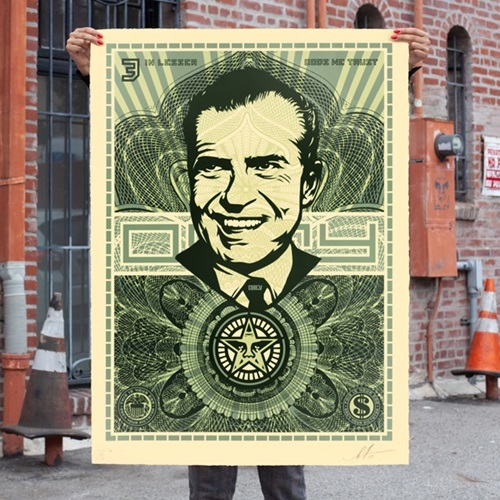
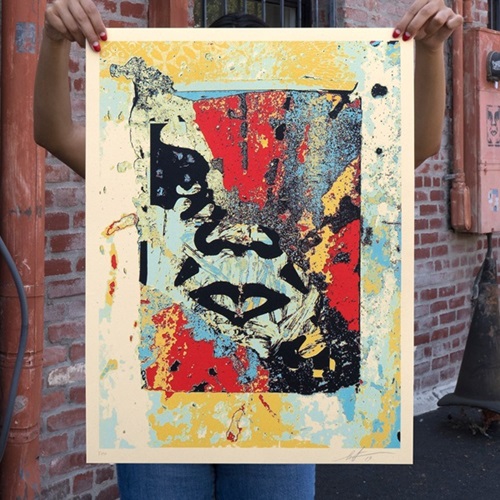
Published by Obey Giant in 1997 in an edition of 100, Lenin marks, in Fairey's own words, the first image in which he tonally superimposed the OBEY star behind a portrait so the two aligned. That technique, embedding the mark so it reads as native to the appropriated image, became central to his later political portraiture. Sitting in his early studio-edition era, the print connects the OBEY street project's concern with suggestion and manipulation to the portrait format he would develop for decades. Its related works extend the consumerism/power and OBEY-iconography threads into later large-format money and disintegration prints, underscoring this piece as an origin point for techniques Fairey carried well beyond the 1990s.
FAQ
What is Lenin by Shepard Fairey?
Lenin is a 1997 screen print published by Obey Giant, 18 x 24 inches on paper, in a First Edition of 100. It depicts a portrait of Lenin with the OBEY star tonally superimposed behind it, a technique Fairey describes as a first in his work.
Why is this print significant?
Per Fairey's statement in the record, it was the first image in which he tonally superimposed the OBEY star behind a portrait so the two aligned. Many viewers later assumed the star was original to the portrait, which he cites as a demonstration of suggestion and manipulation.
How large is the edition?
The record lists a First Edition of 100, making it a comparatively limited early Obey Giant print from 1997.
What was Fairey trying to do with this image?
In his own words, he aimed to get people to question their assumptions, since they make assumptions through associations, by creating new associations incongruous with those assumptions, using the superimposed star as a tool of suggestion.
Related Works

About the Artist

Shepard Fairey (b. 1970, Charleston, South Carolina) is an American street artist, graphic designer, and activist, and a graduate of the Rhode Island School of Design. His 1989 “André the Giant Has a Posse” sticker grew into the global OBEY GIANT campaign — an ongoing experiment in propaganda, obedience, and visual culture. He reached worldwide recognition with the 2008 “Hope” portrait of Barack Obama, now held by the Smithsonian National Portrait Gallery. Across screen prints, stencils, murals, and collage, Fairey channels propaganda aesthetics toward themes of peace, justice, environmentalism, and civil rights. His work is in the collections of the Museum of Modern Art, the Victoria & Albert Museum, and LACMA.