Gauntlet Gallery
What is Shepard Fairey’s piece called “Animal Farm”?
Artist Statement
George Orwell’s timeless satire of a revolution that went wrong – Animal Farm – and chilling portrait of a totalitarian regime – Nineteen Eighty-Four – have become classic works of Twentieth century literature. With these incredible new Shepard Fairey pop-art covers both books will be rediscovered by another generation of readers. To celebrate these new editions, Shepard Fairey has exclusively produced 200 A2 individually signed and numbered lithographs of both posters.
Summary
Animal Farm is a 2008 offset lithograph by Shepard Fairey, published by Penguin Books in an edition of 200 at an original price of $40. Measuring 18 x 24 inches (A2), the print derives from Fairey's pop-art cover design for the Penguin reissue of George Orwell's Animal Farm. Per the source, Fairey produced 200 individually signed and numbered lithographs of this poster to celebrate the new editions of Orwell's books. The work applies Fairey's bold graphic style to Orwell's satire of a revolution gone wrong, pairing his propaganda-inflected aesthetic with a foundational text of twentieth-century political literature.
Why It Matters
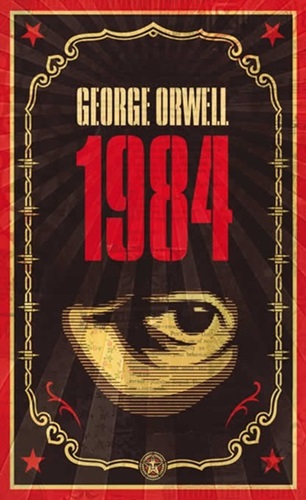
Animal Farm pairs Shepard Fairey's graphic vocabulary with Orwell's enduring satire of corrupted revolution, making it a thematically rich crossover work. The source describes how Fairey designed new pop-art covers for Penguin's reissues of both Animal Farm and Nineteen Eighty-Four, then produced 200 signed and numbered lithographs of each to mark the editions. Orwell's allegory of how revolutionary ideals decay into tyranny resonates with the questions of power, propaganda, and obedience that animate Fairey's own Obey project, giving the commission a natural fit. The print functions both as a commercial book-cover design and as a pointed extension of Fairey's political interests. At an edition of just 200, individually signed and numbered, it is scarcer than his typical screen prints, and the Penguin pedigree lends documentary weight. For collectors, it matters as a literature-meets-design crossover that broadens Fairey's reach into mainstream publishing while reinforcing his core themes, and it forms a deliberate diptych with the companion 1984.0 lithograph.
Collector Perspective
Animal Farm appeals to collectors who sit at the crossroads of Fairey's art, literary culture, and political satire, as well as those drawn to propaganda critique and revolution themes. The Penguin Books pedigree and the Orwell link give it crossover appeal beyond the core Fairey audience. At an edition of 200, individually signed and numbered per the source, it is scarcer than his standard screen prints, raising its appeal for those who favor smaller runs. The 18 x 24 inch A2 format frames cleanly and pairs as a diptych with the companion 1984.0 lithograph. It fits collections organized around propaganda critique, political satire, or Fairey's publishing collaborations.
Historical Context
Animal Farm dates to November 2008 and marks Shepard Fairey's collaboration with Penguin Books on new editions of George Orwell's classics. Fairey designed pop-art covers for both Animal Farm and Nineteen Eighty-Four and produced 200 signed, numbered A2 lithographs of each poster to celebrate them. The commission fits Fairey's arc because Orwell's satire of revolution betrayed dovetails with the themes of power and propaganda that his Obey project had long explored. Unlike most of his 2008 Obey Giant screen prints, this work was issued by a major publisher as an offset lithograph in a comparatively small edition, defining a distinct publishing strand of his output that year. It demonstrates how Fairey extended his graphic style into mainstream literary culture while keeping its critical undertones intact.
FAQ
What is Animal Farm based on?
Per the source, the print derives from Shepard Fairey's pop-art cover design for Penguin's reissue of George Orwell's Animal Farm. To celebrate the new editions of Orwell's books, Fairey produced 200 individually signed and numbered A2 lithographs of this poster.
Who published it and in what medium?
Animal Farm was published by Penguin Books in 2008 as an offset lithograph. This sets it apart from Fairey's usual Obey Giant screen prints and ties it to a mainstream publishing commission for Orwell's reissued novels.
How large is the edition?
The source states Fairey produced 200 individually signed and numbered lithographs of this poster. At 200, the edition is smaller than many of his standard releases, with each print described as individually signed and numbered.
What are the dimensions?
The print measures 18 x 24 inches and is described in the source as an A2 lithograph. It forms a deliberate diptych with the companion 1984.0 lithograph from the same Penguin Orwell commission.
Related Works
About the Artist

Shepard Fairey (b. 1970, Charleston, South Carolina) is an American street artist, graphic designer, and activist, and a graduate of the Rhode Island School of Design. His 1989 “André the Giant Has a Posse” sticker grew into the global OBEY GIANT campaign — an ongoing experiment in propaganda, obedience, and visual culture. He reached worldwide recognition with the 2008 “Hope” portrait of Barack Obama, now held by the Smithsonian National Portrait Gallery. Across screen prints, stencils, murals, and collage, Fairey channels propaganda aesthetics toward themes of peace, justice, environmentalism, and civil rights. His work is in the collections of the Museum of Modern Art, the Victoria & Albert Museum, and LACMA.