Gauntlet Gallery
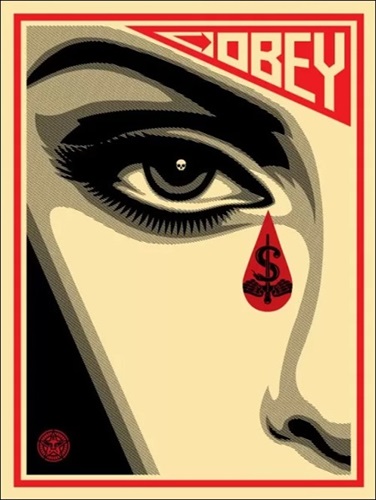
What is Shepard Fairey’s piece called “Eye Alert Red”?
Artist Statement
Edition of 350 $45 Signed/Numbered 18 x 24? The Eye Alert poster is my response to the state of healthcare reform in the U.S. I'm disappointed that instead of focusing on saving lives and improving lives, healthcare reform is succumbing to corporate-fueled fear and disinformation. The healthcare industry is the largest in America, yet 30 million people —10% of our population — are left without the means to access medical care. We know that something needs to be done about our broken (or nonexistent) system, or costs will continue to skyrocket and more and more people will be left without access to healthcare. It's a moral issue and a human rights issue, but it looks like the people who have stood up for it have been outvoted by corporations and their lobbyists. It's a sad day in America. -Shepard
Summary
Eye Alert Red is a 2010 Shepard Fairey screen print, 18 x 24 inches, a first edition of 350 published by Obey Giant. Released January 21, 2010 and signed and numbered at an original price of $45, the poster is Fairey's response to the state of U.S. healthcare reform. He described his disappointment that reform was succumbing to corporate-fueled fear and disinformation, noting that the healthcare industry is the largest in America yet roughly 30 million people, about 10% of the population, lacked access to medical care. He framed it as a moral and human-rights issue. This Red colorway delivers that message in Fairey's alert, propaganda-styled graphic language.
Why It Matters
Eye Alert Red is one of Fairey's most pointed political statements on domestic policy, made at the height of the U.S. healthcare-reform debate. In his own words, the poster is a response to reform succumbing to corporate-fueled fear and disinformation, and he frames access to care explicitly as a moral and human-rights issue, citing roughly 30 million Americans left without medical access. For collectors, this places the print firmly in Fairey's tradition of using poster art as direct civic argument, in the lineage of his propaganda-inspired political work. The Red colorway is one of two variants alongside the Cream version, giving the title a completist dimension. Its smaller edition of 350, lower than many of his 450-piece releases, gives it a modestly tighter footprint. The work matters because it documents an artist intervening in a specific, contested policy moment with the same urgency he brings to civil-rights and anti-corporate themes elsewhere in his catalog, and its surveillance-evoking eye motif reinforces the watchful, alert tone of the message. It is a strong anchor for collections built around Fairey's social-justice and human-rights output.
Collector Perspective
This print appeals to collectors who prioritize Fairey's overtly political and human-rights work over decorative pieces. The artist's own statement framing healthcare access as a moral and human-rights issue gives it clear message-driven appeal, and the alert, eye-centered graphic reads boldly when framed at 18 x 24 inches. Because it exists in two colorways, Red and Cream, some collectors will pursue the pair. The edition of 350 is slightly tighter than many of Fairey's releases. It fits naturally into collections organized around civil rights, social justice, corporate critique, and his catalog of issue-specific protest posters, and pairs directly with the Cream variant and his other rights-themed editions.
Historical Context
Released in January 2010, Eye Alert Red coincided with the contentious national debate over U.S. healthcare reform, and Fairey's accompanying statement ties it directly to that moment. It belongs to his post-2008 run of issue-driven posters in which he applied his propaganda-derived graphic vocabulary to specific American policy fights. The edition of 350, smaller than his common 450 runs, and the two-colorway release are typical of how he varied his editions. Thematically it aligns with his broader civil-rights and anti-corporate work, positioning the artist as an active commentator on contemporary domestic politics rather than a detached image-maker.
FAQ
What is the message behind this print?
In Fairey's own statement, the Eye Alert poster is his response to the state of U.S. healthcare reform. He expressed disappointment that reform was succumbing to corporate-fueled fear and disinformation, noting that roughly 30 million people, about 10% of the population, lacked access to medical care, and he framed it as a moral and human-rights issue.
What is the edition size and format?
Eye Alert Red is a first edition of 350, an 18 x 24 inch screen print published by Obey Giant. It was released on January 21, 2010, signed and numbered, at an original price of $45.
Is there another version of this print?
Yes. The Eye Alert image was issued in two colorways, Red and Cream. Both are editions of 350 at 18 x 24 inches, signed and numbered, carrying the same healthcare-reform statement. This listing is the Red version.
How does this fit Fairey's political work?
It is one of his issue-specific protest posters, applying his propaganda-style graphic language to a contemporary U.S. policy debate. By framing healthcare access as a moral and human-rights concern and criticizing corporate influence, it aligns with his broader civil-rights, human-rights, and anti-corporate themes.
Related Works




About the Artist

Shepard Fairey (b. 1970, Charleston, South Carolina) is an American street artist, graphic designer, and activist, and a graduate of the Rhode Island School of Design. His 1989 “André the Giant Has a Posse” sticker grew into the global OBEY GIANT campaign — an ongoing experiment in propaganda, obedience, and visual culture. He reached worldwide recognition with the 2008 “Hope” portrait of Barack Obama, now held by the Smithsonian National Portrait Gallery. Across screen prints, stencils, murals, and collage, Fairey channels propaganda aesthetics toward themes of peace, justice, environmentalism, and civil rights. His work is in the collections of the Museum of Modern Art, the Victoria & Albert Museum, and LACMA.