Gauntlet Gallery
What is Shepard Fairey’s piece called “Saddam”?
Artist Statement
I made the Saddam Hussein image in 1997 based on a photo I found in a magazine. In the photo, a crowd of soldiers carries a portrait of Saddam, in which he's smiling and looks very benevolent and fatherly. I found it interesting to see the contrast between The ways he's presented in Iraq and the U.S., where he's glorified on one hand and vilified on the other, and I can only imagine that the truth lies somewhere in the middle. Looking at the picture over the past few years, I've often thought about the similarities between the representations of Saddam and George Bush in their respective countries versus their images abroad, and how everything gets manipulated for the sake of political goals. A lot of people didn't really get that, though. They thought it was supporting Saddam, because the mere use of an image causes people to presume that the perpetrator of the image endorses its subject matter. - Shepard Fairey
Summary
Saddam is a 1998 Shepard Fairey screen print published by Obey Giant in a first edition of 100, measuring 18 x 24 inches. The image appropriates a found magazine photo of Saddam Hussein in which the Iraqi leader appears benevolent and fatherly, as he was glorified domestically. Fairey rendered it in his high-contrast propaganda-poster style to highlight the contrast between how Saddam was presented in Iraq versus how he was vilified in the U.S. Fairey has explained the work explores how images are manipulated for political goals, and how merely using an image leads many viewers to wrongly assume the artist endorses its subject.
Why It Matters
Saddam is one of the most explicitly articulated works in Fairey's early catalog, accompanied by his own statement about its intent. By appropriating a propaganda-style portrait that presented Saddam Hussein as benevolent, Fairey directly confronts how political imagery is constructed and weaponized, and how the same figure can be glorified at home and demonized abroad. He extends this to a pointed parallel between the manipulated representations of Saddam and George Bush in their respective countries, underscoring that image-making serves political goals on all sides. Crucially, Fairey notes that many viewers misread the print as supporting Saddam, illustrating his central thesis that simply deploying an image causes people to presume endorsement. This makes Saddam a near-thesis statement for the entire Obey project's critique of obedience and propaganda. For collectors, the documented artist commentary, the charged subject, and the 1998 small-edition format combine to make this a notably significant early work, richer in stated intent than most of its 1998 siblings and central to understanding Fairey's appropriation strategy.
Collector Perspective
Saddam appeals to collectors who prize works with documented artist intent and a strong conceptual narrative, not just a striking image. Fairey's own statement about manipulation, perception, and the Saddam-versus-Bush parallel gives the print unusual depth for an early edition, attracting buyers focused on his appropriation philosophy. The stated first edition of 100 and 1998 date add scarcity and pre-fame provenance appeal. It anchors a collection centered on Fairey's political and propaganda critique and rewards display alongside contextual material that explains its message, since the imagery can be misread without it. Collectors comfortable with provocative subject matter and interested in the intellectual underpinnings of the Obey project will find this among the more compelling early prints to own and discuss.
Historical Context
Saddam was produced in 1998, based on a photo Fairey found in a magazine the prior year, during the consolidation of his Obey Giant project that had grown from his 1989 Andre the Giant sticker campaign. The work fits his early-period focus on appropriating politically charged imagery and exposing how representations are manipulated for political ends. Fairey's recorded reflection drawing a parallel between Saddam and George Bush situates the piece within a broader critique of propaganda across political systems. Issued in an edition of 100 at 18 x 24 inches, it predates his wider recognition and his 2008 Hope poster, placing it firmly in the foundational Posters and Propaganda phase of his arc and exemplifying the conceptual stakes of his appropriation method.
FAQ
What is the concept behind Saddam?
Fairey based the image on a magazine photo in which Saddam Hussein appears benevolent and fatherly. He used it to highlight the contrast between how Saddam was glorified in Iraq and vilified in the U.S., and how images are manipulated for political goals on all sides.
Did people misunderstand the print?
Yes. Fairey has said many viewers thought the print supported Saddam, because simply using an image leads people to presume the artist endorses the subject. That reaction itself illustrates the work's core point about how imagery is perceived.
What are the dimensions and edition size?
The source record lists Saddam at 18 x 24 inches in a first edition of 100, published by Obey Giant in 1998 as a screen print.
Why is Saddam considered significant in Fairey's early work?
It comes with a detailed statement of intent from Fairey, including a parallel between the representations of Saddam and George Bush. This makes it a near-thesis for the Obey project's critique of propaganda and obedience, unusually well documented for a 1998 print.
Related Works

About the Artist
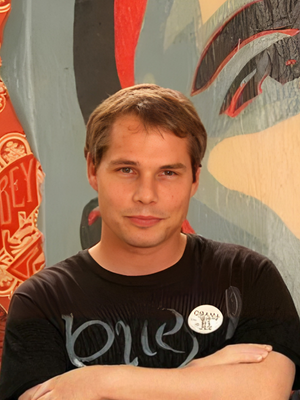
Shepard Fairey (b. 1970, Charleston, South Carolina) is an American street artist, graphic designer, and activist, and a graduate of the Rhode Island School of Design. His 1989 “André the Giant Has a Posse” sticker grew into the global OBEY GIANT campaign — an ongoing experiment in propaganda, obedience, and visual culture. He reached worldwide recognition with the 2008 “Hope” portrait of Barack Obama, now held by the Smithsonian National Portrait Gallery. Across screen prints, stencils, murals, and collage, Fairey channels propaganda aesthetics toward themes of peace, justice, environmentalism, and civil rights. His work is in the collections of the Museum of Modern Art, the Victoria & Albert Museum, and LACMA.