Gauntlet Gallery
What is Shepard Fairey’s piece called “Basquiat Canvas Print”?
Artist Statement
18 x 24? Screen Print. Signed and Numbered Edition of 450. $60 Release Date: 5/27/2010.
Summary
Basquiat Canvas Print is an 18 x 24 inch screen print published by Obey Giant in 2010, released May 27, in a signed and numbered first edition of 450 at $60. The print is Fairey's portrait of artist Jean-Michel Basquiat, rendered as a canvas screen print in his bold, high-contrast portrait style. It belongs to Fairey's 2010 run of Obey Giant canvas portraits of musicians, artists, and cultural figures, sharing the same dimensions and edition size as companion releases in that group.
Why It Matters
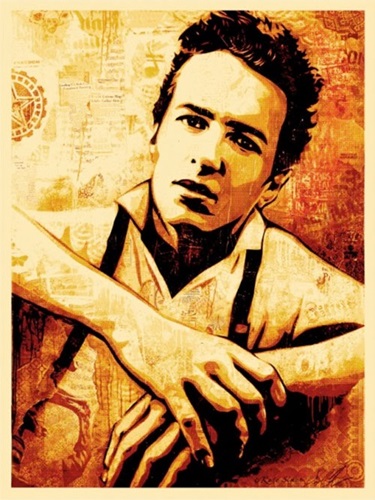
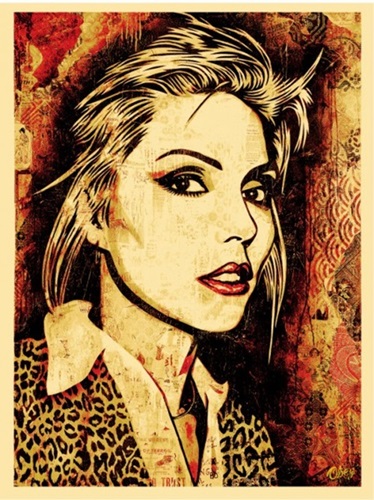
The Basquiat Canvas Print places Fairey's homage practice within the lineage of artists who moved from the street into the gallery, a trajectory Basquiat helped define and one Fairey himself follows. As a portrait of a fellow image-maker rooted in raw, graffiti-adjacent expression, the print functions as a tribute that connects Fairey's screen-print aesthetic to a foundational figure of 1980s New York art. It is part of a clearly defined 2010 series of Obey Giant canvas portraits, all 18 x 24 inches in editions of 450, that includes Debbie Harry, Joe Strummer, and Neil Young, making it a recognizable node in a collectible set. At a $60 release price, it was among the more accessible canvases in the group. The canvas format gave collectors a gallery-ready object distinct from Fairey's paper editions. For collectors, the print matters as an artist-honoring-artist work, as a component of a cohesive 2010 canvas series, and as a portrait of one of the most recognizable names in contemporary art history, lending it crossover appeal beyond Fairey's core audience.
Collector Perspective
This print appeals to collectors of both Fairey and Basquiat, fans of New York's downtown art history, and buyers assembling Fairey's 2010 canvas portrait set. Basquiat's name recognition gives the work crossover demand. The canvas format displays well without glass, and the signed, numbered edition of 450 makes it a limited but attainable release. Its slightly lower $60 release price made it one of the more accessible canvases in the series. It pairs naturally with the companion Debbie Harry, Strummer, and Neil Young canvases for collectors building a thematic wall of Fairey's cultural-figure portraits.
Historical Context
Released May 27, 2010, the Basquiat Canvas Print sits within Fairey's 2010 group of Obey Giant canvas portraits that translated his screen-print portrait language onto canvas. Choosing Jean-Michel Basquiat as a subject reflects Fairey's recurring interest in artists who bridged street culture and the fine-art establishment, a path central to Fairey's own career. The print's uniform 18 x 24 inch size and edition of 450 align it with sibling releases in the series, marking it as part of a cohesive body of work rather than a standalone, and reinforcing how Fairey used this period to commemorate the cultural figures who shaped his outlook.
FAQ
Who is the subject of this print?
The print is Fairey's portrait of artist Jean-Michel Basquiat, the influential 1980s New York painter, rendered as an Obey Giant canvas screen print.
What are the size, edition, and price?
It is an 18 x 24 inch screen print, signed and numbered in a first edition of 450, published by Obey Giant in 2010 at an original price of $60.
When was it released?
The Basquiat Canvas Print was released on May 27, 2010, as part of Fairey's 2010 group of Obey Giant canvas portraits of musicians and cultural figures.
Is this part of a series?
Yes. It belongs to a 2010 set of 18 x 24 inch canvas portraits in editions of 450, alongside companion prints of Debbie Harry, Joe Strummer, and Neil Young.
Related Works


About the Artist

Shepard Fairey (b. 1970, Charleston, South Carolina) is an American street artist, graphic designer, and activist, and a graduate of the Rhode Island School of Design. His 1989 “André the Giant Has a Posse” sticker grew into the global OBEY GIANT campaign — an ongoing experiment in propaganda, obedience, and visual culture. He reached worldwide recognition with the 2008 “Hope” portrait of Barack Obama, now held by the Smithsonian National Portrait Gallery. Across screen prints, stencils, murals, and collage, Fairey channels propaganda aesthetics toward themes of peace, justice, environmentalism, and civil rights. His work is in the collections of the Museum of Modern Art, the Victoria & Albert Museum, and LACMA.