Gauntlet Gallery
What is Shepard Fairey’s piece called “Soup Can (IV)”?
Artist Statement
Shepard Fairey Soup Can IV, 2009 Hand printed silkscreen and pencil on manila acid free archival paper 20 x 16 inches Edition of 200 Numbered and signed by the artist Priced at $250, but price rose rapidly as the edition sold.
Summary
Soup Can (IV) is a hand-printed silkscreen with pencil by Shepard Fairey, published by Iconoclast Editions in an edition of 200, numbered and signed by the artist. Printed on manila acid-free archival paper at 20 x 16 inches, the work was priced at $250 at release. Part of a four-image set (I, II, III, IV), the imagery adapts the soup-can motif into Fairey's graphic, pattern-laden style. The source notes the price rose rapidly as the edition sold. The piece nods to Pop Art's consumer-product iconography while incorporating Fairey's decorative and floral elements.
Why It Matters
Soup Can (IV) places Fairey in direct dialogue with Pop Art's foundational subject, the consumer soup can, reframing a mass-market product through his ornamental, pattern-driven design language. Issued through Iconoclast Editions as a hand-printed silkscreen with hand pencil work on archival paper, it carries a craft emphasis that distinguishes it from his standard Obey Giant poster runs. As the fourth image in a four-part set, it functions within a deliberately structured series, appealing to collectors who pursue complete sets. The source's note that the price rose rapidly as the edition sold signals strong demand at release, though this should be read as a documented sales observation rather than a current market value. The combination of consumer-product critique and Fairey's decorative motifs, including floral elements flagged in the source's secondary theme, situates the work at the intersection of Pop Art homage and his own visual identity. For collectors, the modest edition of 200, the archival hand-printing, and the set structure are the key differentiators. The piece rewards interpretation as a knowing engagement with the lineage of artists who turned commercial packaging into fine art.
Collector Perspective
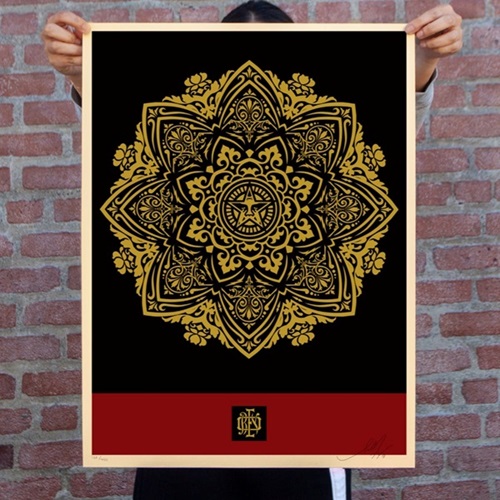
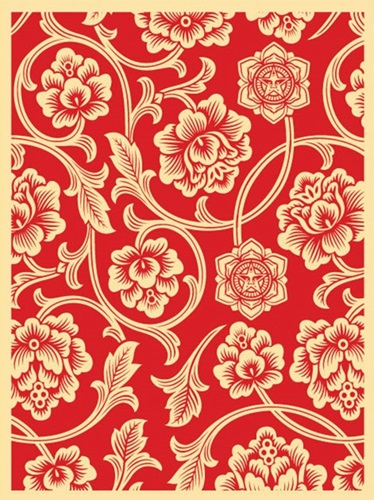
This print suits collectors drawn to Pop Art lineage, fine-art printmaking, and Fairey's more decorative output. The hand-printed silkscreen with pencil on archival paper signals a craft-forward object that print connoisseurs value over mass-produced posters. As part of a four-image set, completist collectors may seek all four, and the 20 x 16 inch format works well framed as a unit or individually. At an edition of 200, it is tighter than many Obey Giant releases, which appeals to buyers prioritizing relative scarcity. Those who collect at the intersection of consumer-product imagery and ornamental design will find it a natural fit, and it pairs visually with Fairey's floral and pattern-based works.
Historical Context
Soup Can (IV) reflects Fairey's recurring engagement with Pop Art traditions, here adapting the soup-can subject most associated with Warhol-era consumer iconography into his own ornamental idiom. Published through Iconoclast Editions rather than Obey Giant, it belongs to his fine-art print collaborations that emphasized hand silkscreen and archival materials. The source dates the image to 2009 with a 2010 release, placing it in the period after his mainstream breakthrough when he expanded into gallery-oriented editions. The integration of floral and pattern elements ties it to a decorative strand that runs through his work of this era, blending critique of consumer culture with the aesthetics of design and craft.
FAQ
How was this print produced?
Per the source, it is a hand-printed silkscreen with pencil on manila acid-free archival paper, measuring 20 x 16 inches. It was numbered and signed by the artist and published by Iconoclast Editions, emphasizing hand-printing and archival materials over mass production.
How large is the edition?
The source lists an edition of 200, numbered and signed by Shepard Fairey. It was priced at $250 at release, and the description notes that the price rose rapidly as the edition sold.
Is this part of a series?
Yes. The source lists all editions as I, II, III, and IV, making Soup Can (IV) the fourth image in a four-part set, which appeals to collectors who pursue complete series.
What is the subject's significance?
The soup-can subject references Pop Art's consumer-product iconography, which Fairey reinterprets through his ornamental, pattern-based design style. The source also tags a floral symbolism element, blending consumer imagery with decorative motifs.
Related Works
About the Artist

Shepard Fairey (b. 1970, Charleston, South Carolina) is an American street artist, graphic designer, and activist, and a graduate of the Rhode Island School of Design. His 1989 “André the Giant Has a Posse” sticker grew into the global OBEY GIANT campaign — an ongoing experiment in propaganda, obedience, and visual culture. He reached worldwide recognition with the 2008 “Hope” portrait of Barack Obama, now held by the Smithsonian National Portrait Gallery. Across screen prints, stencils, murals, and collage, Fairey channels propaganda aesthetics toward themes of peace, justice, environmentalism, and civil rights. His work is in the collections of the Museum of Modern Art, the Victoria & Albert Museum, and LACMA.