Gauntlet Gallery
What is Shepard Fairey’s piece called “Moon Over Biloxi (Cream)”?
Artist Statement
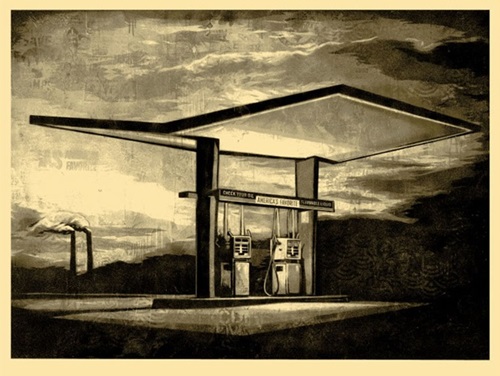
The title of this print “Moon Over Biloxi” is a tribute to the Dead Kennedy’s song “Moon Over Marin”. In 1984 I picked up maybe my 4th punk record which was the 2nd Dead Kennedy’s album “Plastic Surgery Disasters”. The album is a great listen all the way through and includes some blistering tunes like “Riot” and “Bleed For Me” laced with social commentary. The surprise song though is “Moon Over Marin”… detractors have called it the Dead Kennedy’s “U2? song, but I disagree. “Moon Over Marin” is more melodic than most DK, but juxtaposed with the darkness of the lyrics, the song evokes a powerful sense of existential melancholy. I think the concept that struck me, and stuck with me, is that our disrespect of each other and the planet may doom us , but things will continue without us. I think it is healthy to recognize impermanence, but also to appreciate the value of the ephemeral. Moonlight, real or electric, will probably be around, but what it will be casting light on is the real question. There will always be a moon over Biloxi. -Shepard 18 x 24? Screen Print, Signed and Numbered Edition of 400 (Cream) and 200 (White). Limit 1 per person/household, $50 each.
Summary
Moon Over Biloxi is a 2010 screen print by Shepard Fairey, published by Obey Giant at 18 x 24 inches and released July 27, 2010 at $50, with a limit of one per household. Per the source, it was issued in a Cream edition of 400 and a White edition of 200, signed and numbered. Fairey's statement frames the title as a tribute to the Dead Kennedys song 'Moon Over Marin,' reflecting on environmental disrespect, impermanence, and the endurance of the natural world. The image pairs his graphic style with a meditative environmental and existential message.
Why It Matters
Moon Over Biloxi connects Fairey's environmental concerns to his formative punk influences, taking its title from the Dead Kennedys' 'Moon Over Marin' and using that song's existential melancholy as a frame. That documented musical reference makes the print a bridge between his music-rooted sensibility and his environmental themes, a combination collectors of his more reflective work find compelling. Fairey's statement articulates a meditation on impermanence: that humanity's disrespect for one another and the planet may doom us, but the natural world will continue without us. This gives the image a contemplative tone distinct from his more confrontational protest prints. The piece carries Biloxi's resonance with the Gulf Coast, aligning it with his 2010 environmental output, though the statement keeps its message philosophical rather than narrowly topical. Issued in two colorways, Cream at 400 and White at 200, it offers collectors a colorway pairing with differing edition sizes. At $50 with a one-per-household limit, it was an accessible release. For collectors and researchers, the Dead Kennedys reference and the meditative environmental framing are the chief differentiators within his catalog of that year.
Collector Perspective
This print appeals to collectors who appreciate Fairey's quieter, more reflective environmental work and his punk roots, given the Dead Kennedys reference. The two colorways, Cream (400) and White (200), give colorway and edition-size collectors a reason to pursue both, with the smaller White edition being the tighter of the two. At 18 x 24 inches it displays as a contemplative piece and groups well with Fairey's other environmental prints from 2010, such as America's Favorite. Buyers building a thematically reflective or environment-focused Fairey collection will value the existential framing. Availability is reasonable, so collectors typically weigh colorway, condition, and thematic fit over outright rarity.
Historical Context
Moon Over Biloxi belongs to Fairey's 2010 environmental output and reflects how his punk listening history, here the Dead Kennedys' 'Plastic Surgery Disasters' album he cites discovering in 1984, continued to inform his thematic choices. By naming the print after 'Moon Over Marin,' Fairey ties an environmental meditation to the social-commentary tradition of hardcore punk. Within his arc, the work sits alongside his other 2010 conservation-themed pieces and demonstrates a more philosophical register, emphasizing impermanence and the persistence of nature rather than direct policy critique. It illustrates the ongoing fusion of music influence and environmental concern that runs through this period of his Obey Giant releases.
FAQ
Where does the title come from?
Per Fairey's statement, the title is a tribute to the Dead Kennedys song 'Moon Over Marin,' from their 1983 album 'Plastic Surgery Disasters,' which Fairey describes discovering in 1984. He praises the song's melodic quality paired with dark, socially conscious lyrics.
What is the print's message?
Fairey reflects on impermanence, writing that humanity's disrespect for one another and the planet may doom us, but that the world will continue without us. He emphasizes recognizing impermanence while appreciating the value of the ephemeral, symbolized by enduring moonlight.
What were the edition details?
The source lists a signed and numbered screen print at 18 x 24 inches, published by Obey Giant, released July 27, 2010 at $50, with a limit of one per household. It was issued in a Cream edition of 400 and a White edition of 200.
How does it fit Fairey's broader work?
It blends his environmental themes with his punk influences, connecting a meditation on the planet's future to the social-commentary tradition of the Dead Kennedys, and sits alongside his other 2010 environmental prints.
Related Works




About the Artist

Shepard Fairey (b. 1970, Charleston, South Carolina) is an American street artist, graphic designer, and activist, and a graduate of the Rhode Island School of Design. His 1989 “André the Giant Has a Posse” sticker grew into the global OBEY GIANT campaign — an ongoing experiment in propaganda, obedience, and visual culture. He reached worldwide recognition with the 2008 “Hope” portrait of Barack Obama, now held by the Smithsonian National Portrait Gallery. Across screen prints, stencils, murals, and collage, Fairey channels propaganda aesthetics toward themes of peace, justice, environmentalism, and civil rights. His work is in the collections of the Museum of Modern Art, the Victoria & Albert Museum, and LACMA.