Gauntlet Gallery
What is Shepard Fairey’s piece called “Constructivist Banner (Black)”?
Summary
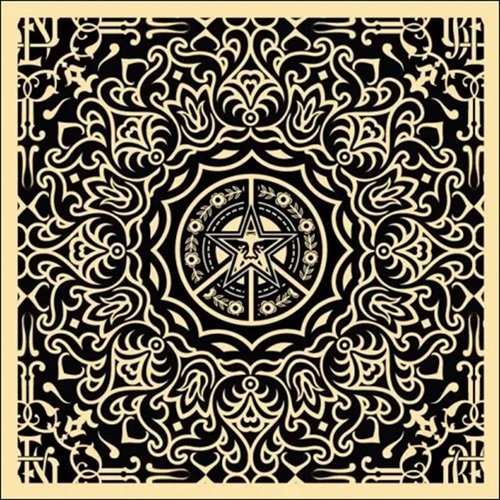
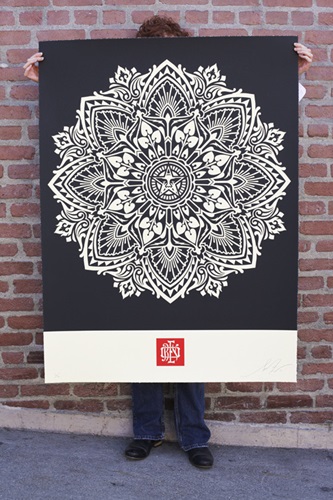
Constructivist Banner (Black) is a 2010 Shepard Fairey screen print published by Obey Giant, measuring 24 inches high by 18 inches wide in a numbered edition of 350. The work was issued in a Black edition. The source provides no description of the imagery, but the title references the Constructivist design tradition that informs much of Fairey's graphic vocabulary. Based on its title and decorative-banner format, it appears to function as a pattern- or design-oriented piece rather than an overt portrait or political poster. Beyond the title, year, edition size, and dimensions, no further facts are supplied in the record.
Why It Matters
Constructivist Banner sits within the design-driven side of Shepard Fairey's practice, where Russian Constructivist and Art Deco motifs supply the visual scaffolding behind his more famous propaganda imagery. The title alone signals a debt to early-twentieth-century Constructivist graphics, a movement Fairey has long cited as foundational to his bold typography, flat color planes, and ornamental framing. Because the record carries no description, its significance here rests on context rather than confirmed iconography: it appears to belong to a run of pattern and banner studies that show how Fairey builds a recognizable house style across both political and decorative output. For collectors, that makes it interesting as a window into method, the structural building blocks that recur beneath the OBEY face and the Obama portrait. At a modest 350 edition, it is more contained than many open Obey releases, but with limited source detail the claim should stay measured. Its value is contextual and completist rather than headline-driving.
Collector Perspective
This print suits collectors who appreciate the design DNA behind Fairey's work rather than only his marquee political images. Pattern- and banner-oriented pieces appeal to those building a representative survey of his Obey Giant output, and to buyers who want graphic, frame-ready decorative art at an accessible original release point. The Black edition of 350 makes it a relatively contained run, attractive to completists tracking Fairey's 2010 releases. Because the record lacks a description, buyers should verify imagery before purchase. It fits naturally into a collection organized around Fairey's ornamental and Constructivist-influenced design language alongside his pattern sets.
Historical Context
Issued in late 2010, Constructivist Banner falls within a productive stretch of Obey Giant pattern and decorative releases that ran alongside Fairey's higher-profile political prints. The Constructivist reference in the title points back to the Russian avant-garde graphic tradition that shaped Fairey's early aesthetic, the same lineage that underpins his propaganda-poster style. Within his arc, work like this represents the ornamental, design-forward thread of his catalog rather than the activist headlines. With only title, date, edition, and dimensions confirmed in the source, its precise place is best described as part of Fairey's ongoing exploration of historical graphic styles translated into contemporary screen prints.
FAQ
What are the dimensions and edition size?
Constructivist Banner (Black) measures 24 inches high by 18 inches wide and was released as a numbered screen print in an edition of 350, published by Obey Giant in 2010.
What edition is this?
This is the Black edition. The record notes the work was also issued as a First Edition within its edition variants, but this specific listing is the Black version printed in 2010.
What medium is it?
It is a screen print. The source confirms the medium, the 2010 year, and the 350-print edition, but does not include a detailed description of the imagery beyond the title's Constructivist reference.
How does it relate to Fairey's style?
The title points to the Russian Constructivist graphic tradition that influenced Fairey's bold, flat-color, ornamental design language, placing it among his pattern- and design-oriented works rather than his portrait or overt political prints.
Related Works
About the Artist

Shepard Fairey (b. 1970, Charleston, South Carolina) is an American street artist, graphic designer, and activist, and a graduate of the Rhode Island School of Design. His 1989 “André the Giant Has a Posse” sticker grew into the global OBEY GIANT campaign — an ongoing experiment in propaganda, obedience, and visual culture. He reached worldwide recognition with the 2008 “Hope” portrait of Barack Obama, now held by the Smithsonian National Portrait Gallery. Across screen prints, stencils, murals, and collage, Fairey channels propaganda aesthetics toward themes of peace, justice, environmentalism, and civil rights. His work is in the collections of the Museum of Modern Art, the Victoria & Albert Museum, and LACMA.