Gauntlet Gallery
What is Shepard Fairey’s piece called “Huey Lewis”?
Artist Statement
HUEY LEWIS Screen Print 18 x 24 inches Edition of 100
Summary
Huey Lewis is a 1999 Shepard Fairey screen print, published by Obey Giant as a first edition of 100, measuring 18 x 24 inches. The title references the musician Huey Lewis, placing the work among Fairey's early pop-culture-referencing screen prints. The source record provides the title, year, medium, dimensions, and edition size but no description of the composition, so the visual concept is documented mainly by the title and the print's position in Fairey's 1999 output. It is a small-format, hand-pulled screen print from the formative Obey Giant period.
Why It Matters
Huey Lewis belongs to the late-1990s phase when Shepard Fairey was folding pop-culture figures into his expanding Obey Giant catalogue alongside his political and propaganda imagery. Naming a print after a popular musician signals the project's interest in how fame, mass media, and recognizable faces circulate through visual culture, a recurring thread across Fairey's work even before his later, better-known music portraits. For collectors, the value lies in the early date and the small edition of 100, which together place this among the foundational tier of Obey editions produced before Fairey's broad public recognition. Because the supplied record gives no description of the actual imagery, claims about its specific composition or treatment should remain cautious; the connection to the musician is established only by the title. What is documented is its structure: a 1999 first edition, hand-pulled at 18 x 24 inches, sharing format and scale with its peers from the same run. As an early example of Fairey applying his graphic vocabulary to a music-world subject, it offers a useful bridge between the propaganda-themed prints of the period and the music-focused work that would later become central to his output.
Collector Perspective
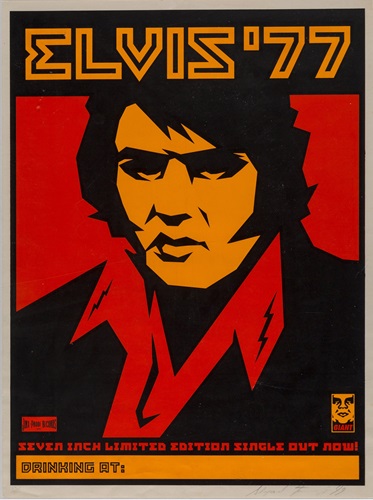
This print interests collectors who track Fairey's early forays into pop-culture and music subjects, as well as those building a complete view of the scarce late-1990s Obey editions. With an edition of just 100, it reads as a connoisseur's piece rather than a decorative one, and its 18 x 24-inch scale frames easily. Music-oriented Fairey collectors may value it as an early instance of him engaging a musician subject, while early-period specialists will appreciate its place in the 1999 cohort. It groups naturally with companions like Revolution and Elvis '77 from the same year and format.
Historical Context
Huey Lewis dates to 1999, within Fairey's run of small-edition Obey Giant screen prints from the late 1990s. This period followed the 1989 Andre the Giant sticker campaign and the consolidation of that street project into numbered studio editions. Applying his graphic language to a popular-music figure at this date foreshadows the music portraiture that would become a major strand of his later career. The edition of 100 is consistent with his output from these years and reflects the limited circulation of his prints before demand grew in the following decade. It sits among the earliest layer of the Obey catalogue, predating his mainstream breakthrough.
FAQ
Who is the subject of this print?
The print is titled Huey Lewis, referencing the popular American musician. It places the work among Fairey's early pop-culture and music-referencing screen prints from the late 1990s.
When was it made and by whom?
Huey Lewis was created in 1999 and published by Obey Giant, Fairey's own imprint, as part of his late-1990s run of small-edition screen prints.
What are the size and edition?
It measures 18 x 24 inches and was issued as a first edition of 100, placing it among the scarcer tiers of Fairey's output compared with his later, larger releases.
Why is it notable in Fairey's career?
As an early print named after a musician, it foreshadows the music portraiture that became central to his later work, while remaining part of the foundational late-1990s Obey catalogue.
Related Works
About the Artist

Shepard Fairey (b. 1970, Charleston, South Carolina) is an American street artist, graphic designer, and activist, and a graduate of the Rhode Island School of Design. His 1989 “André the Giant Has a Posse” sticker grew into the global OBEY GIANT campaign — an ongoing experiment in propaganda, obedience, and visual culture. He reached worldwide recognition with the 2008 “Hope” portrait of Barack Obama, now held by the Smithsonian National Portrait Gallery. Across screen prints, stencils, murals, and collage, Fairey channels propaganda aesthetics toward themes of peace, justice, environmentalism, and civil rights. His work is in the collections of the Museum of Modern Art, the Victoria & Albert Museum, and LACMA.