Gauntlet Gallery
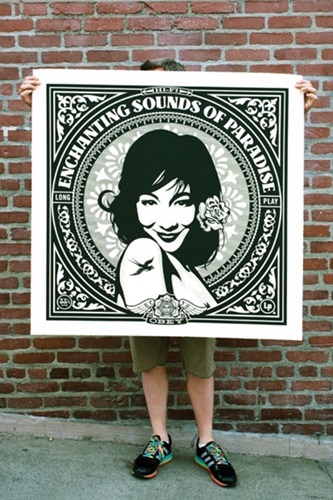
What is Shepard Fairey’s piece called “Jukebox Album Cover (Large Format)”?
Artist Statement
Serigraph, Signed and Numbered Edition of 40. Printed on 100% cotton rag archival paper with deckled edges, 42 x 42 inches. $500. Release Date: 5/3/11
Summary
Jukebox Album Cover is a 2011 large-format serigraph by Shepard Fairey, published by Obey Giant in a signed and numbered edition of 40. The screen print measures 42 x 42 inches and is printed on 100% cotton rag archival paper with deckled edges. It belongs to a 2011 suite of square album-cover compositions, with the jukebox serving as a music-culture motif. The square format, archival stock, and small edition place it among Fairey's deluxe, gallery-scale releases rather than his high-volume poster output.
Why It Matters
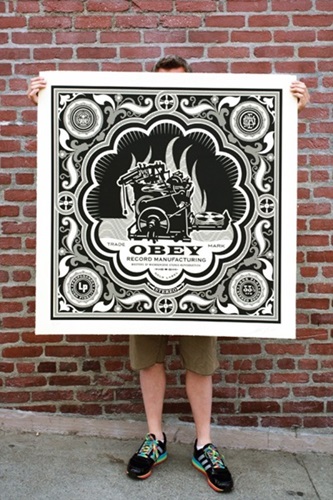
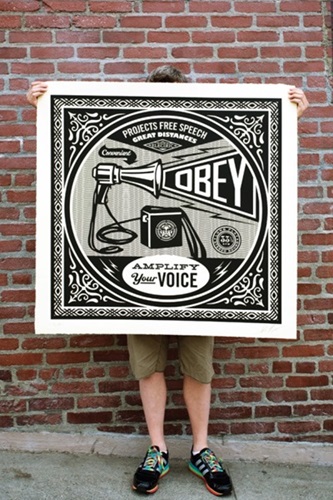
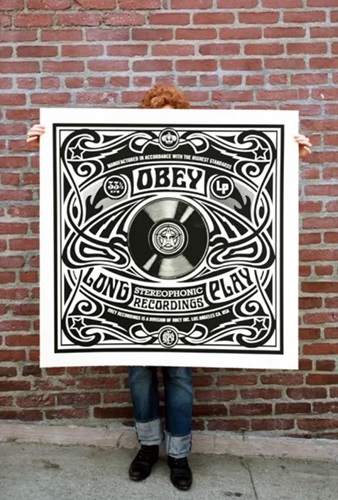
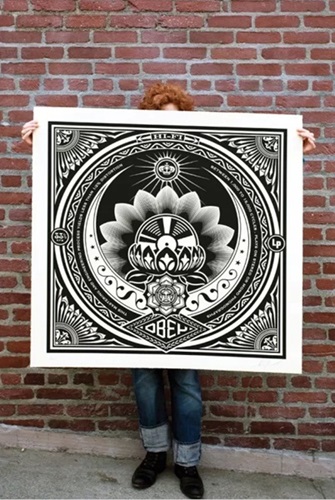
Jukebox Album Cover is one of a cohesive 2011 family of large-format square serigraphs Obey Giant released together, each rendering an album-cover-style composition at gallery scale. The jukebox subject ties the work to music and pop-culture iconography that runs throughout Fairey's practice, from his band collaborations to his music-poster output. With an edition of just 40 and a commanding 42 x 42 inch footprint on deckled cotton rag, it stands apart from the larger poster runs that dominate Fairey's catalog, offering both scale and genuine scarcity. Collectors value the series cohesion: Jukebox reads as a natural companion to Printing Press, Megaphone, and Nouveau, making it attractive to those assembling the complete square-format suite. The work also rewards buyers drawn to the formal craft of screen printing and to Fairey's recurring engagement with music and media culture. As a deluxe, low-edition object, it occupies the more collector-oriented end of his 2011 production, where scale, archival materials, and a recognizable graphic vocabulary combine into a single statement piece.
Collector Perspective
Jukebox appeals to collectors who want a large, music-themed Fairey statement work with a small edition rather than a common poster. At 42 x 42 inches on deckled cotton rag, it functions as a centerpiece and suits buyers building a focused set of the 2011 large-format album covers. Its jukebox motif fits collections organized around music and pop culture, and it pairs naturally with Printing Press, Megaphone, and Nouveau for series-builders. The edition of 40 gives it scarcity beyond Fairey's larger runs while keeping his recognizable graphic identity, making it a confident anchor piece for a wall or a themed grouping.
Historical Context
Released on May 3, 2011, Jukebox Album Cover belongs to a spring cluster of large-format square serigraphs published together by Obey Giant. By this point Fairey routinely produced deluxe, gallery-scale editions alongside his accessible poster releases, and the album-cover conceit reflects his deep ties to music culture and design. The jukebox motif connects to his broader engagement with American pop and music imagery. The 42 x 42 inch format, cotton rag archival paper, and edition of 40 exemplify the refined printmaking of his mature period, where craft, scale, and cohesive series identity carried more weight than the street-derived immediacy of his earliest work.
FAQ
What is the edition size of Jukebox Album Cover (Large Format)?
It is a signed and numbered edition of 40, published by Obey Giant. This makes it considerably scarcer than Fairey's typical poster runs, while the large 42 x 42 inch square format marks it as a deluxe, gallery-scale piece.
What are the dimensions and materials?
The serigraph measures 42 x 42 inches and is printed on 100% cotton rag archival paper with deckled edges. The square format and archival cotton rag stock give it a substantial presentation suited to use as a focal point.
When was it released?
Jukebox Album Cover was released on May 3, 2011, as part of a group of large-format square album-cover serigraphs issued by Obey Giant that spring.
How does it relate to other prints in the series?
It is one of several 2011 large-format album-cover serigraphs, alongside Printing Press, Megaphone, and Nouveau. All share the 42 x 42 inch format and edition of 40, making them natural companions for collectors building the set.
Related Works
About the Artist

Shepard Fairey (b. 1970, Charleston, South Carolina) is an American street artist, graphic designer, and activist, and a graduate of the Rhode Island School of Design. His 1989 “André the Giant Has a Posse” sticker grew into the global OBEY GIANT campaign — an ongoing experiment in propaganda, obedience, and visual culture. He reached worldwide recognition with the 2008 “Hope” portrait of Barack Obama, now held by the Smithsonian National Portrait Gallery. Across screen prints, stencils, murals, and collage, Fairey channels propaganda aesthetics toward themes of peace, justice, environmentalism, and civil rights. His work is in the collections of the Museum of Modern Art, the Victoria & Albert Museum, and LACMA.