Gauntlet Gallery
What is Shepard Fairey’s piece called “The Last Mountain”?
Artist Statement
The big fossil energy corporations keep telling us we have no choice and simply must keep destroying communities(with mountaintop coal mining), spewing pollution and causing 10’s-of-1000’s of illnesses and deaths in the US(with mercury, arsenic, ozone, etc., etc.) and endangering the planet with CO2 — and all just to boil some water to make electricity. But it’s a lie… Even in the heart of coal country in WV, they have a vision and want to see a wind-farm on their ridges, rather than dismantling the mountains for coal. There’s a great new film, “The Last Mountain” which tells this amazing story. Print release on Tuesday June 7, 2011 at a random time. Edition of 450, $55. A portion of the proceeds will help support the film and some of the activist groups in WV. Image portions based on a reference photograph by J Henry Fair.
Summary
The Last Mountain is a 2011 Shepard Fairey screen print, 18 x 24 inches, in a first-edition run of 450 published by Obey Giant. Created in support of the documentary film of the same name, the image draws on a reference photograph by J Henry Fair and confronts mountaintop-removal coal mining in West Virginia. The piece contrasts the destructive cost of fossil-energy extraction with a hopeful alternative vision of wind power on Appalachian ridges. Released June 7, 2011 at $55, it pairs Fairey's bold graphic vocabulary with an explicit environmental and public-health message about pollution, illness, and climate impact.
Why It Matters
This print sits squarely within Fairey's long-running environmental advocacy, using his recognizable graphic language to argue against mountaintop-removal mining and for clean energy. What sets it apart from a generic database entry is the specific tie to the film The Last Mountain and the grassroots activist communities in West Virginia it documents. By basing image portions on photojournalist J Henry Fair's reference photograph, Fairey roots the work in real documentary evidence rather than abstract sloganeering. The source notes a portion of proceeds was intended to support the film and West Virginia activist groups, signaling the print functioned as both art object and fundraising tool. For collectors, it represents the intersection of art and direct activism that defines much of Fairey's catalog. The environmental framing here is unusually concrete: it names pollution sources like mercury, arsenic, and CO2 and the human toll of fossil energy, while offering wind power as the constructive counter-image. As a modestly sized edition of 450, it is accessible while still carrying the weight of a cause-driven release tied to a specific moment in the coal-versus-renewables debate.
Collector Perspective
This appeals to collectors drawn to Fairey's activist and environmental work rather than his purely pop or music-driven prints. Its connection to a documentary film and clean-energy advocacy makes it a natural fit for collections organized around cause-based art, climate themes, or print-as-fundraiser releases. At a modest 18 x 24 inches and an edition of 450, it is approachable for newer collectors while still carrying thematic depth. It displays well alongside other Fairey environmental and film-collaboration pieces, anchoring a wall around the energy and ecology narrative. Buyers who value provenance will appreciate the documented reference to J Henry Fair's source photograph and the stated charitable component, both of which add interpretive richness beyond the image itself.
Historical Context
The Last Mountain belongs to Fairey's prolific 2010-2012 period of film-collaboration and issue-driven prints, when he frequently lent his imagery to documentaries and activist campaigns. It fits his broader environmental arc, which spans clean-energy and climate-themed releases across his career. The work reflects a moment when mountaintop-removal mining and the coal-versus-renewables debate were prominent in American environmental politics, and Fairey aligned his street-derived aesthetic with that cause. By building the image from a working photojournalist's reference, the print also illustrates his recurring method of adapting documentary photography into bold, poster-ready graphics. It stands as one of several Obey Giant releases that paired a print drop with support for a film and on-the-ground activist groups.
FAQ
What is the edition size of The Last Mountain?
The Last Mountain is a first edition of 450 screen prints published by Obey Giant in 2011. It was released on June 7, 2011 at an original price of $55, making it a mid-sized run within Fairey's catalog of issue-driven releases.
What is the print about?
It supports the documentary film The Last Mountain and opposes mountaintop-removal coal mining in West Virginia. The image contrasts the pollution, illness, and climate harm of fossil-energy extraction with a hopeful vision of wind farms on Appalachian ridges as a clean-energy alternative.
What are the dimensions and medium?
The work is a screen print measuring 18 x 24 inches, published by Obey Giant. Image portions are based on a reference photograph by photojournalist J Henry Fair, a detail noted in the source description of the release.
Did proceeds support a cause?
According to the release description, a portion of the proceeds was intended to help support the film and some of the activist groups in West Virginia, framing the print as both an artwork and a fundraising effort tied to the clean-energy campaign.
Related Works

About the Artist
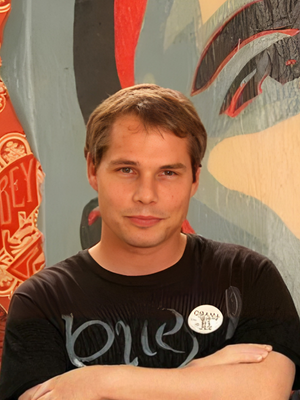
Shepard Fairey (b. 1970, Charleston, South Carolina) is an American street artist, graphic designer, and activist, and a graduate of the Rhode Island School of Design. His 1989 “André the Giant Has a Posse” sticker grew into the global OBEY GIANT campaign — an ongoing experiment in propaganda, obedience, and visual culture. He reached worldwide recognition with the 2008 “Hope” portrait of Barack Obama, now held by the Smithsonian National Portrait Gallery. Across screen prints, stencils, murals, and collage, Fairey channels propaganda aesthetics toward themes of peace, justice, environmentalism, and civil rights. His work is in the collections of the Museum of Modern Art, the Victoria & Albert Museum, and LACMA.