Gauntlet Gallery
What is Shepard Fairey’s piece called “Party At The Moontower”?
Artist Statement
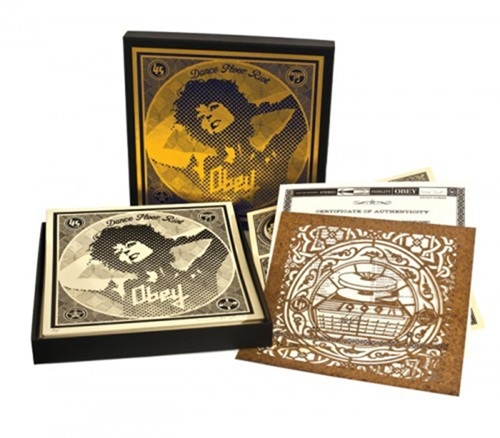
"Long before I knew about art galleries or even street art, I was excited about album cover art, if only because it was the visual counterpart to the music on the records I loved. Album covers conjured a euphoric association with the listening experience. Most of my earliest home-made tee shirts were stencils based on punk album covers… No matter how much I love art, or try to convince myself of its relevance in society, the fact remains that music is a lot cooler and way more able to reach people's hearts and minds… but I'm a populist and I look at it this way: I may not play an instrument, but I'm gonna rock it hard as nails anyway. With my art I try to capture the same energy and spirit that makes music so powerful and democratic. REVOLUTIONS is a celebration of all the great music and accompanying art that has inspired me over the years." – Shepard Two box sets were created for the REVOLUTIONS show which ended in April 2011. On Tuesday June 28 we are releasing the Dance Floor Riot Box Set and on Wednesday June 29 we are releasing the Party at the Moontower Box Set for $950 each. If you purchase both sets we will send you matching numbers and ship them together (and refund a portion of your shipping charges). We love our fans! Each set is a limited edition of 150 and includes 36 signed and numbered screen prints, a stencil, a sticker sheet of 9 stickers, and a certificate of authentication.
Summary
Party At The Moontower is a 2011 Shepard Fairey portfolio published by Obey Giant in a limited edition of 150, released June 29, 2011 at $950. Each 13 x 13 inch box set contains 36 signed and numbered screen prints, a stencil, a sticker sheet of nine stickers, and a certificate of authentication. Created for Fairey's REVOLUTIONS exhibition, which ended in April 2011, the set is a tribute to the music and album-cover art that shaped his visual sensibility. It is the companion to the Dance Floor Riot Box Set released the previous day, and buyers of both originally received matching numbers shipped together.
Why It Matters
Party At The Moontower is the second of two ambitious REVOLUTIONS portfolios Fairey released on consecutive days in June 2011, and like its companion it bundles 36 signed and numbered screen prints with a stencil, sticker sheet, and certificate of authentication. The source describes how buyers who purchased both sets received matching numbers shipped together, encouraging collectors to acquire the pair as a unified statement. Built around Fairey's celebration of album-cover art, the set channels his stated belief that music is a uniquely democratic and powerful force, a conviction he traces to the punk records and homemade stenciled tee shirts of his youth. The 13 x 13 inch format nods to the scale and culture of vinyl, reinforcing the music-as-art thesis at the heart of the project. At an edition of only 150 and a $950 price, it is among the scarcer and more substantial offerings in Fairey's catalog. For collectors, it functions both as a standalone tribute portfolio and as the matching half of a two-set pairing, deepening the music thread that runs throughout his body of work.
Collector Perspective
This portfolio suits dedicated Fairey collectors and music-art lovers seeking a comprehensive multi-piece set rather than a single print. With 36 signed and numbered screen prints plus a stencil, stickers, and a certificate of authentication in an edition of just 150, it is a flagship acquisition for the REVOLUTIONS body of work. Its strongest pairing is the companion Dance Floor Riot Box Set, with which buyers originally received matching numbers, making the two especially desirable together. The 13 x 13 inch record-sleeve scale appeals to collectors who link art with album culture. The small edition and higher price point it as a long-term, investment-minded portfolio for committed collectors.
Historical Context
Party At The Moontower was created for Fairey's REVOLUTIONS exhibition, which the source says ended in April 2011 and centered on his love of music and album-cover art. It belongs to the music strand of his catalog rooted in his punk and album-art origins, which his accompanying statement describes. Released one day after its companion Dance Floor Riot Box Set, it reflects Fairey's practice of tying exhibitions to ambitious limited-edition portfolios and offering paired sets to collectors. The included stencil and sticker sheet connect the work to the street-art methods at the foundation of his practice, while the 36-print scale underscores the breadth of musical influences the project honors.
FAQ
What is included in the box set?
Each Party At The Moontower set contains 36 signed and numbered screen prints, a stencil, a sticker sheet of nine stickers, and a certificate of authentication. It is a limited edition of 150, released by Obey Giant on June 29, 2011 at $950.
How does it relate to Dance Floor Riot?
Party At The Moontower is the companion to the Dance Floor Riot Box Set, released one day earlier. The source notes that collectors who purchased both sets received matching numbers shipped together and a partial refund on shipping.
What exhibition inspired the set?
It was created for Fairey's REVOLUTIONS exhibition, which the source says ended in April 2011. The show celebrated the music and album-cover art that shaped Fairey's sensibility, themes he expands on in his accompanying statement.
What are the dimensions and edition size?
Each box measures 13 x 13 inches and the set is a limited edition of 150. The record-sleeve-scale format reinforces the music theme, and each set includes signed and numbered prints with a certificate of authentication.
Related Works
About the Artist

Shepard Fairey (b. 1970, Charleston, South Carolina) is an American street artist, graphic designer, and activist, and a graduate of the Rhode Island School of Design. His 1989 “André the Giant Has a Posse” sticker grew into the global OBEY GIANT campaign — an ongoing experiment in propaganda, obedience, and visual culture. He reached worldwide recognition with the 2008 “Hope” portrait of Barack Obama, now held by the Smithsonian National Portrait Gallery. Across screen prints, stencils, murals, and collage, Fairey channels propaganda aesthetics toward themes of peace, justice, environmentalism, and civil rights. His work is in the collections of the Museum of Modern Art, the Victoria & Albert Museum, and LACMA.