Gauntlet Gallery
What is Shepard Fairey’s piece called “Obey Lotus Diamond (Diamond Dust - Black & Gold)”?
Artist Statement
This new series of prints are Shepard Fairey’s first use of diamond dust printing. The series is comprised of 4 stunning prints of floral ornament abstraction utilizing white and black diamond dust. The new medium, diamond dust, adhered to the surface of the screen prints is a shimmering and elegant material. Perhaps most famously used by Andy Warhol, who understood perfectly how to convey a message, Diamond Dust was used to add glamour, transforming ordinary images into coveted objects . The material aligns with Shepard’s work and interest in the seduction of advertising and consumerism. Diamond Dust, literally and metaphorically is superficial, applied to the surface of the print, the luminous effect is both beautiful and alluring. 24x36" Edition of 75 $1500 or set of 4 for $5250
Summary
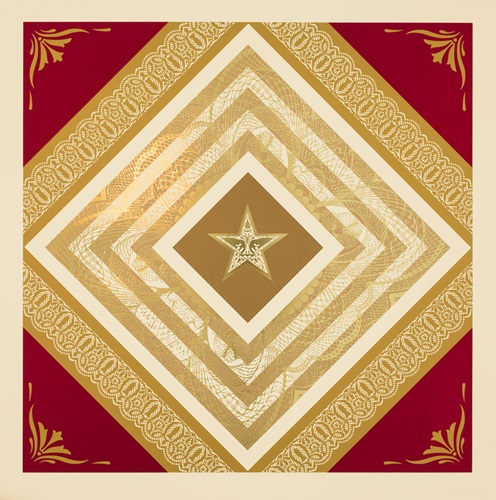
Obey Lotus Diamond (Diamond Dust - Black & Gold) is a 2013 screen print by Shepard Fairey, published by Paul Stolper Gallery in an edition of 75 at 24 x 36 inches. It is part of a four-print series of floral ornament abstractions and uses diamond dust, Fairey's first work with the medium. The Black & Gold colorway combines a diamond-shaped lotus ornamental motif with a shimmering, reflective surface. The print emphasizes decorative pattern and glamorous materiality over explicit political content, foregrounding the seductive surface effect that the diamond dust provides.
Why It Matters
This print belongs to Shepard Fairey's first diamond dust series, a technical milestone in his catalog. The source explains that diamond dust, most famously used by Andy Warhol, was applied to add glamour and transform ordinary images into coveted objects, and that the material aligns with Fairey's interest in the seduction of advertising and consumerism. The diamond-shaped lotus ornamentation makes this a companion to the crescent version, with both sharing the same edition size and Black & Gold finish. For collectors, the conceptual self-awareness, where the print openly stages its own superficial luminosity, sets it apart from straightforwardly decorative floral works. Published by London's Paul Stolper Gallery in a small edition of 75, and available either individually or as part of a four-print set, it occupies a gallery-oriented fine-art lane distinct from Fairey's mass-edition Obey Giant releases. The pairing of a limited edition, experimental material, and explicit consumer-culture theme gives the work durable interest for buyers focused on technique and concept rather than topical politics, and supports its standing within Fairey's ornamental and pattern-based body of work.
Collector Perspective
This print appeals to collectors who favor Fairey's ornamental and decorative work and who appreciate experimental print materials. The diamond-shaped lotus and shimmering Black & Gold finish make it elegant and reflective, well suited to a polished interior. It is a natural companion to the Lotus Crescent print, and buyers building a thematic group may pursue both or the full set of four that the source notes was offered together. At an edition of 75 and a 24 x 36 inch format, it functions as a refined statement piece. It draws buyers who value a documented technical first in Fairey's output and who want a work bridging his graphic OBEY identity with fine-art print experimentation rather than overt protest imagery.
Historical Context
This print dates to the early 2010s, when Fairey broadened his practice beyond posters into more materially experimental, gallery-published editions. The source identifies the series as his first use of diamond dust, marking a specific point in his technical development. Issued by Paul Stolper Gallery, a London dealer associated with several of his fine-art print projects, it reflects Fairey's ongoing engagement with consumer culture and the alluring surfaces of advertising. The diamond and lotus ornamentation connects to his broader vocabulary of decorative pattern and mandala-style motifs. Rather than responding to a single political moment, the work emphasizes medium and concept, situating Fairey within a Warhol-influenced fine-art tradition while retaining the OBEY framework that critiques glamour and consumerism.
FAQ
Is this the same as the Lotus Crescent print?
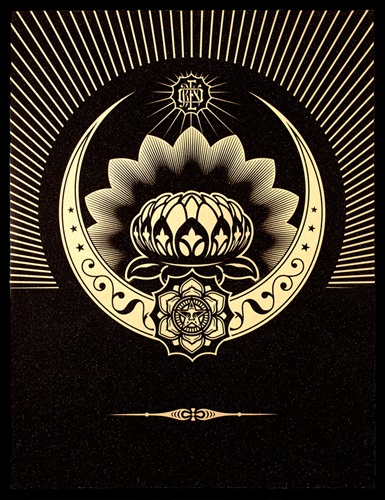
They are companions from the same 2013 diamond dust series. This is the Lotus Diamond version, using a diamond-shaped ornamental motif, while the Crescent uses a crescent form. Both are 24 x 36 inch screen prints in a Black & Gold edition of 75, published by Paul Stolper Gallery.
What is diamond dust?
The source describes diamond dust as a shimmering, elegant material adhered to the surface of the screen print. Most famously used by Andy Warhol, it adds glamour and, per the source, aligns with Fairey's interest in the seduction of advertising and consumerism.
Can this be bought as part of a set?
Yes. The source describes a series of four floral ornament prints, listed at $1500 individually or $5250 for the set of four.
What does the print depict?
It shows a diamond-shaped lotus floral ornament rendered as decorative abstraction, emphasizing the reflective, luminous surface effect of the diamond dust rather than overt political imagery.
Related Works


About the Artist

Shepard Fairey (b. 1970, Charleston, South Carolina) is an American street artist, graphic designer, and activist, and a graduate of the Rhode Island School of Design. His 1989 “André the Giant Has a Posse” sticker grew into the global OBEY GIANT campaign — an ongoing experiment in propaganda, obedience, and visual culture. He reached worldwide recognition with the 2008 “Hope” portrait of Barack Obama, now held by the Smithsonian National Portrait Gallery. Across screen prints, stencils, murals, and collage, Fairey channels propaganda aesthetics toward themes of peace, justice, environmentalism, and civil rights. His work is in the collections of the Museum of Modern Art, the Victoria & Albert Museum, and LACMA.