Gauntlet Gallery
What is Shepard Fairey’s piece called “Shepard Fairey x Red Dog X Glen E Friedman X Collab Skate Decks (Custom Airbrushed)”?
Artist Statement
SHEPARD FAIREY X RED DOG X GLEN E FRIEDMAN X COLLAB SKATE DECKS HANDMADE , SHAPED, and SCREEN PRINTED by Jim Muir. Signed and Numbered by Shepard Fairey, Glen E. Friedman, and Jim “Red Dog” Muir. Limited Release of 75 (edition of 90). $250 each Release Date: November 21, 2013 at 10am PST in Collectibles Almost 30 years ago I started skateboarding and listening to punk rock. I’m not sure when I first heard or read the name Jim Muir, but I knew the name of Dogtown, the skateboard company he founded, from shortly after I began skateboarding. Dogtown had pioneered the wide skateboard and was highly respected by all the O.G.’s. In 1984, I also began listening to Suicidal Tendencies, fronted by Jim’s brother Mike, and managed by photographer Glen E. Friedman. I was stoked to discover that Jim and Mike were at the forefront of skateboarding and punk, the two subcultures that changed my life. I have been a Dogtown fan for a long time. I vividly remember the Muir brothers featured together in Thrasher. I rode several Dogtown boards in the 80's… Scott Oster, Mick Alba, and Eric Dressen. I loved the Dogtown graphics by Wes Humpston and their cross logo. I made a paper-cut stencil Dogtown tee shirt when I was a freshman at art school. At my first Action Sports Retail Trade show in 1995, my booth was right next to Dogtown’s booth and Jim Muir was there. I was too intimidated to say hello, but I hoped he noticed my designs. I later made OBEY tribute graphics to several of my favorite old school skate graphics and the Dogtown Bulldog art was one of the logos I remixed. Even though I worked on the soundtrack design for the documentary Dogtown and Z-Boys, and we have several friends in common, I did not meet Jim Muir until after he broke his neck surfing in 2009. My friend Glen E. Friedman let me know about Jim’s accident and asked if I’d collaborate with him on a portrait of Jim to raise money for his medical expenses. I was happy to help out a skate icon in need and do another collaboration with Glen. I was very familiar with Glen’s photos of Jim and I knew I could make a cool illustration from the Endless Wave 1977 shot. The prints sold out right away and Jim stopped by my studio to say thanks and hello. I got along with Jim right away and we had a bunch of shared interests in music and art. Jim even mentioned my ASR booth from ’95 and I felt like an idiot for being scared to talk to him. Jim and I kept in touch and one day he let me know that he’d found the actual hand-made board that he was riding in the Friedman shot from ’77. He used it as a template and made some new boards the same way he made them in ’77. He asked if I’d be interested in putting the art I’d made based on Glen’s photo on a run of the boards. Of course, I loved the idea of having the boards come full circle after 36 years! Jim did an amazing job selecting the wood, building the shapes, airbrushing, hand screening, and lacquering the boards. The boards are all signed by Jim, Glen, and me. I’m very proud to be part of this project and grateful to Jim for his hard work. -Shepard
Summary
This 2013 collaboration is a run of skate decks made with Jim 'Red Dog' Muir and photographer Glen E. Friedman. Each deck was handmade, shaped, airbrushed, hand screen printed, and lacquered by Muir, founder of the Dogtown skateboard company, using the actual 1977 hand-made board he rode in Friedman's Endless Wave shot as a template. Fairey's illustration is based on that Friedman photograph of Muir. Measuring 20 x 80 (inches per the record), the Custom Airbrushed decks were a limited release of 75 within an edition of 90, signed and numbered by Fairey, Friedman, and Muir, priced at $250 each. Released November 21, 2013.
Why It Matters
This release is among Fairey's most personal objects, tying together the two subcultures he credits with changing his life: skateboarding and punk. Collaborating with Dogtown founder Jim 'Red Dog' Muir and photographer Glen E. Friedman, Fairey put his illustration, drawn from Friedman's 1977 Endless Wave photo of Muir, onto skate decks that Muir himself built using the very board he rode in that shot as a template. That detail brings the work full circle after 36 years and gives the object rare authenticity: these are functional, hand-shaped decks made by a skate icon, not just printed graphics. The triple signing by Fairey, Friedman, and Muir documents a deep web of relationships Fairey recounts in detail, from riding Dogtown boards in the 1980s to an earlier Friedman collaboration to raise money for Muir's medical expenses. As a small edition of 90 with only 75 in the Custom Airbrushed release, at $250 each, it sits at the collectible-object end of Fairey's catalog, prized by skate-culture collectors for its craft, provenance, and the convergence of street art, punk, and skateboarding heritage.
Collector Perspective
This appeals strongly to skate-culture collectors, Dogtown and Z-Boys enthusiasts, Glen E. Friedman followers, and Fairey collectors who prize functional, hand-crafted objects. The decks' handmade construction by Jim Muir, the use of his original 1977 board as a template, and the triple signature give the piece exceptional provenance and a compelling origin story. As a small edition with only 75 in the Custom Airbrushed colorway, it is a higher-tier collectible rather than a routine print, and its three-dimensional, displayable form suits collectors who want skate art beyond paper. It fits a collaboration or skate/music-heritage grouping and pairs with Fairey's other Friedman collaborations and punk-and-skate-themed releases.
Historical Context
These skate decks distill Fairey's origins in 1980s skateboarding and punk into a single collaborative object, made with two figures central to that world: Dogtown founder Jim Muir and scene photographer Glen E. Friedman. Fairey recounts riding Dogtown boards in the 1980s, making a paper-cut Dogtown stencil shirt in art school, working on the Dogtown and Z-Boys soundtrack design, and an earlier Friedman collaboration to support Muir after his 2009 injury. The decks build on Friedman's 1977 Endless Wave photograph, continuing Fairey's method of illustrating from documentary images. Released in late 2013 among many collaborations, the project exemplifies his move into hand-crafted, three-dimensional collectibles rooted in skate and punk heritage.
FAQ
What makes these skate decks special?
Each deck was handmade, shaped, airbrushed, hand screen printed, and lacquered by Jim 'Red Dog' Muir, founder of the Dogtown skateboard company. Muir used the actual 1977 hand-made board he rode in Glen E. Friedman's Endless Wave shot as a template, bringing the project full circle after 36 years.
Who signed and numbered them?
They are signed and numbered by Shepard Fairey, Glen E. Friedman, and Jim 'Red Dog' Muir. Fairey's illustration is based on Friedman's 1977 photograph of Muir.
What is the edition size and price?
The Custom Airbrushed decks were a limited release of 75 within an edition of 90, priced at $250 each. They were released on November 21, 2013, listed in the Collectibles category by Obey Giant.
How does this connect to Fairey's background?
Fairey describes skateboarding and punk as the two subcultures that changed his life. He rode Dogtown boards in the 1980s, worked on the Dogtown and Z-Boys soundtrack design, and had earlier collaborated with Friedman on a portrait to help cover Muir's medical expenses after a 2009 injury.
Related Works

About the Artist
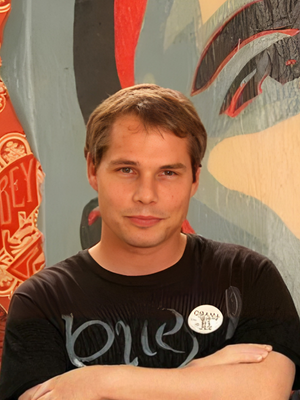
Shepard Fairey (b. 1970, Charleston, South Carolina) is an American street artist, graphic designer, and activist, and a graduate of the Rhode Island School of Design. His 1989 “André the Giant Has a Posse” sticker grew into the global OBEY GIANT campaign — an ongoing experiment in propaganda, obedience, and visual culture. He reached worldwide recognition with the 2008 “Hope” portrait of Barack Obama, now held by the Smithsonian National Portrait Gallery. Across screen prints, stencils, murals, and collage, Fairey channels propaganda aesthetics toward themes of peace, justice, environmentalism, and civil rights. His work is in the collections of the Museum of Modern Art, the Victoria & Albert Museum, and LACMA.