Gauntlet Gallery
What is Shepard Fairey’s piece called “Burroughs”?
Artist Statement
I collaborated with Kate Simon, the photographer behind the first Clash album cover and the Bob Marley “Kaya” cover, on this image of writer William S. Burroughs in celebration of what would be his 100th birthday on Feb. 5th. Burroughs is often associated with the Beat writers and collaborated with Jack Kerouac, but in his long career he produced an amazingly diverse body of writing. Burroughs was a true outsider and his voice was consistently provocative and evocative. As a drug user and explorer of the seedier side of things, Burroughs had a disdain for authority and the square life. I love his quote “how I hate those who are dedicated to producing conformity”. I read Naked Lunch in high school, and I was fascinated by it, but I found it challenging. I have recently been reading Word Virus, a compilation of Burroughs’ writing, at Kate Simon’s recommendation. Word Virus is a great intro if you are unfamiliar with Burroughs. Kate also shot the cover image for the book. -Shepard Burroughs 18 x 24 inch screen print on Speckletone paper. Signed by Kate Simon and Shepard Fairey. Numbered edition of 450. $65 each.
Summary
Burroughs is a 2014 Shepard Fairey screen print on Speckletone paper, 18 x 24 inches, in a numbered edition of 450 published by Obey Giant and released in early February 2014. It depicts writer William S. Burroughs and was made in collaboration with photographer Kate Simon, known for the first Clash album cover and Bob Marley's 'Kaya' cover; both Simon and Fairey signed the edition. Released to mark what would have been Burroughs's 100th birthday on February 5, the print honors the provocative Beat-associated author. The original price was 65 dollars.
Why It Matters
Burroughs extends Fairey's long-running practice of portraying countercultural figures who shaped his worldview, here the provocative Beat-associated writer William S. Burroughs. The print is grounded in a meaningful collaboration with photographer Kate Simon, whose images include the first Clash album cover and Bob Marley's 'Kaya' cover, linking the work to a lineage of music and counterculture photography. Fairey frames Burroughs as a true outsider with a disdain for authority and conformity, quoting his line 'how I hate those who are dedicated to producing conformity', a sentiment that resonates with Fairey's own anti-authority stance. Released to coincide with Burroughs's centennial, it functions as a literary tribute portrait, broadening Fairey's gallery of honored figures beyond musicians and activists into letters. The dual signature by artist and photographer adds collaborative provenance. With an edition of 450 it is more widely available than his smaller drops, but the cultural specificity, the centennial timing, and the Simon collaboration give it added depth for collectors interested in the literary and countercultural threads of Fairey's work.
Collector Perspective
Burroughs appeals to collectors interested in literary and Beat-generation culture as well as Fairey's broader gallery of countercultural portraits. The collaboration with photographer Kate Simon and the dual signatures add provenance that rewards collectors who value the stories behind images. At 18 x 24 inches on Speckletone paper it frames handsomely and pairs well with Fairey's other portrait and counterculture prints. The edition of 450 keeps it relatively accessible, suiting both newer collectors and those building a thematic group around the writers, musicians, and outsiders Fairey has honored. Its centennial-tribute context gives it conversational appeal on display.
Historical Context
Released in February 2014 by Obey Giant, Burroughs is part of Fairey's extensive series of portraits celebrating influential cultural and countercultural figures. Timed to William S. Burroughs's 100th birthday, it positions Fairey as a chronicler of the outsiders and anti-authority voices who informed his sensibility. The collaboration with Kate Simon connects the work to documentary music and counterculture photography of earlier decades. Within Fairey's mid-2010s output, the print exemplifies his habit of honoring writers and artists alongside political subjects, and reinforces the through-line of resistance to conformity that runs across his portrait work.
FAQ
Who is depicted in this print?
The print depicts writer William S. Burroughs, often associated with the Beat writers. It was made in celebration of what would have been his 100th birthday on February 5, 2014, honoring his provocative, anti-conformity voice.
Who collaborated on the image?
Fairey collaborated with photographer Kate Simon, who shot the first Clash album cover and Bob Marley's 'Kaya' cover. The print is signed by both Kate Simon and Shepard Fairey.
What are the edition details?
It is an 18 x 24 inch screen print on Speckletone paper, signed by both artists, in a numbered edition of 450. The original price was 65 dollars.
Why did Fairey choose Burroughs?
Fairey describes Burroughs as a true outsider with a disdain for authority and the square life, quoting his line about hating those dedicated to producing conformity. He read Naked Lunch in high school and made the print for Burroughs's centennial.
Related Works

About the Artist
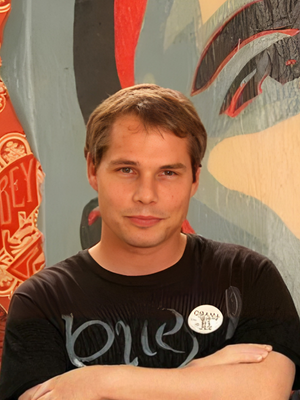
Shepard Fairey (b. 1970, Charleston, South Carolina) is an American street artist, graphic designer, and activist, and a graduate of the Rhode Island School of Design. His 1989 “André the Giant Has a Posse” sticker grew into the global OBEY GIANT campaign — an ongoing experiment in propaganda, obedience, and visual culture. He reached worldwide recognition with the 2008 “Hope” portrait of Barack Obama, now held by the Smithsonian National Portrait Gallery. Across screen prints, stencils, murals, and collage, Fairey channels propaganda aesthetics toward themes of peace, justice, environmentalism, and civil rights. His work is in the collections of the Museum of Modern Art, the Victoria & Albert Museum, and LACMA.