Gauntlet Gallery
What is Shepard Fairey’s piece called “Jello Biafra”?
Artist Statement
JELLO BIAFRA The Dead Kennedys album “Plastic Surgery Disasters” was one of the first punk albums I bought back in 1984. I loved the music and lyrics from the album, especially the song “Bleed For Me” which skewered Ronnie Reagan’s foreign policy and human rights record. I bought all of the Dead Kennedys albums that were out up to that point and they were a big part of my evolution toward questioning authority and corporate greed. “Fresh Fruit For Rotting Vegetables” is a classic. I have been able to work with Jello Biafra, the singer and brilliant lyricist of The Dead Kennedys, on a few projects over the years, and when he asked me to design a portrait skateboard of him for Powell-Peralta I knew I’d ask Glen E Friedman if I could work from one of his photos. Glen liked the way the skateboard turned out enough to suggest we do a screen print. Jello agreed and all three of us signed it. I think this is a pretty special collaboration considering how influential Jello and Glen have been in my life. Oh, Winston Smith deserves a shout out, because he created the Dead Kennedys logo and the Alternative Tentacles logo which are included in the collage. -Shepard 16 x 24 inch screen print. Signed by Shepard Fairey, Jello Biafra, and Glen E. Friedman. Numbered edition of 450. $70.
Summary
Jello Biafra is a 2014 Shepard Fairey screen print, 16 x 24 inches, in a numbered edition of 450 published by Obey Giant and released in March 2014 at 70 dollars. It portrays Jello Biafra, singer and lyricist of the Dead Kennedys, and was developed from a Glen E. Friedman photograph after Fairey designed a Biafra portrait skateboard for Powell-Peralta. The print is signed by Shepard Fairey, Jello Biafra, and Glen E. Friedman, and its collage incorporates the Dead Kennedys and Alternative Tentacles logos created by Winston Smith. It honors a figure Fairey credits with shaping his anti-authority outlook.
Why It Matters
Jello Biafra is a richly layered tribute that braids together several strands of Fairey's punk roots into a single collaborative print. He recounts that the Dead Kennedys' 'Plastic Surgery Disasters' was among his first punk album purchases in 1984 and that the band shaped his evolution toward questioning authority and corporate greed, making this a deeply personal homage. The work is triple-signed by Fairey, Biafra himself, and photographer Glen E. Friedman, an influential documentarian of punk and hip-hop, giving it exceptional collaborative provenance. It also folds in the Dead Kennedys and Alternative Tentacles logos by Winston Smith, layering punk graphic history directly into the collage. Originating from a Powell-Peralta skateboard design, it further connects to skate culture, another pillar of Fairey's sensibility. For collectors, the convergence of three signatures, the embedded countercultural iconography, and the portrait of a foundational punk figure makes it a standout in Fairey's music and counterculture catalog. With an edition of 450 it remains attainable, but its dense web of collaborators and references gives it strong narrative and historical depth.
Collector Perspective
Jello Biafra is a magnet for collectors of punk culture, Dead Kennedys fans, and those drawn to Fairey's music and counterculture portraits. The triple signature by Fairey, Biafra, and photographer Glen E. Friedman adds rare collaborative provenance that rewards collectors who value the people and history behind an image. The embedded Winston Smith logos and the skateboard-design origin deepen its appeal to punk and skate-culture enthusiasts. At 16 x 24 inches it frames well within a music-themed grouping, and the edition of 450 keeps it accessible. It fits naturally into a collection focused on Fairey's musical influences and his portraits of countercultural figures.
Historical Context
Released in March 2014 by Obey Giant, Jello Biafra sits firmly within Fairey's music and counterculture portrait work and reflects the formative influence of early-1980s punk on his worldview. Fairey ties the image to his 1984 discovery of the Dead Kennedys and their critiques of authority and corporate greed, themes that recur throughout his career. The print's origin in a Powell-Peralta skateboard design links it to skate culture, while its collaboration with photographer Glen E. Friedman and inclusion of Winston Smith's logos connect it to a broader network of punk visual history. Within Fairey's arc, it exemplifies how he honors the subcultural figures and graphic traditions that shaped his anti-authority sensibility.
FAQ
Who is depicted in this print?
The print portrays Jello Biafra, the singer and lyricist of the punk band the Dead Kennedys. Fairey describes Biafra as influential in his own evolution toward questioning authority and corporate greed, dating back to 1984.
Who signed the print?
It is signed by Shepard Fairey, Jello Biafra, and photographer Glen E. Friedman, whose photo the image was developed from. Fairey calls it a special collaboration given how influential Jello and Glen have been in his life.
How did the image originate?
Biafra asked Fairey to design a portrait skateboard of him for Powell-Peralta, working from a Glen E. Friedman photo. Friedman liked the result enough to suggest a screen print, and Biafra agreed.
What logos appear in the collage?
The collage includes the Dead Kennedys logo and the Alternative Tentacles logo, both created by Winston Smith, whom Fairey credits in his text for the artwork.
Related Works
About the Artist
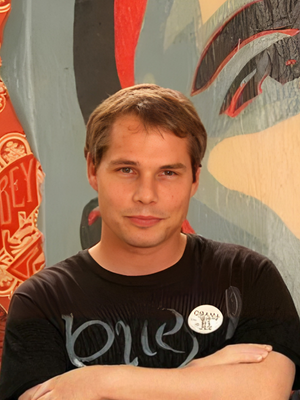
Shepard Fairey (b. 1970, Charleston, South Carolina) is an American street artist, graphic designer, and activist, and a graduate of the Rhode Island School of Design. His 1989 “André the Giant Has a Posse” sticker grew into the global OBEY GIANT campaign — an ongoing experiment in propaganda, obedience, and visual culture. He reached worldwide recognition with the 2008 “Hope” portrait of Barack Obama, now held by the Smithsonian National Portrait Gallery. Across screen prints, stencils, murals, and collage, Fairey channels propaganda aesthetics toward themes of peace, justice, environmentalism, and civil rights. His work is in the collections of the Museum of Modern Art, the Victoria & Albert Museum, and LACMA.