Gauntlet Gallery
What is Shepard Fairey’s piece called “SOLD”?
Artist Statement
Renowned political artist Shepard Fairey spoofs his 2008 Obama "HOPE" poster in this gorgeous print. He has offered our donors a very limited edition of 200 signed and numbered screenprints, approximately 24x36" — and absolutely gorgeous. It's incredibly rare for an artist of this caliber to spoof his own work, but he believes strongly in this cause. We are so honored to have them.
Summary
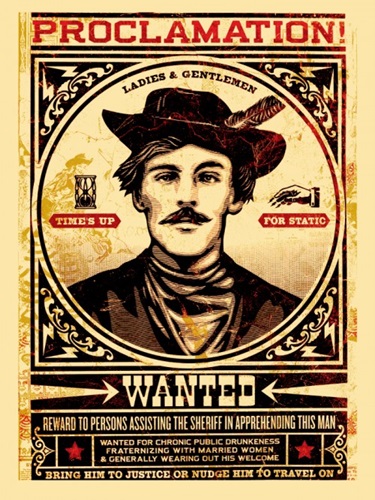
SOLD is a 2014 Shepard Fairey screen print released through an Indiegogo campaign. As described in the source, Fairey spoofs his own 2008 Obama HOPE poster in this image. It is a signed and numbered first edition of 200, measuring approximately 24 x 36 inches, originally offered at $200. The source notes it is unusual for an artist of Fairey's stature to parody his own famous work, which he did here in support of a cause tied to the crowdfunding campaign. The piece reworks the iconic HOPE composition into a new statement, making it a self-referential political and pop-culture print.
Why It Matters
SOLD is significant because it is Fairey directly parodying his most famous image, the 2008 Obama HOPE poster, an act the source itself calls incredibly rare for an artist of his caliber. That self-referential gesture turns the print into a pointed commentary, reworking a symbol of political optimism into something titled SOLD, which the source frames under politics and democracy with a pop-culture dimension. For collectors, works that engage directly with HOPE carry outsized interpretive weight, because HOPE is the cornerstone of Fairey's public reputation; a print that comments on it participates in that legacy conversation. Released through Indiegogo in support of a cause, it also documents Fairey's use of crowdfunding platforms and benefit-driven releases during this period. With a small first edition of 200, signed and numbered at roughly 24 x 36 inches, it is both compact in supply and conceptually loaded. The combination of a recognizable visual lineage, an unusual self-parody premise, and a cause-driven release context makes SOLD a distinctive and conversation-rich piece relative to Fairey's many straightforward screen prints of the same year.
Collector Perspective
SOLD appeals to collectors focused on Fairey's political work and especially to those who collect anything connected to the HOPE image, since the source explicitly describes it as a spoof of that 2008 poster. The self-parody concept gives it strong narrative appeal as a talking-point piece. At roughly 24 x 36 inches, it is a sizable wall work suited to display in a politically themed or HOPE-adjacent grouping. The small edition of 200 and its cause-driven Indiegogo origin add provenance interest for collectors who value campaign-tied and benefit releases. It fits collections organized around Fairey's democracy and political imagery or around his self-referential and pop-culture works.
Historical Context
SOLD sits within Fairey's post-HOPE arc, years after the 2008 Obama poster cemented his public profile, and shows him revisiting and subverting that defining image. The source ties the print to an Indiegogo campaign supporting a cause, placing it among Fairey's benefit and crowdfunding-linked releases of the early-to-mid 2010s. By spoofing his own most recognizable work, Fairey engages in a reflexive commentary unusual for an artist of his standing, as the source emphasizes. Within his career, this 2014 piece illustrates how the HOPE composition continued to function as a reference point he could rework for new political and fundraising purposes rather than leaving it as a fixed monument.
FAQ
What does SOLD depict?
According to the source, Fairey spoofs his own 2008 Obama HOPE poster in this print. He reworks that iconic composition into a new image titled SOLD, an unusual instance of the artist parodying his most famous work, which the source notes is rare for an artist of his caliber.
What is the edition size and how was it released?
The source describes a signed and numbered first edition of 200, measuring approximately 24 x 36 inches, originally offered at $200. It was released through an Indiegogo crowdfunding campaign in support of a cause Fairey believed in.
Why is this print considered notable?
The source states it is incredibly rare for an artist of Fairey's caliber to spoof his own work. By reinterpreting the HOPE poster, the print engages directly with the image central to his reputation, giving it strong conceptual and conversational appeal.
Is the print signed?
Yes. The source describes it as a signed and numbered edition of 200. Each piece carries Fairey's signature and an edition number, consistent with his standard practice for limited screen prints.
Related Works
About the Artist

Shepard Fairey (b. 1970, Charleston, South Carolina) is an American street artist, graphic designer, and activist, and a graduate of the Rhode Island School of Design. His 1989 “André the Giant Has a Posse” sticker grew into the global OBEY GIANT campaign — an ongoing experiment in propaganda, obedience, and visual culture. He reached worldwide recognition with the 2008 “Hope” portrait of Barack Obama, now held by the Smithsonian National Portrait Gallery. Across screen prints, stencils, murals, and collage, Fairey channels propaganda aesthetics toward themes of peace, justice, environmentalism, and civil rights. His work is in the collections of the Museum of Modern Art, the Victoria & Albert Museum, and LACMA.