Gauntlet Gallery
What is Shepard Fairey’s piece called “Commanda Mural”?
Artist Statement
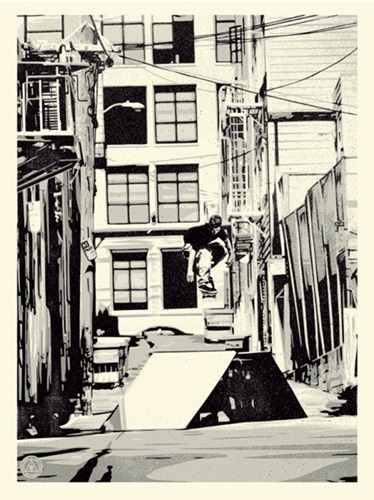
COMMANDA MURAL PRINT RELEASE! This “Commanda Mural” print is a co-publishing collaboration with the Ernst Hilger Gallery based on the mural I did in Vienna Austria near the gallery. I’m very excited about this print because the high end process used is very similar to photogravure, which is one of the earliest etching techniques used to reproduce continuous tone photography. In this case, the printing plate used is zinc, opposed to copper. The zinc plate was prepared with photosensitive varnish in acid bath to yield the printing surface for the black areas of the print. The black area of the work was printed by hand on printing press; the color part of the work was printed with lithography. The art was printed by the esteemed Stamperia Carini in San Giovanni Valdarno, Italy. The paper used is 100% cotton rag. Stamperia Carini uses only raw materials of the high quality for its editions. All inks used in the printing process are the highest degree of resistance to the light available on the market; the paper usually used for the edition is the highest standard of pure cotton (100%). The print looks incredible in person and I’m very happy with how the process translated many elegant, and hard to capture, nuances. -Shepard Shepard Fairey Commanda Mural, 2013 Heliograph and lithograph (Etching) Signed, Numbered Ed. 389 17 inches x 21.5 inches, $250 Release date: March 17, 2015
Summary
Commanda Mural is a 2015 print released by Obey Giant as a co-publishing collaboration with Vienna's Ernst Hilger Gallery, based on a mural Fairey painted in Vienna. Measuring 17 x 21.5 inches on 100% cotton rag paper, it combines an etching-like heliograph process on a zinc plate, hand-printed for the black areas, with lithography for the color. It was printed by Stamperia Carini in San Giovanni Valdarno, Italy. Signed and numbered in an edition of 389, it references the mural's 2013 source imagery and was released March 17, 2015, at $250.
Why It Matters
Commanda Mural stands out for its unusually high-end production: Fairey describes a heliograph process on a zinc plate akin to early photogravure, hand-printed by the esteemed Stamperia Carini in Italy on 100% cotton rag, with the color rendered by lithography. That combination of intaglio-style and lithographic techniques is rare in his catalog and reflects a fine-art ambition beyond his standard screen prints. The print also documents Fairey's international footprint, originating from a mural he painted in Vienna and co-published with the Ernst Hilger Gallery, underscoring his European exhibition presence in the early-to-mid 2010s. For collectors, the appeal lies in this technical pedigree, the European co-publishing provenance, and the relatively small edition of 389 at a higher original price point of $250. It connects a public mural to a refined studio edition, letting collectors own a translated, archival version of a site-specific Vienna work. Within a Fairey collection, it is a premium, process-forward piece that rewards attention to printmaking craft and his global practice.
Collector Perspective
This print appeals to collectors who value printmaking craft and Fairey's international and mural-based work. The heliograph-and-lithograph process, hand-printing by Stamperia Carini, and 100% cotton rag paper make it a connoisseur's piece, while the Ernst Hilger Gallery co-publishing and Vienna mural origin add European provenance. With an edition of 389 and a $250 release price, it sits above his routine screen prints and anchors a collection focused on his fine-art editions or his mural-to-print translations. Its 17 x 21.5 inch format displays well framed, and the documented Italian printing pedigree gives it strong narrative and presentation value for discerning buyers.
Historical Context
Commanda Mural reflects Fairey's expanding international practice in the early-to-mid 2010s, deriving from a mural he created in Vienna near the Ernst Hilger Gallery, which co-published the print. Its production through Stamperia Carini in Italy, using a zinc-plate heliograph process and lithography, situates it among his more technically ambitious editions of the period, distinct from his high-volume Obey Giant screen prints. The work translates a 2013 public mural into an archival studio edition, illustrating how Fairey carried site-specific European wall work into the collectible print market. Released in 2015, it belongs to the Modern Activism period of his catalog and exemplifies his collaborations with established galleries and master printers abroad.
FAQ
What is Commanda Mural based on?
According to Fairey, the print is a co-publishing collaboration with Vienna's Ernst Hilger Gallery, based on a mural he painted in Vienna, Austria near the gallery. The print translates that 2013 mural imagery into an archival fine-art edition released in 2015.
What printing process was used?
Fairey describes a high-end process similar to photogravure: a zinc plate prepared with photosensitive varnish in an acid bath, with the black areas hand-printed on a press and the color printed via lithography. The work was printed by Stamperia Carini in San Giovanni Valdarno, Italy, on 100% cotton rag paper.
What are the edition details?
Commanda Mural measures 17 x 21.5 inches and is signed and numbered in an edition of 389. It was released March 17, 2015, at $250 through Obey Giant in collaboration with the Ernst Hilger Gallery.
Why is this print considered high-end?
The source emphasizes its refined production: a heliograph zinc-plate process akin to early photogravure, hand-printing by the esteemed Stamperia Carini, light-resistant inks, and 100% cotton rag paper. These elements set it apart from Fairey's standard screen prints and place it among his more technically ambitious editions.
Related Works
About the Artist

Shepard Fairey (b. 1970, Charleston, South Carolina) is an American street artist, graphic designer, and activist, and a graduate of the Rhode Island School of Design. His 1989 “André the Giant Has a Posse” sticker grew into the global OBEY GIANT campaign — an ongoing experiment in propaganda, obedience, and visual culture. He reached worldwide recognition with the 2008 “Hope” portrait of Barack Obama, now held by the Smithsonian National Portrait Gallery. Across screen prints, stencils, murals, and collage, Fairey channels propaganda aesthetics toward themes of peace, justice, environmentalism, and civil rights. His work is in the collections of the Museum of Modern Art, the Victoria & Albert Museum, and LACMA.