Gauntlet Gallery
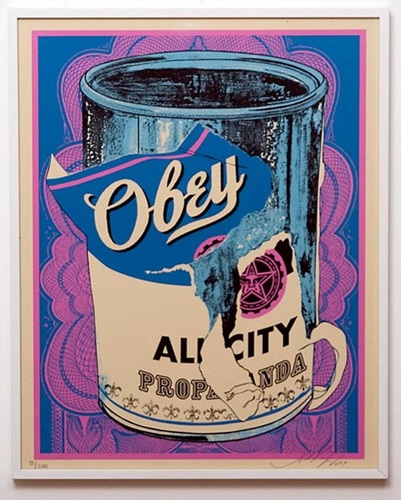
What is Shepard Fairey’s piece called “Paint It Black Series”?
Artist Statement
For our third limited edition with Shepard, we're switching things up again. Paint It Black is a set of three prints, two-color silkscreen and printed on a thick 100% cotton archival paper. As with all PCP editions, all are numbered, signed by the artist and validated by a certificate of authenticity. Prints are crafted in Los Angeles using the finest paper and archival inks. The edition is limited to 300 sets, once they sell out, they will not be reproduced. $185 Paint It Black Series 14 x 18 inches / set of 3 Limited Edition of 300 Signed by Shepard Fairey Two-color silkscreen on Somerset, 100% cotton archival paper Prints are numbered, embossed and exclusive to Poster Child Prints, validated by a Certificate of Authenticity.
Summary
Paint It Black Series is a 2016 set of three two-color silkscreen prints published by Poster Child Prints, Shepard Fairey's third limited edition with that publisher. Each set measures 14 x 18 inches and is printed on Somerset 100% cotton archival paper. The edition is limited to 300 sets at an issue price of $185. Prints are numbered, embossed, signed by Shepard Fairey, and validated by a Certificate of Authenticity. The work pairs Fairey's signature graphic-design vocabulary with floral motifs across the three-print suite, crafted in Los Angeles using archival inks. The publisher states the edition will not be reproduced once sold out.
Why It Matters
Paint It Black sits within Fairey's long-running practice of fine-art screen-print collaborations with boutique publishers, here Poster Child Prints, who frame it as their third limited edition with the artist. The set format, three coordinated prints sold together, makes it a deliberate suite rather than a single image, appealing to collectors who value cohesive groupings and the discipline of a two-color silkscreen reduced to its graphic essentials. The use of Somerset cotton archival paper, embossing, numbering, and a Certificate of Authenticity signals a production standard aimed at serious print collectors rather than casual buyers. The floral and decorative leanings noted in the source connect it to Fairey's broader exploration of pattern and ornament, themes he returns to across his catalog. As a publisher-exclusive edition of 300 sets, it occupies a recognizable tier in the secondary market: scarce enough to hold interest, accessible enough to circulate. Its significance is more about craft, format, and series collecting than about overt political messaging, distinguishing it from Fairey's protest-driven work of the same period.
Collector Perspective
This appeals to collectors who pursue complete sets and value coordinated suites over single hero images. The three-print format rewards collectors who like to display works as a triptych or grouped wall, and the modest 14 x 18 inch sheet size suits intimate framing in a home or office. Print purists will appreciate the two-color silkscreen on Somerset cotton paper, the embossing, and the included Certificate of Authenticity, all hallmarks of a carefully produced edition. At its original $185 issue price for a set of three, it functioned as an accessible entry point into signed Fairey works. It fits naturally into a collection organized around Fairey's publisher collaborations or his decorative and floral-leaning output, and pairs well with other Poster Child Prints releases.
Historical Context
Released in April 2016, Paint It Black belongs to a mature phase of Fairey's print career in which he regularly partnered with specialist publishers to issue tightly produced limited editions. Poster Child Prints describes it as their third collaboration with the artist, situating it within an ongoing publisher relationship rather than a one-off. By 2016 Fairey had long since moved beyond his early street-poster origins into a studio practice spanning screen prints, paintings, and gallery shows, and works like this reflect his emphasis on archival materials and craftsmanship. The set's decorative and floral character aligns with a recurring strand in his catalog where he explores pattern and ornament alongside his more pointed political imagery. It is a representative example of his collector-oriented, publisher-exclusive editions from the mid-2010s.
FAQ
How many prints are in the Paint It Black Series?
It is a set of three prints. The edition is limited to 300 sets, each set containing all three two-color silkscreens. According to Poster Child Prints, once the edition sells out it will not be reproduced. Every set is numbered, embossed, signed by Shepard Fairey, and validated by a Certificate of Authenticity.
What size are the prints and what paper are they on?
Each print measures 14 x 18 inches and is printed on Somerset 100% cotton archival paper using archival inks. The prints were crafted in Los Angeles. They are exclusive to Poster Child Prints and carry an embossment in addition to the artist's signature and edition numbering.
Who published Paint It Black and when?
It was published by Poster Child Prints and released in 2016, dated April 7, 2016. The publisher describes it as their third limited edition collaboration with Shepard Fairey. The original issue price was $185 for the set of three prints.
Is each print signed?
Yes. The source states the prints are signed by Shepard Fairey, as well as numbered, embossed, and validated by a Certificate of Authenticity. These were standard production practices for Poster Child Prints editions during this period.
Related Works
About the Artist

Shepard Fairey (b. 1970, Charleston, South Carolina) is an American street artist, graphic designer, and activist, and a graduate of the Rhode Island School of Design. His 1989 “André the Giant Has a Posse” sticker grew into the global OBEY GIANT campaign — an ongoing experiment in propaganda, obedience, and visual culture. He reached worldwide recognition with the 2008 “Hope” portrait of Barack Obama, now held by the Smithsonian National Portrait Gallery. Across screen prints, stencils, murals, and collage, Fairey channels propaganda aesthetics toward themes of peace, justice, environmentalism, and civil rights. His work is in the collections of the Museum of Modern Art, the Victoria & Albert Museum, and LACMA.