Gauntlet Gallery
What is Shepard Fairey’s piece called “No Future Letterpress”?
Artist Statement
My art is usually social and political regardless of who is in the White House, but my concerns and frustrations are amplified by the election of Donald Trump. I joked while Trump was campaigning that his slogan should be "Manifest Density," a parody of "Manifest Destiny," which was an embarrassingly egotistical pronouncement by rich white men that it was God's desire for them to conquer ocean to ocean in the territory that would become the United States. Trump appealed to an uninformed electorate who looked for scapegoats and were driven by most likely one or more of the dark impulses listed in the print.I'm pushing for a future where those impulses have no place and definitely no traction. Let's move forward, not backward. – Shepard No Future. 10 x 13 inches. Letterpress on cream cotton paper with hand-deckled edges. Signed by Shepard Fairey. Numbered edition of 300. $65.
Summary
No Future Letterpress is a 2016 Shepard Fairey letterpress print, 10 x 13 inches, produced on cream cotton paper with hand-deckled edges and published by Obey Giant. Issued in a numbered edition of 300 and signed by Fairey, the print catalogs a list of negative human impulses that the artist argues have no place in the future he advocates. Created in the immediate aftermath of the 2016 U.S. election, it pairs Fairey's typographic, text-forward composition with his recurring call to move forward rather than backward. The work was released alongside a companion piece sharing the same theme and edition size.
Why It Matters
No Future Letterpress sits at a charged moment in Fairey's catalog: it was released in December 2016, weeks after the U.S. presidential election that the artist's own statement names as amplifying his political concerns. Rather than a single portrait or icon, the print uses typography to list the 'dark impulses' Fairey wanted excluded from the future, making the message direct and reproducible as a protest object. For collectors, the letterpress medium on hand-deckled cream cotton paper distinguishes it from Fairey's more common screen prints, giving it a tactile, craft-forward quality. The edition of 300 keeps it relatively contained without being scarce. Its value as a collectible is tied to its documentary role in the wave of overtly anti-Trump-era work Fairey produced, and to its pairing with the companion 'Obey With Caution' print, which Fairey created at the same time because he could not decide between two versions. As one of a closely linked set of post-election statement prints, it appeals to collectors who track Fairey's political arc and want a representative, text-driven piece from that period rather than an image-led one.
Collector Perspective
This print suits collectors drawn to Fairey's political and typographic work rather than his portrait or floral output. The letterpress process, cream cotton paper, and hand-deckled edges give it a handmade presence that displays well in a clean frame and reads as a deliberate, message-first object. At an edition of 300 and an original release price of $65, it is an accessible entry point for someone building a thematic group of Fairey's post-2016 political prints. It pairs naturally with its companion piece and with other future-themed works in his catalog, making it a strong anchor for a focused mini-collection. Buyers who value text-driven activist art and the tactile qualities of letterpress will find it more rewarding than those seeking Fairey's signature iconography.
Historical Context
No Future Letterpress belongs to the surge of overtly political work Fairey produced around the 2016 U.S. election, a period in which his long-running social and political concerns became, in his words, amplified. It connects to his recurring 'future' motif and to the satirical 'Manifest Density' framing he used to critique expansionist, nationalist rhetoric. Fairey released it through Obey Giant alongside a near-twin print, underscoring how prolifically he was responding to the moment. Within his arc, the work marks the transition from earlier propaganda-style imagery toward blunt, text-forward statements aimed squarely at contemporary politics, prefiguring the larger body of resistance imagery he would create in the following years.
FAQ
What medium and paper is No Future Letterpress printed on?
It is a letterpress print on cream cotton paper with hand-deckled edges, measuring 10 x 13 inches. The letterpress process and deckled edges give it a tactile, craft-forward quality that sets it apart from Fairey's more common screen prints from the same period.
How large is the edition?
No Future Letterpress was published by Obey Giant in a numbered edition of 300 and is signed by Shepard Fairey. It was released on December 20, 2016 at an original price of $65.
What is the print about?
Fairey's statement describes it as a response to the 2016 election, listing dark human impulses he wants excluded from the future. He frames it as a push to move forward, not backward, parodying nationalist rhetoric with his 'Manifest Density' joke.
Is there a companion print?
Yes. Fairey created a second version, Obey With Caution, at the same time because he could not decide which he preferred. Both were issued in editions of 300, making them closely linked companion works from late 2016.
Related Works

About the Artist
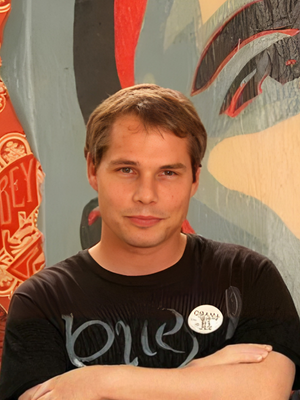
Shepard Fairey (b. 1970, Charleston, South Carolina) is an American street artist, graphic designer, and activist, and a graduate of the Rhode Island School of Design. His 1989 “André the Giant Has a Posse” sticker grew into the global OBEY GIANT campaign — an ongoing experiment in propaganda, obedience, and visual culture. He reached worldwide recognition with the 2008 “Hope” portrait of Barack Obama, now held by the Smithsonian National Portrait Gallery. Across screen prints, stencils, murals, and collage, Fairey channels propaganda aesthetics toward themes of peace, justice, environmentalism, and civil rights. His work is in the collections of the Museum of Modern Art, the Victoria & Albert Museum, and LACMA.