Gauntlet Gallery
What is Shepard Fairey’s piece called “Welcome Visitor Diptych”?
Artist Statement
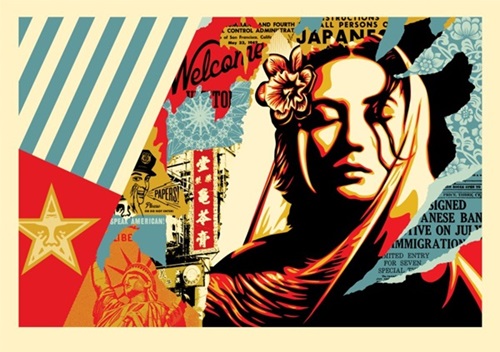
The "Welcome Visitor" diptych is an exploration of the contradictions between America's tourism industry and it's immigration policies; the uncomfortable collision of economic opportunism and xenophobia. We've probably all seen the Schoolhouse Rock! about Ellis Island and "The Great American Melting Pot," but we're now witnessing the fear surrounding the scapegoating of Latinos and Muslims. In "Welcome Visitor," I highlight the immigration ban and internment of Japanese people including Japanese-American citizens during World War II when the Japanese were seen as the enemy. I hope that the level of relative comfort most people feel towards Japanese people presently puts in perspective the irrational and disproportionate fear of Muslims and Latinos that is going on now. I understand that immigration is a complex issue, but a basic belief in the humanity and dignity of all people is not that complicated and should be what is paramount in deciding our policies around both immigration and tourism. The fear around immigration is not based on fact. Crime rates are lower for immigrants than they are for native-born citizens. – Shepard Welcome Visitor. Diptych. 18 x 24 inches. Screenprint on cream Speckle Tone paper. Signed by Shepard Fairey. Numbered edition of 450. $90.
Summary
Welcome Visitor is a 2017 diptych screenprint by Shepard Fairey, printed on cream Speckle Tone paper, signed and issued in a numbered first edition of 450 through Obey Giant. The combined diptych measures 36 inches wide by 24 inches high. Fairey describes the work as an exploration of the contradiction between America's tourism industry and its immigration policies, contrasting the 'melting pot' ideal against the scapegoating of Latinos and Muslims and recalling the World War II internment of Japanese Americans. The piece pairs his graphic portrait language with a pointed message about human dignity, arguing that fear around immigration is not supported by fact.
Why It Matters
Welcome Visitor is one of Fairey's clearest statements on immigration and civil rights, made significant by the artist's own extended explanation. In his text, Fairey directly links contemporary fear of Latinos and Muslims to the historic injustice of Japanese-American internment, framing both as irrational and disproportionate. He explicitly counters anti-immigrant rhetoric with the point that crime rates are lower for immigrants than for native-born citizens. That documented intent gives this diptych unusual weight as a primary-source artwork about a charged political moment. As a two-panel format it is also visually ambitious, offering collectors a larger, more narrative composition than a single sheet. The edition of 450 and accessible original price make it attainable, while its subject ties it to Fairey's broader catalog of social-justice work. A later large-format version of Welcome Visitor confirms that Fairey considered this image important enough to revisit at scale. For collectors who prioritize Fairey as an activist rather than a decorator, this print is a centerpiece: it documents a specific argument about immigration, humanity, and dignity in the artist's own words, and it does so in a striking diptych format that commands wall space.
Collector Perspective
Welcome Visitor draws collectors who value Fairey's explicitly political and civil-rights work over his purely decorative output. The diptych format, spanning 36 inches wide, makes it a statement piece suited to prominent display rather than a small accent. Its documented message about immigration and human dignity gives it narrative depth that appeals to socially engaged buyers and to those assembling a thematic collection around justice and human rights. Signed and numbered in an edition of 450, it balances collectibility with attainability. It pairs naturally with the later large-format Welcome Visitor and with Fairey's other rights-focused titles, letting collectors build a coherent activist grouping. For institutions or individuals interested in art that records a specific political debate, this diptych is a strong, legible anchor.
Historical Context
Welcome Visitor dates from 2017, a period when Fairey responded directly to the political climate surrounding immigration and the treatment of Latino and Muslim communities. Drawing an explicit parallel to the WWII internment of Japanese Americans, the work situates contemporary debate within a longer American history of fear-driven policy. This places the print firmly in Fairey's tradition of using accessible graphic art as social commentary, a lineage running back through his protest imagery. The existence of a 2018 large-format edition shows the image's importance within his catalog. Within his arc, Welcome Visitor exemplifies the mature activist phase of Fairey's career, in which detailed artist statements accompany editions and the work functions as both fine art and documented argument.
FAQ
What is Welcome Visitor about?
In Fairey's own words, the diptych explores the contradiction between America's tourism industry and its immigration policies. It highlights the WWII internment of Japanese Americans to put present-day fear of Muslims and Latinos in perspective, arguing for the humanity and dignity of all people.
What format and size is this print?
Welcome Visitor is a diptych, a two-panel work, printed on cream Speckle Tone paper. The combined piece measures 36 inches wide by 24 inches high. It was published by Obey Giant in 2017 as a signed screenprint.
How many were made?
The work was issued as a signed, numbered first edition of 450. Each print is signed by Shepard Fairey, consistent with the edition information in the source description.
Did Fairey comment on immigration crime claims?
Yes. In his statement, Fairey writes that fear around immigration is not based on fact, noting that crime rates are lower for immigrants than for native-born citizens. This claim is part of the artist's documented text for the piece.
Related Works
About the Artist

Shepard Fairey (b. 1970, Charleston, South Carolina) is an American street artist, graphic designer, and activist, and a graduate of the Rhode Island School of Design. His 1989 “André the Giant Has a Posse” sticker grew into the global OBEY GIANT campaign — an ongoing experiment in propaganda, obedience, and visual culture. He reached worldwide recognition with the 2008 “Hope” portrait of Barack Obama, now held by the Smithsonian National Portrait Gallery. Across screen prints, stencils, murals, and collage, Fairey channels propaganda aesthetics toward themes of peace, justice, environmentalism, and civil rights. His work is in the collections of the Museum of Modern Art, the Victoria & Albert Museum, and LACMA.