Gauntlet Gallery
What is Shepard Fairey’s piece called “Flint Eye Alert Globe”?
Artist Statement
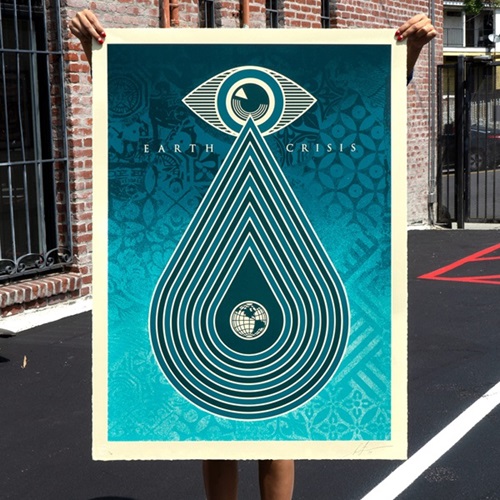
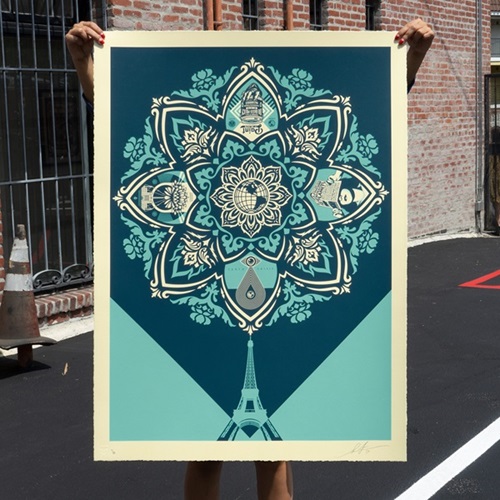
Edition Size: 450 Price: $60 18 x 24 Inches 4-Color Screen Print on 100lb French True White Speckletone Fine Art Paper "This piece is based on a painting I did for my 'Earth Crisis' show in Paris. The entire body of work for that show used these shades of blue/turquoise as a connection to the air and water that is essential to sustaining life on planet Earth. This piece is more specifically about the idea that we need to see what is right in front of us, that we are dependent on nature and I used the blooming flower as a symbol of both beauty and growth. If we keep ruining the air and water, things won't grow, not to mention we'll all get sick." - Shepard Fairey
Summary
Flint Eye Alert Globe is a 2017 four-color screenprint on 100lb French True White Speckletone paper, measuring 18 x 24 inches, issued in an edition of 450 and published by 1xRUN. Based on a painting from Fairey's 'Earth Crisis' show in Paris, the print uses blue and turquoise tones to evoke the air and water essential to life. Fairey pairs an eye-and-globe motif with a blooming flower, which he describes as a symbol of both beauty and growth. The work argues that humanity must recognize its dependence on nature, warning that continued damage to air and water threatens growth and health.
Why It Matters
Flint Eye Alert Globe is a focused entry in Fairey's environmental body of work, anchored to his 'Earth Crisis' exhibition in Paris. The artist's statement gives the piece clear conceptual grounding: the blue and turquoise palette is a deliberate connection to air and water, and the blooming flower stands for beauty and growth that depend on a healthy planet. This makes the print a concise visual argument about ecological dependence rather than a generic nature image. Its publication by 1xRUN, distinct from Fairey's usual Obey Giant releases, situates it within a specific collaborative print platform. Collectors value the work because it links directly to a named exhibition and a coherent series, allowing it to function as a documented fragment of a larger project. The eye motif, recurring across Fairey's catalog, here serves an environmental message about seeing what is in front of us. At a moderate edition of 450 and an accessible original price, it offers an attainable way to own a piece tied to Fairey's climate advocacy. For collectors building around environmental themes, Flint Eye Alert Globe connects naturally to the Earth Crisis large-format works and to his lotus and nature imagery, reinforcing one of the most consistent causes in his later career.
Collector Perspective
This print suits collectors drawn to Fairey's environmental advocacy and to his lotus-and-nature visual vocabulary. The cool blue and turquoise palette makes it a calming yet pointed display piece, well suited to rooms where its symbolism of air and water can be appreciated. Its direct tie to the Earth Crisis show gives it provenance appeal for buyers who like works anchored to a specific exhibition. Signed status and an edition of 450 keep it collectible and attainable. It groups effectively with the Earth Crisis large-format prints and with Fairey's lotus and floral environmental titles, letting collectors assemble a focused ecological subset. For those who want a Fairey work that is decorative and message-driven without being overtly partisan, this is a strong fit.
Historical Context
Flint Eye Alert Globe stems from Fairey's 'Earth Crisis' project, an exhibition in Paris for which he created a body of work unified by blue and turquoise tones tied to air and water. By 2017 environmental themes had become a sustained focus in his output, and this print extends that program into an accessible edition through 1xRUN. The blooming-flower motif and eye imagery place it within his broader symbolic language while serving a specific ecological message about human dependence on nature. The later Earth Crisis large-format editions confirm the series' ongoing importance. Within Fairey's arc, the work marks the maturation of his climate-focused practice, where exhibition paintings are translated into editioned prints that carry the same advocacy to a wider audience.
FAQ
What inspired Flint Eye Alert Globe?
Fairey states the piece is based on a painting he made for his 'Earth Crisis' show in Paris. That body of work used blue and turquoise shades as a connection to the air and water essential to sustaining life on Earth, a palette carried into this print.
What does the blooming flower represent?
In Fairey's statement, the blooming flower is a symbol of both beauty and growth. He uses it to argue that we depend on nature, warning that if we keep ruining the air and water, things won't grow and people will get sick.
What are the print's specifications?
It is a four-color screenprint measuring 18 x 24 inches, printed on 100lb French True White Speckletone fine art paper. The edition size is 450 and it was published by 1xRUN in 2017.
Who published this print?
Flint Eye Alert Globe was published by 1xRUN, a print platform, rather than Fairey's own Obey Giant. The source lists an edition of 450 and an original price of $60.
Related Works



About the Artist

Shepard Fairey (b. 1970, Charleston, South Carolina) is an American street artist, graphic designer, and activist, and a graduate of the Rhode Island School of Design. His 1989 “André the Giant Has a Posse” sticker grew into the global OBEY GIANT campaign — an ongoing experiment in propaganda, obedience, and visual culture. He reached worldwide recognition with the 2008 “Hope” portrait of Barack Obama, now held by the Smithsonian National Portrait Gallery. Across screen prints, stencils, murals, and collage, Fairey channels propaganda aesthetics toward themes of peace, justice, environmentalism, and civil rights. His work is in the collections of the Museum of Modern Art, the Victoria & Albert Museum, and LACMA.