Gauntlet Gallery
What is Shepard Fairey’s piece called “Damaged Times”?
Artist Statement
created this print to commemorate and accompany the Damaged Times newspaper I published as a 26-page supplement to my show DAMAGED, on view Wednesday-Saturday from 11am-6pm until December 17 at 1650 Naud Street in Downtown, Los Angeles! There are articles written by Henry Rollins, Naomi Klein, David DeGraw, Arlene Mejorado, Gwynn Vitello, Evan Pricco, Simon Steinhardt, and me! The newspaper flips the standard model by having REAL news and FAKE ads! If you don't like deterioration of mass media, be the media yourself! – Shepard Damaged Times. 18 x 24 inches. Screen print on cream Speckletone paper. Signed by Shepard Fairey. Numbered edition of 450. $45.
Summary
Damaged Times is a 2017 screen print by Shepard Fairey, published by Obey Giant. It measures 18 x 24 inches, is printed on cream Speckletone paper, signed by Fairey, and issued as a numbered edition of 450. Fairey created it to commemorate and accompany the Damaged Times newspaper, a 26-page supplement he published alongside his DAMAGED exhibition in Downtown Los Angeles. The newspaper inverted the standard media model with real news and fake ads, and featured contributors including Henry Rollins and Naomi Klein. The print's message, that viewers should resist the deterioration of mass media by becoming the media themselves, drives its critique of corporate media decay.
Why It Matters
Damaged Times is a centerpiece artifact of Shepard Fairey's 2017 DAMAGED exhibition, one of his most ambitious self-organized shows. The print does not stand alone: it commemorates and accompanies the Damaged Times newspaper, a 26-page supplement Fairey published with contributions from writers including Henry Rollins, Naomi Klein, David DeGraw, and others. That context elevates the work from a single image to a node in a larger media-critique project. The newspaper's central gambit, real news paired with fake ads, makes the argument explicit: the conventional model of media, where ads fund and distort the news, is broken. Fairey's accompanying call, if you dislike the deterioration of mass media, be the media yourself, encapsulates a DIY-activist ethic that has animated his work since his earliest street campaigns. For collectors, this print carries unusual documentary weight; it is tied to a specific exhibition, a specific publication, and a coherent statement about corporate media and consumerism. Signed and editioned at 450, it offers an accessible way to own a piece directly connected to a major moment in Fairey's exhibition history, where his critique of power and the media reached its fullest expression.
Collector Perspective
Damaged Times appeals to collectors who value works tied to a specific exhibition and a clear intellectual project rather than a standalone image. Its direct link to the DAMAGED show and the accompanying newspaper gives it documentary appeal, making it a strong fit for collectors who follow Fairey's exhibition history and his media-critique thread. The signature and 18 x 24 inch Speckletone format make it a displayable, recognizable Fairey object. At an accessible price and an edition of 450, it suits both newer buyers and those building a themed collection around corporate critique and consumerism. It pairs naturally with other DAMAGED-era prints and Fairey's power and media works.
Historical Context
Damaged Times is anchored to Fairey's 2017 DAMAGED exhibition in Downtown Los Angeles, on view through mid-December at 1650 Naud Street. The accompanying Damaged Times newspaper, with essays by Henry Rollins, Naomi Klein, and others, made the show a multi-format statement on media decay rather than a conventional gallery hang. Within Fairey's arc, the work belongs to a sustained critique of corporate power and mass media that runs from his early street campaigns through his mature gallery practice. The print exemplifies how, by 2017, Fairey paired editioned objects with publications, exhibitions, and named collaborators to extend a single argument across multiple media forms.
FAQ
What exhibition is Damaged Times connected to?
Fairey created the print to commemorate and accompany the Damaged Times newspaper, a 26-page supplement to his DAMAGED show in Downtown Los Angeles at 1650 Naud Street, on view through December 17. The print is directly tied to that exhibition and publication rather than standing alone.
What was the Damaged Times newspaper?
It was a 26-page supplement Fairey published with the show, featuring articles by Henry Rollins, Naomi Klein, David DeGraw, Arlene Mejorado, Gwynn Vitello, Evan Pricco, Simon Steinhardt, and Fairey himself. It inverted the standard media model with real news and fake ads.
Is the print signed and how large is the edition?
Yes, Damaged Times is signed by Shepard Fairey and issued as a numbered edition of 450, published by Obey Giant in 2017. It measures 18 x 24 inches on cream Speckletone paper.
What is the message of the work?
Fairey's stated message is to resist the deterioration of mass media by becoming the media yourself. The print and its newspaper critique the broken conventional media model in which advertising funds and distorts the news.
Related Works
About the Artist
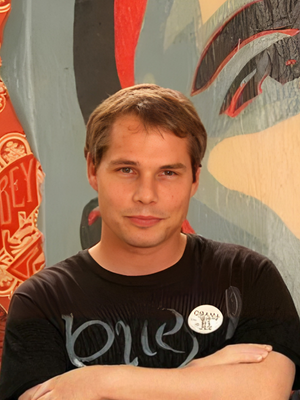
Shepard Fairey (b. 1970, Charleston, South Carolina) is an American street artist, graphic designer, and activist, and a graduate of the Rhode Island School of Design. His 1989 “André the Giant Has a Posse” sticker grew into the global OBEY GIANT campaign — an ongoing experiment in propaganda, obedience, and visual culture. He reached worldwide recognition with the 2008 “Hope” portrait of Barack Obama, now held by the Smithsonian National Portrait Gallery. Across screen prints, stencils, murals, and collage, Fairey channels propaganda aesthetics toward themes of peace, justice, environmentalism, and civil rights. His work is in the collections of the Museum of Modern Art, the Victoria & Albert Museum, and LACMA.