Gauntlet Gallery
What is Shepard Fairey’s piece called “Hammer (Large Format)”?
Artist Statement
The composition of "OBEY Hammer" is a classic example of work by Shepard Fairey that combines historic design elements and his identifiable iconography. The use of arrows and exclamation marks are a reference to Russian Constructivism, and Social Realist propaganda posters inspire the hammer and ribbon. Fairey also inserts his iconic imagery, the Obey Star, an element that borrows from the Soviet Flag that he created in 1996 alongside references to the key elements of the "Andre the Giant Has a Posse" sticker, "Seven Feet Four Inches" and "Five Hundred and Twenty Pounds." In an urban landscape covered with advertising, Fairey has chosen to use imagery associated with communism to steal the viewers' attention. OBEY Hammer. Serigraph on Coventry Rag, 100% Cotton Custom Archival Paper with hand-deckled edges. 30 x 41 inches. Signed by Shepard Fairey. Numbered edition of 89. Comes with a certificate of authenticity. $900.
Summary
Hammer (Large Format) is a 2019 Shepard Fairey screen print, published by Obey Giant in a signed, numbered first edition of 89, measuring 30 x 41 inches on Coventry Rag archival cotton paper with hand-deckled edges. It combines a hammer and ribbon inspired by Social Realist propaganda posters with arrows and exclamation marks referencing Russian Constructivism. Fairey inserts his Obey Star, borrowed from a Soviet-flag motif he created in 1996, alongside text from the "Andre the Giant Has a Posse" sticker, "Seven Feet Four Inches" and "Five Hundred and Twenty Pounds." The work uses communist-associated imagery to seize attention in an advertising-saturated landscape.
Why It Matters
Hammer is a textbook example of how Fairey fuses borrowed historical design with his own iconography. The hammer and ribbon draw on Social Realist propaganda posters, while the arrows and exclamation marks reference Russian Constructivism, locating the work within a deep lineage of revolutionary graphic design. Into that framework Fairey inserts the Obey Star, an element borrowing from the Soviet flag that he created in 1996, and the original "Andre the Giant Has a Posse" data points, "Seven Feet Four Inches" and "Five Hundred and Twenty Pounds," weaving the street campaign's DNA into a propaganda-styled composition. The strategic point is explicit in the release: in an urban landscape saturated with advertising, Fairey deliberately deploys imagery associated with communism to steal the viewer's attention, repurposing the visual force of state propaganda toward his own ends. As part of the 2019 large-format edition-of-89 group tied to the thirtieth-anniversary period, Hammer rewards collectors interested in Fairey's sources and methods, making visible the dialogue between Constructivist history, Soviet symbolism, and the Obey project. The signed, numbered edition of 89 with a certificate of authenticity gives it scarcity to match its iconographic density.
Collector Perspective
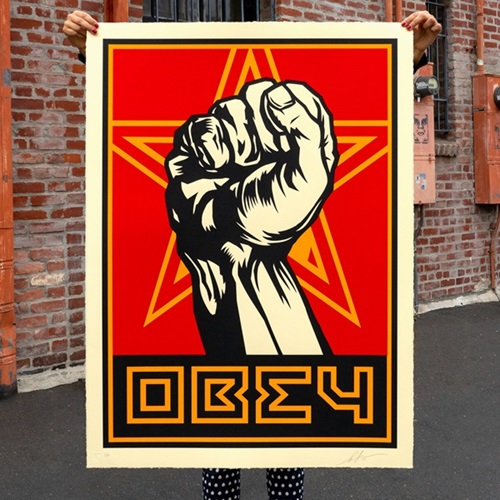
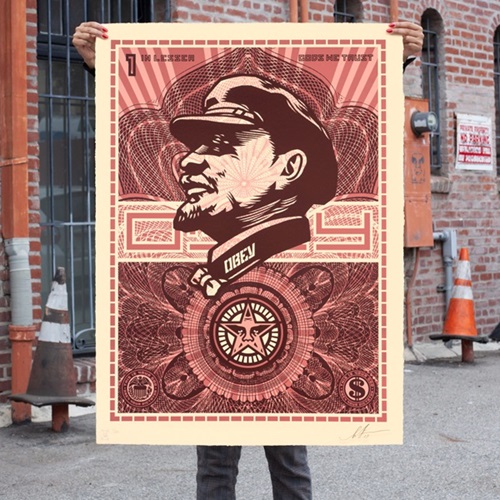
Hammer suits collectors who appreciate the art-historical depth behind Fairey's iconography, especially his debts to Constructivism and Social Realist propaganda. The arrows, exclamation marks, and hammer-and-ribbon make it a visually dense, propaganda-styled 30 x 41 inch piece that holds a wall with authority. It pairs directly with the Fist print as a companion Obey-icon work and complements the currency series within the 2019 large-format group. For buyers who enjoy decoding sources and the embedded "Andre the Giant Has a Posse" references, it offers strong interpretive appeal. The small first edition of 89, signed and numbered with a certificate of authenticity, reinforces its standing for collectors who value scarcity alongside conceptual richness.
Historical Context
Hammer foregrounds the historical roots of Fairey's visual language, drawing on Russian Constructivism and Social Realist propaganda while incorporating the Obey Star he created in 1996 from a Soviet-flag motif. The embedded "Andre the Giant Has a Posse" measurements connect the work back to the 1989-era origins of his sticker campaign, while the 2019 large-format edition situates it in the thirtieth-anniversary "Facing the Giant: Three Decades of Dissent" period. By openly repurposing communist propaganda imagery to compete with advertising for attention, the print encapsulates Fairey's long-standing strategy of turning the tools of mass persuasion against themselves, making it a clear statement of method within his mature catalog.
FAQ
What historical sources inform the Hammer print?
The arrows and exclamation marks reference Russian Constructivism, and the hammer and ribbon are inspired by Social Realist propaganda posters. Fairey repurposes these revolutionary design traditions within his own Obey-iconography composition.
What is the Obey Star and when did it originate?
The Obey Star is Fairey's icon that borrows from the Soviet flag, which the release states he created in 1996. It appears here alongside references to his "Andre the Giant Has a Posse" campaign.
What is the edition size and format?
It is a numbered first edition of 89, signed by Shepard Fairey with a certificate of authenticity. The large-format serigraph measures 30 x 41 inches on Coventry Rag 100% cotton archival paper with hand-deckled edges, published by Obey Giant in 2019.
Why does Fairey use communist imagery?
Per the description, in an urban landscape covered with advertising, Fairey chose imagery associated with communism to steal the viewer's attention, repurposing the visual force of propaganda to make his own work stand out.
Related Works

About the Artist

Shepard Fairey (b. 1970, Charleston, South Carolina) is an American street artist, graphic designer, and activist, and a graduate of the Rhode Island School of Design. His 1989 “André the Giant Has a Posse” sticker grew into the global OBEY GIANT campaign — an ongoing experiment in propaganda, obedience, and visual culture. He reached worldwide recognition with the 2008 “Hope” portrait of Barack Obama, now held by the Smithsonian National Portrait Gallery. Across screen prints, stencils, murals, and collage, Fairey channels propaganda aesthetics toward themes of peace, justice, environmentalism, and civil rights. His work is in the collections of the Museum of Modern Art, the Victoria & Albert Museum, and LACMA.