Gauntlet Gallery
What is Shepard Fairey’s piece called “Voting Rights Are Human Rights MKE Mural”?
Artist Statement
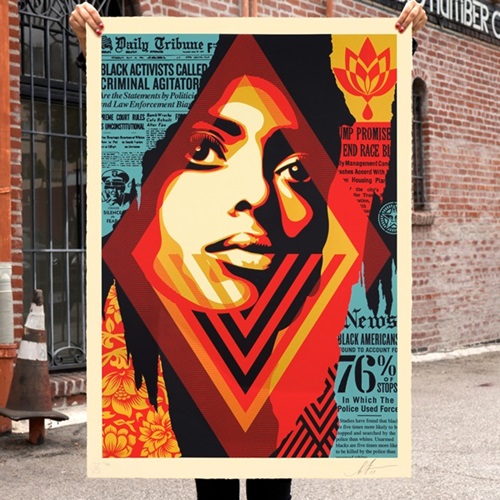
I wanted to remind people how important it is to assert their right to vote when I created this mural in Milwaukee last summer. The inspiration behind "Voting Rights are Human Rights" is the striking image of an anonymous civil rights marcher photographed by Steve Schapiro from the early 1960's. I felt that this subject is emblematic of the ongoing fight.? ? It was important to me that I wasn't the only voice in this piece. I feel fortunate that fellow artists Tyanna Buie, Niki Johnson, Tom Jones, Claudio Martinez, and Dyani Whitehawk, were open to being included in the mural to demonstrate the need for voting rights and racial and social justice! I hope that people will look at this mural and remind themselves that their voice matters in shaping the future. Thanks again to Wallpapered City, Black Box Fund, and the Milwaukee Bucks for the support on this project! A poster of this mural drops this Thursday, January 14th, on my site: store.obeygiant.com. A portion of the proceeds goes to Souls to the Polls!? -Shepard? ? Voting Rights are Human Rights MKE Mural. 24 x 18 inches. Screen print on thick cream Speckletone paper. Original photo by Jonathan Furlong. Signed by Shepard Fairey. Numbered edition of 550. $65
Summary
Voting Rights Are Human Rights MKE Mural is a 2021 screen print by Shepard Fairey documenting a mural he created in Milwaukee. The image is based on a striking photograph of an anonymous civil rights marcher from the early 1960s, presented as emblematic of an ongoing fight. Printed on thick cream Speckletone paper at 24 x 18 inches, it was published by Obey Giant in a numbered edition of 550, signed by Shepard Fairey. The collaborative mural included fellow artists, and a portion of proceeds went to Souls to the Polls. It released January 14, 2021 at $65.
Why It Matters
This print captures a moment where Fairey's studio practice and public mural work intersect with active civic organizing. The source image, an anonymous early-1960s civil rights marcher, deliberately links the historic voting-rights struggle to present-day efforts, framing the right to vote as a continuous human-rights fight rather than a settled issue. What distinguishes the Milwaukee mural is its explicitly collaborative origin: Fairey names fellow artists who joined the project, emphasizing that he was not the only voice in the work. That collaborative, place-specific dimension makes the print a record of a real public artwork tied to a 2020 election-season context and to Milwaukee's community partners. The donation of proceeds to Souls to the Polls grounds it in concrete civic action. For collectors, the piece functions both as a standalone graphic statement and as documentation of public art, bridging Fairey's gallery-edition output with his street and mural practice. Its tight edition of 550 and dual themes of civil rights and democracy place it squarely within his most consistent and historically resonant subject area, where the visual language of protest photography meets his bold screen-printed style.
Collector Perspective
This draws collectors focused on Fairey's political and civil-rights work, as well as those interested in public murals and their documentation. The print preserves a specific Milwaukee mural and its collaborative roots, giving it appeal to buyers who value place and process alongside imagery. At 24 x 18 inches it is a manageable, framable size that pairs well with other voting-rights and justice pieces in a themed grouping. The civil-rights marcher image, drawn from early-1960s protest photography, gives it gravity and a documentary feel that displays strongly. With an edition of 550 and an accessible original price, it fits collections built around Fairey's democracy and activism output, and its charitable tie to Souls to the Polls adds a values-driven dimension many of these collectors appreciate.
Historical Context
This 2021 release belongs to the dense run of civil-rights and democracy prints Fairey produced around the 2020 election cycle and its aftermath. It documents a Milwaukee mural made the prior summer, situating it in his ongoing practice of translating public works into signed editions. By basing the image on an early-1960s civil-rights marcher, Fairey explicitly connects the historic movement to contemporary voting-rights battles, a recurring strategy in his work of this period. The collaborative mural and partnerships with local organizations reflect his increasing emphasis on community and shared authorship rather than solo authorship. It sits comfortably among his other justice-themed editions of 2020 and 2021, reinforcing voting rights as one of the central, repeated concerns of his catalog in these years.
FAQ
What does this print depict?
It depicts an anonymous civil rights marcher based on a striking photograph from the early 1960s, which Fairey describes as emblematic of the ongoing fight for voting rights. It documents a mural he created in Milwaukee the previous summer.
Was this a collaborative work?
Yes. Fairey states he wanted more than one voice in the piece and names fellow artists Tyanna Buie, Niki Johnson, Tom Jones, Claudio Martinez, and Dyani Whitehawk as participants in the Milwaukee mural demonstrating the need for voting rights and racial and social justice.
What are the edition and size details?
It is a screen print on thick cream Speckletone paper measuring 24 x 18 inches, published by Obey Giant in a numbered edition of 550 and signed by Shepard Fairey. It released on January 14, 2021 at $65.
Did proceeds support a cause?
According to the source, a portion of the proceeds goes to Souls to the Polls, an organization supporting voter participation.
Related Works
About the Artist
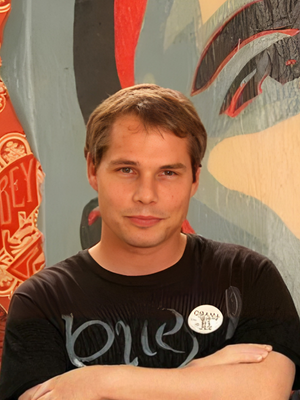
Shepard Fairey (b. 1970, Charleston, South Carolina) is an American street artist, graphic designer, and activist, and a graduate of the Rhode Island School of Design. His 1989 “André the Giant Has a Posse” sticker grew into the global OBEY GIANT campaign — an ongoing experiment in propaganda, obedience, and visual culture. He reached worldwide recognition with the 2008 “Hope” portrait of Barack Obama, now held by the Smithsonian National Portrait Gallery. Across screen prints, stencils, murals, and collage, Fairey channels propaganda aesthetics toward themes of peace, justice, environmentalism, and civil rights. His work is in the collections of the Museum of Modern Art, the Victoria & Albert Museum, and LACMA.