Gauntlet Gallery
What is Shepard Fairey’s piece called “The Future Is Unwritten Collage”?
Artist Statement
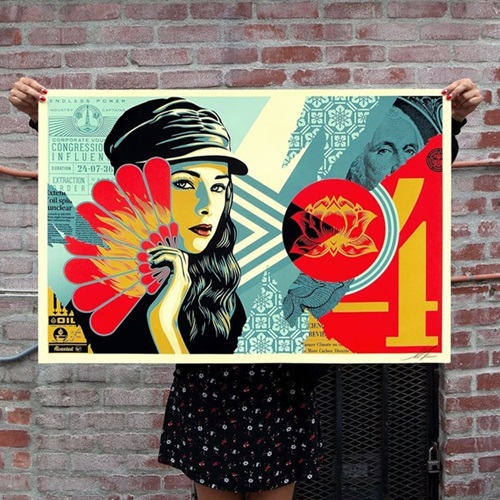
The Future is Unwritten Collage, 2021; screen print on 80 LB cream French Speckletone paper; 18 x 24 inches The Future is Unwritten Collage uses the aesthetics of a wall of ripped posters to symbolize the complex collisions and layers of ideologies that will shape the world's future. Climate change, corporate power over politics and the erosion of democracy versus environmental responsibility and the cultivation of peace, harmony and equality—we have important choices to make about what we value and what we want our world to be like.
Summary
The Future Is Unwritten Collage is a 2021 screen print by Shepard Fairey, published by RISD. It is an 18 x 24 inch screen print on 80 LB cream French Speckletone paper, issued in a first edition of 300. The source describes the image as using the aesthetics of a wall of ripped posters to symbolize the colliding, layered ideologies that will shape the world's future, weighing climate change, corporate power over politics and the erosion of democracy against environmental responsibility and the cultivation of peace, harmony and equality. The collage motif frames a choice about what humanity values and what kind of world it wants.
Why It Matters
This print stands out for its collage construction, in which Fairey layers torn-poster aesthetics to visualize competing ideologies, a more conceptual approach than his single-image propaganda posters. The source frames it as a meditation on consequential choices: climate change, corporate influence over politics and democratic erosion set against environmental responsibility, peace and equality. That makes it a thematically dense piece that bridges his environmental and anti-corporate concerns within one image. Its publication by RISD, Fairey's alma mater, adds an institutional dimension, connecting the work to his roots in the design school where his career began. As a database entry it documents Fairey's use of the ripped-wall collage device, a recurring formal strategy that mirrors how messages physically accumulate on urban surfaces. The edition of 300 is modest, and the absence of a listed price keeps its commercial framing open. For collectors, it matters as a layered, idea-driven work that ties together several of Fairey's central themes while showcasing his collage technique.
Collector Perspective
This appeals to collectors who value Fairey's more conceptual, collage-based work and the layered street-poster aesthetic over straightforward single-image posters. The dense composition rewards close viewing and suits display in spaces where its themes of climate, democracy and corporate power can be appreciated. The RISD publication adds appeal for those interested in Fairey's design-school roots. With a first edition of 300, it is a relatively limited release; the source lists no price, so collectors should treat market value as undetermined. It fits collections organized around environmental and anti-corporate themes, and pairs with related democracy- and power-focused prints to build a thematic grouping.
Historical Context
The Future Is Unwritten Collage sits within Fairey's contemporary, environmentally and politically engaged period, and its RISD publication links it back to the Rhode Island School of Design where his career took shape. The ripped-poster collage device it employs echoes the accumulation of messages on street surfaces that informed his early work, here adapted into a finished editioned print. Thematically it bridges his environmental concerns with his critiques of corporate power and democratic erosion, combining multiple long-running threads of his practice in a single image. Within Fairey's arc, the work shows how he continued to layer collage aesthetics and pointed political content into the early 2020s, using an institutional collaboration to frame a meditation on the choices shaping the future.
FAQ
What does the collage imagery represent?
The source says the print uses the aesthetics of a wall of ripped posters to symbolize the complex collisions and layers of ideologies that will shape the world's future, weighing climate change, corporate power and democratic erosion against environmental responsibility, peace, harmony and equality.
Who published this print?
According to the source, it was published by RISD, the Rhode Island School of Design. The institutional publication connects the work to Fairey's design-school background.
What are the print's specifications?
It is an 18 x 24 inch screen print on 80 LB cream French Speckletone paper, dated 2021 and issued as a first edition of 300. The source does not list a release price.
What themes does the print address?
It addresses climate change, corporate power over politics and the erosion of democracy, contrasted with environmental responsibility and the cultivation of peace, harmony and equality. The source frames it around the choices humanity must make about what it values.
Related Works

About the Artist

Shepard Fairey (b. 1970, Charleston, South Carolina) is an American street artist, graphic designer, and activist, and a graduate of the Rhode Island School of Design. His 1989 “André the Giant Has a Posse” sticker grew into the global OBEY GIANT campaign — an ongoing experiment in propaganda, obedience, and visual culture. He reached worldwide recognition with the 2008 “Hope” portrait of Barack Obama, now held by the Smithsonian National Portrait Gallery. Across screen prints, stencils, murals, and collage, Fairey channels propaganda aesthetics toward themes of peace, justice, environmentalism, and civil rights. His work is in the collections of the Museum of Modern Art, the Victoria & Albert Museum, and LACMA.