Gauntlet Gallery
What is Shepard Fairey’s piece called “Ocean Today Desert Tomorrow”?
Artist Statement
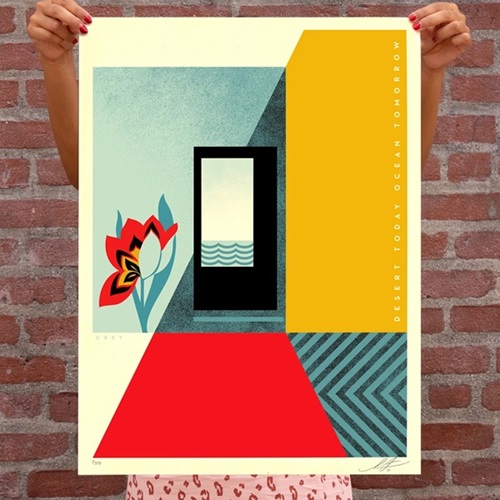
These "Desert Today Ocean Tomorrow" and "Ocean Today Desert Tomorrow" prints are inspired by the tranquil view and angled shadows looking from the courtyard of Georgia O'Keeffe's studio through to the surrounding New Mexico desert. However, I replaced the desert with a flood on the horizon in these prints. There is beauty in the ways people adapt to live in demanding terrain, whether it be in proximity to oceans or deserts. Even though people are remarkably adaptive, the unpredictable impacts of climate change mean that many of those adaptive measures are not suited to protect from unexpected droughts, floods, and temperature swings. We have the means to adapt to the use of more renewable energy sources, which will mitigate climate change and be much less costly and chaotic than adapting to rising sea levels and rising temperatures. Let's evolve and embrace the adaptive measures that make the most sense rather than burying our heads in the sand. A portion of the proceeds from this print will benefit Greenpeace to support its work to enhance environmental protections and combat climate change. – Shepard Desert Today Ocean Tomorrow & Ocean Today Desert Tomorrow. 18 x 24 inches. Screen print on thick cream Speckletone paper. Signed by Shepard Fairey. Numbered edition of 375. A limited amount of matching numbered sets will be available for $110. Sold separately for $55.
Summary
Ocean Today Desert Tomorrow is a 2022 Shepard Fairey screen print, 18 x 24 inches on thick cream Speckletone paper, signed and numbered in an edition of 375 and published by Obey Giant. Priced at $55, it is one of a pair with Desert Today Ocean Tomorrow; matching numbered sets were offered at $110. The image is inspired by the view from Georgia O'Keeffe's New Mexico studio courtyard, but Fairey replaces the desert with a flood on the horizon to evoke climate-driven change. He argues that human adaptation cannot keep pace with unpredictable droughts, floods, and temperature swings, and urges a shift to renewable energy. A portion of proceeds benefits Greenpeace.
Why It Matters
Ocean Today Desert Tomorrow pairs landscape beauty with a pointed climate warning, a combination that defines much of Fairey's environmental work. Drawing on the tranquil view from Georgia O'Keeffe's New Mexico studio, he subverts the scene by inserting a flood on the horizon, dramatizing how quickly stable terrain could be transformed by climate change. Fairey's accompanying statement makes the argument explicit: human adaptation is remarkable but cannot reliably protect against sudden droughts, floods, and temperature swings, so a shift to renewable energy is the wiser, less chaotic path. The print is one half of a deliberately paired set with Desert Today Ocean Tomorrow, the two titles mirroring each other and rewarding collectors who acquire both. The O'Keeffe reference adds art-historical resonance unusual in a climate poster, broadening its appeal beyond activism. With a contained edition of 375 and a Greenpeace benefit, it aligns message and object in the way collectors of his cause-driven prints expect. As a signed, numbered screen print on his signature Speckletone stock, it serves as an accessible, thoughtful entry in his environmental catalog.
Collector Perspective
This print appeals to collectors of Fairey's environmental and landscape-based work, and especially to those who like to acquire matched pairs, since it is designed as a companion to Desert Today Ocean Tomorrow. The O'Keeffe-inspired scene gives it broader art-historical appeal and makes it a calmer, more painterly display piece than his slogan-driven posters. At 375 signed and numbered impressions and an accessible original price, it is attainable for newer collectors, while the Greenpeace association adds cause-minded appeal. It fits a themed grouping of his climate prints or a paired display with its companion title.
Historical Context
Ocean Today Desert Tomorrow belongs to Fairey's early-2020s run of environmental prints tied to Greenpeace and printed on sustainable cream Speckletone paper. Released in April 2022 as part of a deliberate pair, it reflects his interest in landscape imagery as a vehicle for climate argument, here referencing Georgia O'Keeffe's New Mexico setting. Within his arc, the work shows the mature artist blending art-historical homage with activist messaging, using paired editions to underscore the theme of shifting, unstable environments driven by climate change.
FAQ
What inspired Ocean Today Desert Tomorrow?
It is inspired by the tranquil view and angled shadows from Georgia O'Keeffe's New Mexico studio courtyard. Fairey replaced the desert with a flood on the horizon to dramatize how climate change could transform stable terrain.
Is this print part of a set?
Yes. It is one of a pair with Desert Today Ocean Tomorrow, the two titles mirroring each other. A limited number of matching numbered sets were offered for $110, while each print sold separately for $55.
What is the edition size and cause?
The print is a numbered edition of 375, signed by Shepard Fairey and published by Obey Giant in 2022. A portion of the proceeds benefits Greenpeace to support environmental protection and climate work.
What are the dimensions and medium?
The print measures 18 x 24 inches and is a screen print on thick cream Speckletone paper, hand-signed and numbered from an edition of 375.
Related Works
About the Artist
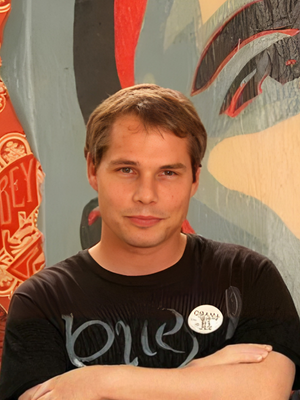
Shepard Fairey (b. 1970, Charleston, South Carolina) is an American street artist, graphic designer, and activist, and a graduate of the Rhode Island School of Design. His 1989 “André the Giant Has a Posse” sticker grew into the global OBEY GIANT campaign — an ongoing experiment in propaganda, obedience, and visual culture. He reached worldwide recognition with the 2008 “Hope” portrait of Barack Obama, now held by the Smithsonian National Portrait Gallery. Across screen prints, stencils, murals, and collage, Fairey channels propaganda aesthetics toward themes of peace, justice, environmentalism, and civil rights. His work is in the collections of the Museum of Modern Art, the Victoria & Albert Museum, and LACMA.