Gauntlet Gallery
What is Shepard Fairey’s piece called “Lennon Peace And Liberty (Blue)”?
Artist Statement
John Lennon is a hero of mine for his incredible music and activism. Lennon wrote many powerful songs with the Beatles, including "Revolution," "Happiness is a Warm Gun," "Come Together," "Dear Prudence," and "All You Need is Love." However, Lennon did some of his most potent and brave work as a solo artist. Listen to the lyrics of "Imagine," "Gimme Some Truth," "Instant Karma," "Give Peace a Chance," "Power To The People," or "Happy Christmas (War is Over)" demonstrate a profound reflection on the struggles of humanity. Those songs were amazing statements, and Lennon and Yoko Ono funded campaigns like WAR IS OVER to promote peace and end the Vietnam War. John and Yoko were persecuted for their politics, and the U.S. government under Nixon made several attempts to deport Lennon. Understanding that context, Bob Gruen's photo of John Lennon in front of the Statue of Liberty is extremely compelling. Lennon was a world citizen and an advocate of peace and liberty. The Statue of Liberty also symbolizes welcoming immigrants to the United States, so the idea of deporting Lennon is especially disturbing juxtaposed with the statue. I have loved Bob Gruen's photos since I was a teenager because he shot incredible pics of the Sex Pistols and the Clash. His body of work has amazing range, and his photos often document critical players and cultural moments. I'm honored to collaborate with Bob on these Lennon prints. –Shepard The US government, under the direction of President Richard Nixon, perceived John Lennon as a political threat because he was talking of peace in a time of war. They moved to have him deported from the country. I personally felt that was wrong and seeing the Statue of Liberty as a symbol of welcome to the United States, I felt that if we took a picture of John Lennon at the Statue of Liberty it would help dramatize his case for staying in the country. I suggested to John that we take a picture in front of the Statue and I was thrilled when he agreed. I think this photo is popular now because people relate to John Lennon as a symbol of personal freedom similar to the way people feel about the Statue of Liberty. –Bob Gruen Lennon Peace and Liberty (Two Colorways: Blue & Red). 18 x 24 inches. Screen print on thick cream Speckletone paper. Original Illustration based on a photograph by Bob Gruen. Signed by Shepard Fairey and Bob Gruen. Numbered edition of 300. Comes with a Digital Certificate of Authenticity provided by Verisart. A limited amount of matching numbered sets will be available for $170. Sold separately for $85.
Summary
Lennon Peace And Liberty (Blue) is a 2023 Obey Giant screen print, 18 x 24 inches on thick cream Speckletone paper, in a numbered edition of 300. The blue colorway is one of two (Blue and Red). The image is an original illustration based on Bob Gruen's photograph of John Lennon standing in front of the Statue of Liberty, a collaboration between Fairey and Gruen and signed by both. It pairs Lennon as a figure of personal freedom with the Statue of Liberty as a symbol of welcome, framing Lennon as an advocate of peace and liberty in a graphic portrait composition.
Why It Matters
This print sits at the intersection of music, activism, and Fairey's long practice of collaborating with celebrated photographers. The source frames Lennon as a hero for both his Beatles and solo work and for funding peace campaigns such as WAR IS OVER with Yoko Ono. Bob Gruen's accompanying note explains that the Statue of Liberty photo was conceived to dramatize Lennon's fight against deportation under the Nixon administration, making the image a layered statement about freedom and welcome to immigrants. For collectors, the appeal is the union of a recognizable cultural icon with a documentary photograph by a photographer known for shooting the Sex Pistols and the Clash. The work signed by both Fairey and Gruen adds collaborative weight, and the relatively small edition of 300 distinguishes it from Fairey's larger editions. It rewards buyers who value the music-meets-politics thread in Fairey's catalog and the dialogue between his graphic illustration style and Gruen's source photograph. Its themes of peace, liberty, and the rights of the persecuted give it resonance beyond simple portraiture, anchoring it firmly in Fairey's collaboration and pop-culture lineage.
Collector Perspective
This appeals to collectors who focus on music and counterculture, Lennon and Beatles fans, and admirers of Bob Gruen's rock photography. The dual signatures from Fairey and Gruen and the comparatively small edition of 300 make it attractive to those who prioritize collaboration prints and lower edition counts. At an 18 x 24 inch scale on cream Speckletone paper, it displays well in a music room, study, or gallery wall alongside other portrait and peace-themed works. The Blue colorway gives collectors a choice against the Red edition, and matching numbered sets were offered, which appeals to completists. It fits naturally into a collection organized around Fairey's musician portraits and his collaborations, sitting comfortably next to other peace-and-liberty themed pieces.
Historical Context
The print belongs to Fairey's mature collaboration phase, in which he partnered with established photographers to reinterpret iconic images of cultural and political figures. The Lennon subject connects to Fairey's recurring engagement with musicians who used their platform for activism. The source ties the imagery to historical context: Lennon's solo-era peace songs, the WAR IS OVER campaign with Yoko Ono funded during the Vietnam War, and the Nixon administration's attempts to deport him. By recreating Gruen's Statue of Liberty photograph as a graphic illustration, Fairey continues his practice of translating documentary photography into bold, signature-style portraiture. Within his broader arc, it reinforces the throughline linking music, personal freedom, and resistance to state overreach that runs across many of his celebrity and activist portraits.
FAQ
What is the edition size of this print?
Lennon Peace And Liberty (Blue) is a numbered edition of 300, according to the source. It is one of two colorways, the other being Red. It comes with a Digital Certificate of Authenticity provided by Verisart and is signed by both Shepard Fairey and Bob Gruen.
Who took the original photograph?
The print is an original illustration based on a photograph by Bob Gruen of John Lennon in front of the Statue of Liberty. Gruen explains in the source that the photo was conceived to dramatize Lennon's case for staying in the United States. Fairey collaborated directly with Gruen on the prints.
What are the dimensions and materials?
The print measures 18 x 24 inches and is a screen print on thick cream Speckletone paper, as stated in the source. Its original release price was $85, with matching numbered sets of the Blue and Red colorways offered separately at $170.
Why the Statue of Liberty?
Per the source, Gruen suggested photographing Lennon at the Statue of Liberty because the statue symbolizes welcome to immigrants, making the Nixon administration's deportation attempts especially jarring. Fairey notes Lennon was a world citizen and advocate of peace and liberty.
Related Works
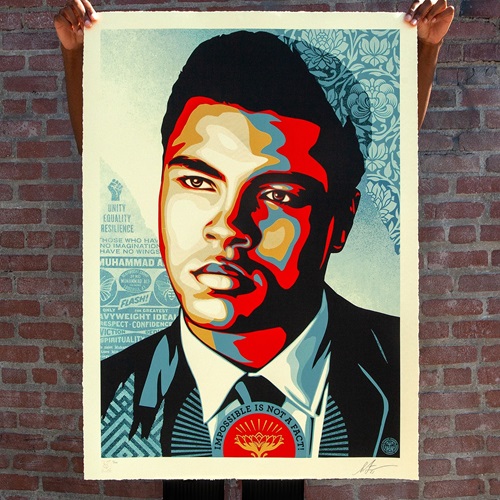
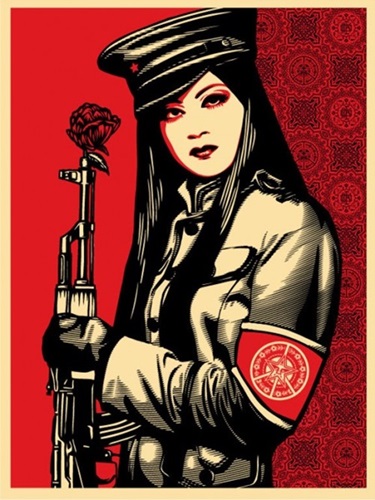
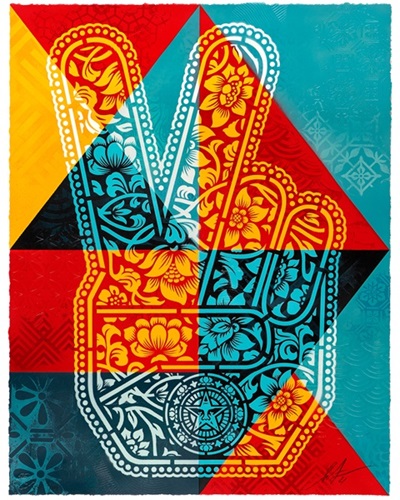
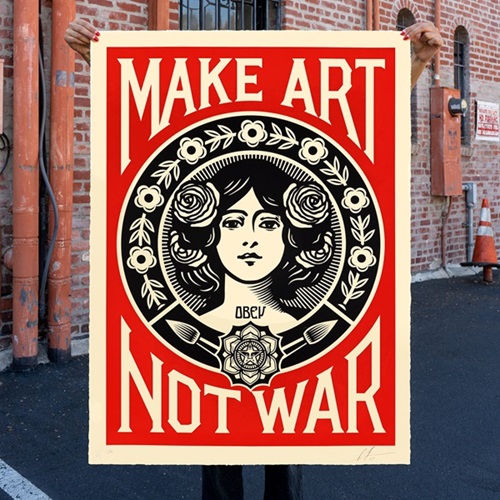
About the Artist

Shepard Fairey (b. 1970, Charleston, South Carolina) is an American street artist, graphic designer, and activist, and a graduate of the Rhode Island School of Design. His 1989 “André the Giant Has a Posse” sticker grew into the global OBEY GIANT campaign — an ongoing experiment in propaganda, obedience, and visual culture. He reached worldwide recognition with the 2008 “Hope” portrait of Barack Obama, now held by the Smithsonian National Portrait Gallery. Across screen prints, stencils, murals, and collage, Fairey channels propaganda aesthetics toward themes of peace, justice, environmentalism, and civil rights. His work is in the collections of the Museum of Modern Art, the Victoria & Albert Museum, and LACMA.