Gauntlet Gallery
What is Shepard Fairey’s piece called “Overloading The Grid (David Byrne)”?
Artist Statement
I've been a fan of the Talking Heads since I was a kid and heard songs like "Once in A Lifetime" and "Burning Down the House" on the radio, well before I discovered punk rock and understood the Talking Heads' important role in the nascent punk scene as it developed in NYC at CBGB's in the mid-70's. I remember seeing the film Stop Making Sense on HBO as a teen and thinking the Talking Heads singer, David Byrne, was very weird and very fearless to dance around in an absurdly oversized suit. I didn't yet realize that exploring the awkward nature of existence was precisely Byrne's strong suit! Later, as I got a little more sophisticated, I realized how creatively adventurous the Talking Heads were both musically and with their visuals. I also was excited to find that David, Tina, and Chris all met at the Rhode Island School of Design, the same art college I attended. For this "Overloading the Grid" (David Byrne) print, I collaborated with photographer Bobby Grossman who worked with the Talking Heads in the 70's. Bobby is also who I've collaborated with on three different Debbie Harry images. My inspiration for the grid in the print is the cover of the Talking Heads' album "More Songs About Buildings and Food" whose cover conceived by Byrne uses a grid of close-up Polaroids to form a full picture of the band. I've always loved the fractured, imperfect mosaic of that cover. I also like the idea that David Byrne, as a creative visionary, found powerful tension between appealing melody, unexpected sonic explorations, and provocative lyrics. There are so many creative layers to the Talking Heads that they easily overload the grid. Thanks to David and the rest of the Talking Heads for your innovation! A portion of the proceeds from this print will support the ACLU and their mission to protect voting rights and other crucial rights. -Shepard Overloading the Grid (David Byrne). 18 x 24 inches. Screen print on thick cream Speckletone paper. Original illustration based on photograph by Bobby Grossman. Signed by Shepard Fairey. Numbered edition of 550. Comes with a Digital Certificate of Authenticity provided by Verisart. $80.
Summary
Overloading The Grid (David Byrne) is a 2024 Shepard Fairey screen print, 18 x 24 inches, printed on thick cream Speckletone paper in a numbered edition of 550. The portrait of Talking Heads frontman David Byrne is built from a grid composition inspired by the band's album cover for More Songs About Buildings and Food, which used a mosaic of close-up Polaroids. Fairey created the original illustration based on a photograph by Bobby Grossman, who worked with the Talking Heads in the 1970s. The print is signed by Fairey and comes with a Verisart Digital Certificate of Authenticity.
Why It Matters
This print sits at the intersection of Fairey's two enduring passions: music and graphic design rooted in his RISD education, the same school Byrne, Tina Weymouth, and Chris Frantz attended. Rather than a straight portrait, Fairey adopts the fractured grid concept Byrne himself devised for a Talking Heads album cover, turning the formal device into a metaphor for the band's many creative layers. The collaboration with photographer Bobby Grossman, who documented the Talking Heads in the 1970s and previously supplied Fairey with Debbie Harry source images, grounds the work in authentic CBGB-era source material and connects it to Fairey's wider portrait-of-musicians practice. For collectors, the David Byrne subject carries broad recognition across punk, new wave, and art-school audiences, while the edition of 550 keeps it relatively available. A portion of proceeds supports the ACLU's work protecting voting and other rights, extending Fairey's habit of pairing cultural homage with civic causes. The piece is a strong example of how Fairey translates personal fandom and design history into a collectible music portrait.
Collector Perspective
This appeals to music collectors and fans of Talking Heads, punk, and new wave, as well as design-minded buyers who appreciate the grid concept borrowed from the band's own album art. The 18 x 24 vertical format displays well alongside other Fairey musician portraits and record-cover-adjacent pieces. At the released price and an edition of 550, it is an accessible signed screen print suited to building a music-themed wall. The Bobby Grossman photographic source and RISD connection give it provenance and a story that resonates with collectors who value the link between Fairey and the artists he depicts. It fits naturally into a music-portrait collection group.
Historical Context
Overloading The Grid extends Fairey's deep catalog of musician portraits, a thread that runs throughout his career and overlaps with his own roots in punk and skate culture. The work reflects his RISD background and his recurring collaborations with photographer Bobby Grossman, who connects him to the 1970s CBGB scene. Released in April 2024, it belongs to Fairey's Modern Activism period in terms of its release model, with Verisart authentication and an ACLU proceeds tie-in, while artistically it continues his music homage tradition. The grid borrowed from Byrne's album design shows Fairey engaging directly with music-design history rather than simply illustrating a famous face.
FAQ
Who is depicted and who took the source photo?
The print depicts David Byrne of Talking Heads. Fairey created an original illustration based on a photograph by Bobby Grossman, who worked with the Talking Heads in the 1970s and previously supplied source images for Fairey's Debbie Harry prints.
What inspired the grid composition?
Fairey based the grid on the cover of Talking Heads' album More Songs About Buildings and Food, conceived by Byrne, which used a grid of close-up Polaroids to form a picture of the band. Fairey calls it a fractured, imperfect mosaic.
What is the edition size and medium?
It is a screen print on thick cream Speckletone paper, 18 x 24 inches, signed by Fairey in a numbered edition of 550. It comes with a Digital Certificate of Authenticity provided by Verisart.
Does it support a cause?
Yes. According to the source, a portion of proceeds supports the ACLU and its mission to protect voting rights and other crucial rights.
Related Works
About the Artist
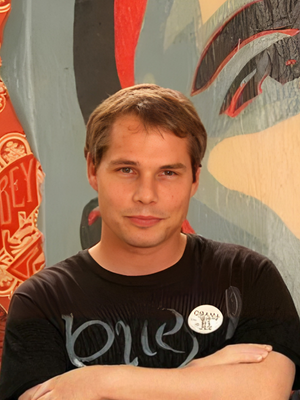
Shepard Fairey (b. 1970, Charleston, South Carolina) is an American street artist, graphic designer, and activist, and a graduate of the Rhode Island School of Design. His 1989 “André the Giant Has a Posse” sticker grew into the global OBEY GIANT campaign — an ongoing experiment in propaganda, obedience, and visual culture. He reached worldwide recognition with the 2008 “Hope” portrait of Barack Obama, now held by the Smithsonian National Portrait Gallery. Across screen prints, stencils, murals, and collage, Fairey channels propaganda aesthetics toward themes of peace, justice, environmentalism, and civil rights. His work is in the collections of the Museum of Modern Art, the Victoria & Albert Museum, and LACMA.