Gauntlet Gallery
What is Shepard Fairey’s piece called “Obey Deco Floral Pattern (Red)”?
Artist Statement
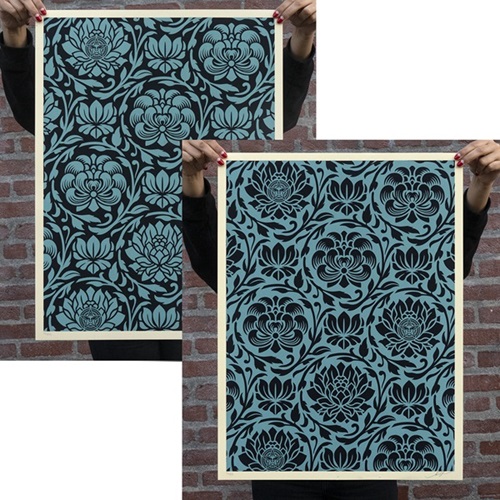
I have enjoyed designing wallpaper patterns for about 20 years. They began as a way to add a pleasing decorative element to my fine art pieces as well as a device to use in my large scale modular street installations that would serve as a rhythmic break between grids of smaller posters and larger scale images. As I became better at designing patterns my goal became to make a pleasing stand-alone image for each tile of the wallpaper grid, but also to make sure the repeating pattern worked well. I'm a big fan of early Art Deco which retained some of the curves of the Art Nouveau style but evolved it to be more simple and structured… it's from this era of Art Deco that this pattern takes its inspiration. -Shepard PRINT DETAILS: Obey Deco Floral Pattern (Red) & Obey Deco Floral Pattern (Blue). 18 x 24 inches. Screen print on thick cream Speckletone paper. Signed by Shepard Fairey. Numbered edition of 275. Comes with a Digital Certificate of Authenticity provided by Verisart. A limited amount of matching numbered sets will be available for $100. Sold separately for $50.
Summary
Obey Deco Floral Pattern is a 2024 Shepard Fairey screen print, 18 x 24 inches, printed on thick cream Speckletone paper in a numbered edition of 275 per colorway, with Red and Blue editions released. The work is a decorative wallpaper-style floral pattern that Fairey drew from early Art Deco, a style he describes as retaining some of the curves of Art Nouveau while evolving toward simpler, more structured forms. It reflects roughly two decades of his pattern design, used both in fine-art pieces and large-scale modular street installations. Signed by Fairey, the print includes a Verisart Digital Certificate of Authenticity, with matching numbered sets offered separately.
Why It Matters
This print spotlights an under-appreciated but central part of Fairey's practice: pattern design. He explains that he has designed wallpaper patterns for about twenty years, first as decorative elements within his fine-art work and as rhythmic breaks between grids of posters in his modular street installations, then increasingly as standalone tile images. Obey Deco Floral Pattern is the culmination of that craft, a piece meant to read both as a single pleasing image and as a repeating system. Its grounding in early Art Deco, balancing Art Nouveau curves with structured simplicity, gives it a clear design lineage and broad decorative appeal that extends beyond Fairey's political collectors. The numbered edition of 275 per colorway, with Red and Blue options and matching-set availability, makes it attractive both to set-completist collectors and to those who want a non-political, design-forward Fairey work. For a collection, it offers contrast to the artist's protest pieces while still carrying his signature aesthetic and authentication, documenting the decorative dimension of his Obey Giant output.
Collector Perspective
This appeals to collectors who appreciate Fairey's decorative and design-driven work rather than his overt political imagery, as well as interior-minded buyers seeking pattern-based art. The Red and Blue colorways and the option of matching numbered sets invite set collecting and paired display. At 18 x 24 inches with an edition of 275 per color, it is an accessible, versatile piece that complements both Fairey-heavy walls and more general design interiors. The early Art Deco inspiration gives it a timeless, ornamental quality that suits collectors who want a signed, authenticated Fairey work that leans aesthetic over political. It fits well in a pattern- or floral-oriented grouping.
Historical Context
Obey Deco Floral Pattern reflects roughly twenty years of Fairey's wallpaper and pattern design, a practice that originated as decorative support within his fine-art pieces and as connective rhythm in his large-scale modular street installations. Over time these patterns evolved into standalone images, and this 2024 print represents that maturation. Released in April 2024 with Verisart authentication, it sits in his Modern Activism-era release model while artistically belonging to his ongoing decorative-pattern lineage. The early Art Deco source ties it to a specific design-history reference point and shows Fairey working in a purely aesthetic register alongside his more message-driven editions.
FAQ
What is the edition size of Obey Deco Floral Pattern?
Each colorway is a numbered edition of 275. Both a Red and a Blue edition were released, signed by Fairey and accompanied by a Digital Certificate of Authenticity from Verisart. Matching numbered sets were offered separately.
What inspired the pattern?
Fairey drew on early Art Deco, which he describes as retaining some of the curves of Art Nouveau while evolving toward a simpler, more structured style. The print reflects roughly twenty years of his wallpaper pattern design.
What are the size and medium?
It is a screen print on thick cream Speckletone paper, measuring 18 x 24 inches. It was released in two colorways, Red and Blue, each in a numbered edition of 275.
How does this relate to Fairey's street work?
Fairey notes he developed such patterns partly as rhythmic breaks between grids of smaller posters and larger images in his large-scale modular street installations, later refining them into standalone tile images.
Related Works
About the Artist

Shepard Fairey (b. 1970, Charleston, South Carolina) is an American street artist, graphic designer, and activist, and a graduate of the Rhode Island School of Design. His 1989 “André the Giant Has a Posse” sticker grew into the global OBEY GIANT campaign — an ongoing experiment in propaganda, obedience, and visual culture. He reached worldwide recognition with the 2008 “Hope” portrait of Barack Obama, now held by the Smithsonian National Portrait Gallery. Across screen prints, stencils, murals, and collage, Fairey channels propaganda aesthetics toward themes of peace, justice, environmentalism, and civil rights. His work is in the collections of the Museum of Modern Art, the Victoria & Albert Museum, and LACMA.