Gauntlet Gallery
What is Shepard Fairey’s piece called “Chaos Mandala”?
Artist Statement
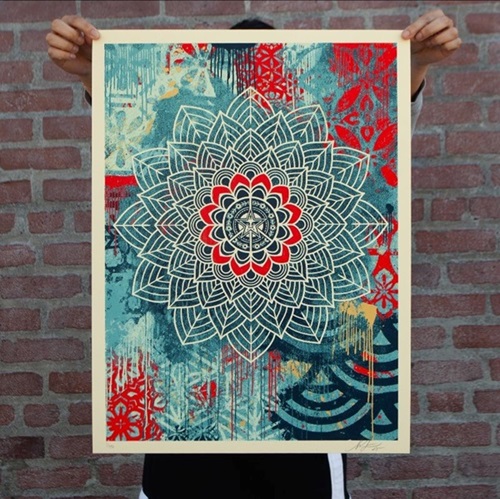
This Chaos Mandala print merges two seemingly contrasting concepts and aesthetics…chaos and harmony. I have always been fascinated by the cyclical chaos of posters and graffiti accumulating on the streets and then being ripped at by humans and the elements. There is beauty in the layering and in accepting that there are too many variables of push and pull for any of us to control them all. For me, the philosophy to embrace is "enjoy the ride and savor the ephemeral". In my backgrounds I'm often trying to replicate in my studio the charm of the layering and chaos one finds on the streets but using my own patterns and collage. Mandalas on the other hand are symbols of harmony, wholeness, and the universe in its ideal form. Chaos and harmony might seem hard to reconcile, but Buddhist monks poetically address the paradox of striving for harmony but accepting impermanence and destruction with their rituals of creating and destroying elaborate sand mandalas. This Chaos Mandala print is a blend of all of these ideas. -Shepard Chaos Mandala. 18 x 24 inches. Screen print on 80# cream Speckletone paper. Signed by Shepard Fairey. Numbered edition of 550. Comes with a Digital Certificate of Authenticity provided by Verisart. $60.
Summary
Chaos Mandala is a 2025 screen print, 18 x 24 inches, on 80# cream Speckletone paper, signed and numbered in a first edition of 550 published by Obey Giant. The image merges two contrasting ideas: chaos and harmony. Fairey draws on his fascination with the cyclical accumulation and tearing of street posters and graffiti, recreating that layered street decay with his own patterns and collage backgrounds. He pairs this with the mandala, a symbol of harmony, wholeness, and the universe in ideal form, citing Buddhist monks who create and destroy sand mandalas as a model for reconciling harmony with impermanence. Priced at $60.
Why It Matters
Chaos Mandala is a clear statement of the philosophy underlying much of Fairey's recent studio work: embrace impermanence, enjoy the ride, and savor the ephemeral. By fusing the disordered, layered look of torn street posters with the centered geometry of the mandala, Fairey visualizes a reconciliation of opposites, the same push-and-pull he says is too complex for anyone to fully control. The Buddhist sand-mandala reference gives the piece a contemplative, almost spiritual frame, distinguishing it from his more overtly political editions while still carrying conceptual weight. The collaged background, built from his own patterns to mimic the charm of street accumulation, ties the work to his studio methodology and shows how he translates public-space aesthetics into controlled compositions. For collectors, the mandala motif offers a meditative, decorative subject that remains unmistakably Fairey, and its modest $60 price and edition of 550 make it accessible. It also anchors a small set, with a second colorway, Chaos Mandala 2, released the same year, rewarding collectors who pursue both.
Collector Perspective
This appeals to collectors who favor Fairey's mandala and pattern-based work and to those drawn to its meditative, symmetrical aesthetic over his more confrontational political pieces. The centered mandala composition makes a strong, calming focal point for a wall and suits contemplative or design-forward interiors. At $60 in an edition of 550, it is one of his more affordable signed screen prints, and the existence of a companion colorway, Chaos Mandala 2, invites set collecting. It fits a mandala or pattern-themed grouping and pairs naturally with related peace and collage mandala works. The signature, numbering, and Verisart certificate document it as an official Obey Giant release.
Historical Context
Chaos Mandala continues Fairey's recurring return to the mandala motif, which he uses to reflect on harmony, impermanence, and the layered chaos of the street. Released in 2025 by Obey Giant, it represents the studio side of his practice, recreating the look of accumulated, torn street posters through deliberate patterns and collage. The Buddhist sand-mandala framing situates the work within his broader interest in symbolic and meditative imagery that runs parallel to his political output. As the first of a paired release, with Chaos Mandala 2 following as a complementary colorway, it reflects his ongoing practice of issuing variant editions of resonant images, extending the reach of a motif he says he keeps coming back to.
FAQ
What does Chaos Mandala combine?
It merges two contrasting concepts: chaos and harmony. Fairey draws on the cyclical chaos of street posters and graffiti accumulating and being torn by humans and the elements, and pairs it with the mandala, a symbol of harmony, wholeness, and the universe in its ideal form.
What is the significance of the mandala motif?
Fairey notes that Buddhist monks address the paradox of striving for harmony while accepting impermanence through rituals of creating and destroying elaborate sand mandalas. The mandala is a motif he returns to in order to reflect on this balance of harmony and ephemerality.
What are the edition details?
Chaos Mandala is a screen print measuring 18 x 24 inches on 80# cream Speckletone paper, signed by Shepard Fairey and numbered in an edition of 550. Published by Obey Giant in 2025, it includes a digital Certificate of Authenticity from Verisart and was priced at $60.
Is there more than one version of this print?
Yes. A complementary colorway, Chaos Mandala 2, was released as a separate numbered edition of 550 in 2025, allowing collectors to acquire either version or pursue the set.
Related Works

About the Artist

Shepard Fairey (b. 1970, Charleston, South Carolina) is an American street artist, graphic designer, and activist, and a graduate of the Rhode Island School of Design. His 1989 “André the Giant Has a Posse” sticker grew into the global OBEY GIANT campaign — an ongoing experiment in propaganda, obedience, and visual culture. He reached worldwide recognition with the 2008 “Hope” portrait of Barack Obama, now held by the Smithsonian National Portrait Gallery. Across screen prints, stencils, murals, and collage, Fairey channels propaganda aesthetics toward themes of peace, justice, environmentalism, and civil rights. His work is in the collections of the Museum of Modern Art, the Victoria & Albert Museum, and LACMA.