Gauntlet Gallery
What is Shepard Fairey’s piece called “Stalin Cabinet”?
Artist Statement
Screen Print 18 x 24 inches Edition of 100
Summary
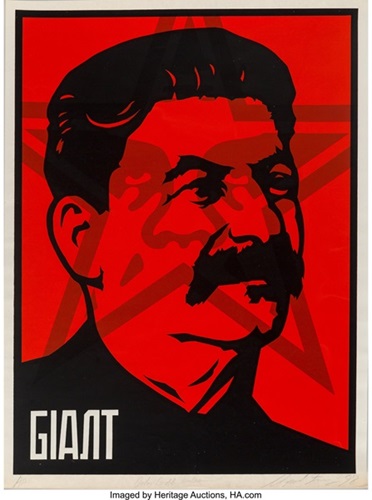
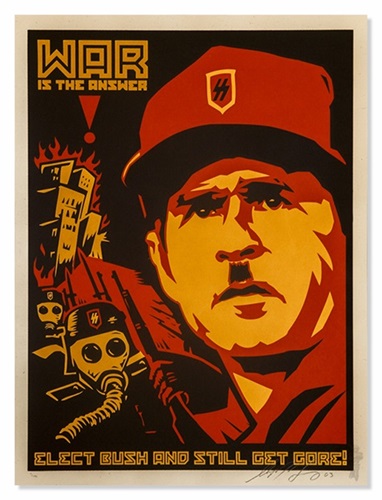
Stalin Cabinet is a 1997 screen print published by Obey Giant in a first edition of 100, measuring 18 x 24 inches. The work draws on the visual language of mid-century authoritarian propaganda, pairing a dictatorial figure with Fairey's bold graphic framing in his early propaganda-poster style. Rendered in his characteristic limited palette, the print treats imagery of state power as material for critique and recontextualization. As an early hand-pulled Obey Giant screen print in a small edition, it sits within Fairey's foundational late-1990s output examining how propaganda and political authority are pictured and circulated.
Why It Matters
Stalin Cabinet sits in Fairey's late-1990s phase, when he was building a catalog of editioned screen prints that interrogated the aesthetics of power and propaganda. By invoking a figure synonymous with authoritarian state control, the work foregrounds his central preoccupation: how propaganda imagery commands obedience and how that visual grammar can be exposed by reusing it. The 1997 date and first edition of 100 place it among the early, hand-pulled Obey Giant prints that collectors regard as formative to his catalog. For a Fairey collection it matters as a direct engagement with totalitarian iconography, complementing his other appropriated-leader prints from the same years and illustrating the propaganda-critique logic that underpins the OBEY project itself. The source provides no pricing, signature, or sales data, so its importance rests on subject, date, and edition size rather than documented market performance, and claims here stay grounded in those supplied facts.
Collector Perspective
Stalin Cabinet draws collectors interested in Fairey's propaganda-critique work and in politically pointed graphic art. Its authoritarian subject and bold framing make it a striking wall piece and a strong anchor within a themed grouping of his appropriated-leader prints. Collectors assembling a chronological view of his late-1990s output will value it as an early edition of 100 from the formative Obey Giant period. It groups naturally with the other 1997-1998 propaganda portraits, reinforcing the obedience-and-power theme. The 18 x 24 inch size frames conventionally and suits a gallery-style arrangement of related early works.
Historical Context
Dating to 1997, Stalin Cabinet belongs to the period when Fairey was formalizing the OBEY street project into editioned fine-art prints under Obey Giant. The work taps the imagery of twentieth-century authoritarian propaganda, aligning with his broader strategy of repurposing the visual tools of state power to question them. It is part of the cluster of 1997-1998 editions of 100 that defined his propaganda-inspired idiom before his Obama-era prominence. Within his arc, the print demonstrates how he used recognizable figures of authority to probe the mechanics of obedience that the OBEY campaign satirized, situating it among his foundational political-graphic statements.
FAQ
When was Stalin Cabinet made?
Stalin Cabinet was made in 1997 and published by Obey Giant, Shepard Fairey's print imprint. It is part of his late-1990s body of hand-pulled screen prints.
What is the edition size?
The record lists it as a first edition of 100. No further editions of this print are noted in the source data.
What medium and size is it?
It is a screen print measuring 18 x 24 inches, according to the source. It was produced as a hand-pulled screen print in Fairey's early propaganda style.
How does it relate to the Stalin print?
Stalin Cabinet shares its authoritarian subject with the 1998 Stalin print, and both belong to Fairey's run of appropriated-leader works that examine the imagery of state power and propaganda.
Related Works

About the Artist

Shepard Fairey (b. 1970, Charleston, South Carolina) is an American street artist, graphic designer, and activist, and a graduate of the Rhode Island School of Design. His 1989 “André the Giant Has a Posse” sticker grew into the global OBEY GIANT campaign — an ongoing experiment in propaganda, obedience, and visual culture. He reached worldwide recognition with the 2008 “Hope” portrait of Barack Obama, now held by the Smithsonian National Portrait Gallery. Across screen prints, stencils, murals, and collage, Fairey channels propaganda aesthetics toward themes of peace, justice, environmentalism, and civil rights. His work is in the collections of the Museum of Modern Art, the Victoria & Albert Museum, and LACMA.