Gauntlet Gallery
What is Shepard Fairey’s piece called “Tank”?
Artist Statement
Screen Print 18 x 24 inches Edition of 100
Summary
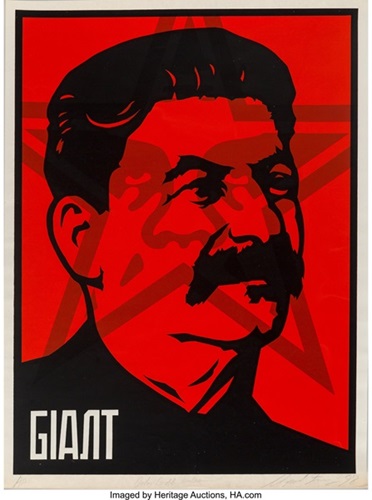
Tank is a 1997 screen print published by Obey Giant in a first edition of 100, measuring 18 x 24 inches. The work centers on military imagery, rendered through Fairey's early propaganda-poster style with bold graphic framing and a limited palette. By isolating an icon of armed state power, the print engages his recurring interrogation of militarism and the aesthetics of authority. As an early hand-pulled Obey Giant screen print in a small edition, it sits within his foundational late-1990s output that repurposes the visual language of propaganda to question power and force.
Why It Matters
Tank comes from Fairey's late-1990s period of building editioned screen prints that scrutinize power, militarism, and propaganda imagery. Foregrounding an instrument of state force, the work channels the anti-authoritarian undercurrent of the OBEY project into a single graphic emblem, asking viewers to register how military might is pictured and normalized. Its 1997 date and first edition of 100 place it among the early hand-pulled Obey Giant prints collectors treat as formative. In a Fairey holding, Tank matters as a concentrated statement on militarism that complements his appropriated-leader portraits from the same years, rounding out the propaganda-critique thread with imagery of armament rather than personality. The source includes no pricing, signature, or market data, so its significance rests on subject, date, and edition size rather than any documented sales record, and the interpretation here stays anchored to those supplied facts.
Collector Perspective
Tank suits collectors drawn to Fairey's militarism and anti-authoritarian themes and to bold single-icon graphics. Its stark subject reads clearly from a distance, making it an effective focal point on a wall or within a themed cluster of his late-1990s propaganda prints. Collectors mapping his foundational period will value it as an early edition of 100 from the Obey Giant catalog. It pairs naturally with his 1997-1998 leader portraits and military-themed works, reinforcing the power-and-force motif. The 18 x 24 inch format frames easily and complements a grouping of related early prints.
Historical Context
Tank dates to 1997, when Fairey was translating the OBEY street campaign into a body of editioned screen prints under Obey Giant. The work's military emblem aligns with his broader use of propaganda imagery to interrogate state power, a stance rooted in the satirical obedience theme of the OBEY project. It belongs to the 1997-1998 cluster of editions of 100 that established his propaganda-inspired idiom before his Obama-era visibility. Within his arc, Tank shows him distilling critique into a single forceful icon, situating it among the early graphic statements that anticipate his later, more explicitly political work.
FAQ
When and by whom was Tank released?
Tank was released in 1997 and published by Obey Giant, Shepard Fairey's print imprint. It belongs to his late-1990s catalog of hand-pulled screen prints.
What is the edition size?
According to the record, Tank is a first edition of 100. No further editions of this print are listed in the source data.
What is the medium and size?
It is a screen print measuring 18 x 24 inches, as stated in the source. It was produced as a hand-pulled screen print in Fairey's early propaganda style.
What is the subject?
The print centers on military tank imagery, an emblem of armed state power. Fairey uses it within his propaganda-inspired idiom to engage themes of militarism and authority.
Related Works

About the Artist

Shepard Fairey (b. 1970, Charleston, South Carolina) is an American street artist, graphic designer, and activist, and a graduate of the Rhode Island School of Design. His 1989 “André the Giant Has a Posse” sticker grew into the global OBEY GIANT campaign — an ongoing experiment in propaganda, obedience, and visual culture. He reached worldwide recognition with the 2008 “Hope” portrait of Barack Obama, now held by the Smithsonian National Portrait Gallery. Across screen prints, stencils, murals, and collage, Fairey channels propaganda aesthetics toward themes of peace, justice, environmentalism, and civil rights. His work is in the collections of the Museum of Modern Art, the Victoria & Albert Museum, and LACMA.