Gauntlet Gallery
What is Shepard Fairey’s piece called “Grenade”?
Artist Statement
GRENADE Screen Print 18 x 24 inches Edition of 100
Summary
Grenade is a 1998 Shepard Fairey screen print published by Obey Giant in a first edition of 100, measuring 18 x 24 inches. The image centers on a grenade, an unambiguous symbol of force and militarized violence, rendered in Fairey's flat, high-contrast propaganda-poster style. Reduced to bold graphic shapes and a limited palette, the weapon becomes a confrontational icon rather than a literal object. The print belongs to Fairey's late-1990s sequence of editioned screen prints that recast charged symbols and figures of power through the visual vocabulary of mass-produced propaganda, sitting alongside companion images of authority and ideology.
Why It Matters
Grenade extends Fairey's early Obey Giant interrogation of power into the realm of militarized force, using a single weapon as a stand-in for violence, conflict, and the imagery of war. Rendering it in the same commanding propaganda style he applied to ideological leaders draws a deliberate line between symbols of state authority and the instruments of force that back them. The 1998 date places it among the foundational editioned screen prints that formalized Fairey's propaganda aesthetic before his wider recognition. For collectors, Grenade represents the harder, more politically pointed side of Fairey's catalog, distinct from his celebrity portraits and decorative motifs. Its small stated edition of 100 makes it one of the scarcer early Obey releases. Within a collection it functions as a thematic counterpoint to the leader portraits of the same year, broadening the late-1990s narrative from figures of power to the tools of force. It documents the period when Fairey was systematically building a visual language around authority, militarism, and obedience that would persist throughout his anti-war and political work in later decades.
Collector Perspective
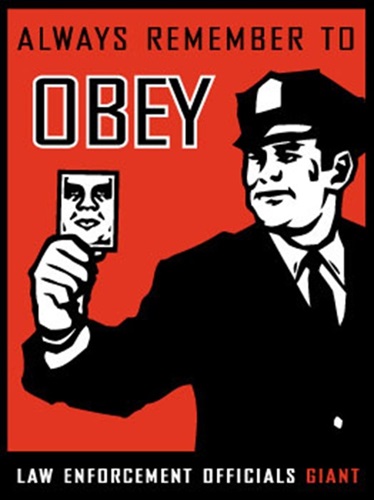
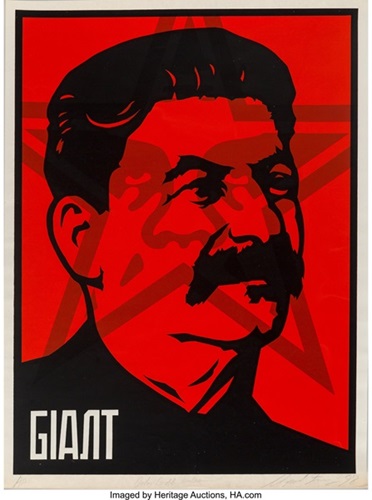
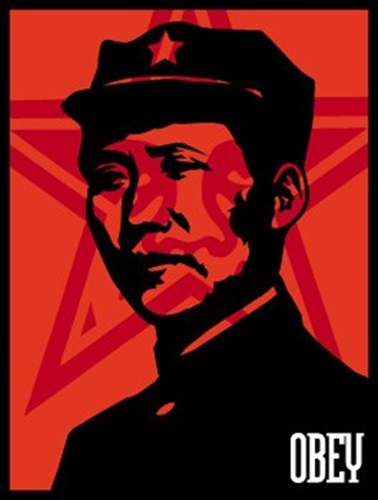
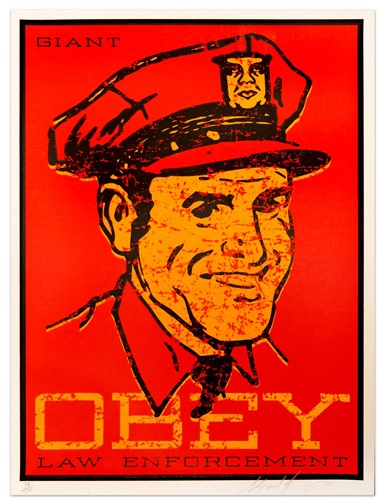
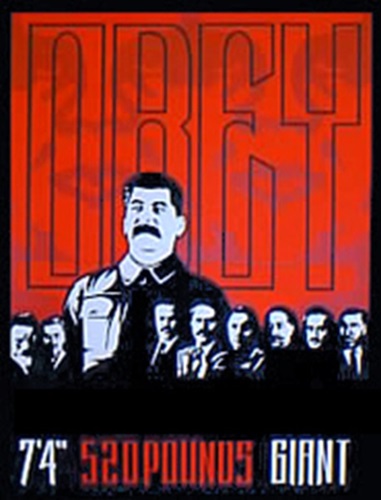
Grenade appeals to collectors who favor Fairey's political and anti-militarist imagery and the early Obey Giant period in particular. The stated first edition of 100 and 1998 date attract buyers focused on scarcity and pre-fame provenance. As an object-centered image rather than a portrait, it offers visual variety within a thematic grouping and pairs strongly with the companion 1998 prints, Cop, Stalin, and Mao, all at the same 18 x 24 inch size. Its stark, weapon-as-icon composition makes a bold wall statement and reads as a clear symbol of force, appealing to collectors building a narrative around power and militarism in Fairey's catalog. The uniform format supports display as part of a matched late-1990s set.
Historical Context
Grenade was produced in 1998 as Fairey consolidated the Obey Giant project that grew out of his 1989 Andre the Giant sticker campaign. During this period he issued 18 x 24 inch screen prints in editions of 100 appropriating charged political imagery and symbols of power. A grenade fits his early engagement with militarism and force as components of authority. These late-1990s editions predate his broad fame and his 2008 Hope poster, placing Grenade in the foundational Posters and Propaganda phase of his arc, when the propaganda-inspired aesthetic and recurring anti-war undertones of his later work were taking shape in repeatable, collectible form.
FAQ
What does Grenade depict?
Grenade is a 1998 Obey Giant screen print centered on a grenade, rendered in Shepard Fairey's flat, high-contrast propaganda style. The weapon becomes a confrontational graphic icon of force and militarized violence rather than a literal object.
What are the print's size and edition?
The source record lists Grenade at 18 x 24 inches in a first edition of 100, published by Obey Giant in 1998 as a screen print.
How does it relate to Fairey's other 1998 works?
It belongs to a 1998 group of 18 x 24 inch editions of 100, alongside Cop, Stalin, and Mao. As an object-based image it complements the leader portraits, broadening the theme from figures of power to the instruments of force.
Why collect an early Obey print like Grenade?
It dates to 1998, before Fairey's wider fame, and was issued in a small edition of 100. Collectors value it as a foundational example of his propaganda aesthetic and his early engagement with militarism and force.
Related Works
About the Artist

Shepard Fairey (b. 1970, Charleston, South Carolina) is an American street artist, graphic designer, and activist, and a graduate of the Rhode Island School of Design. His 1989 “André the Giant Has a Posse” sticker grew into the global OBEY GIANT campaign — an ongoing experiment in propaganda, obedience, and visual culture. He reached worldwide recognition with the 2008 “Hope” portrait of Barack Obama, now held by the Smithsonian National Portrait Gallery. Across screen prints, stencils, murals, and collage, Fairey channels propaganda aesthetics toward themes of peace, justice, environmentalism, and civil rights. His work is in the collections of the Museum of Modern Art, the Victoria & Albert Museum, and LACMA.