Gauntlet Gallery
What is Shepard Fairey’s piece called “Marcos Profile”?
Artist Statement
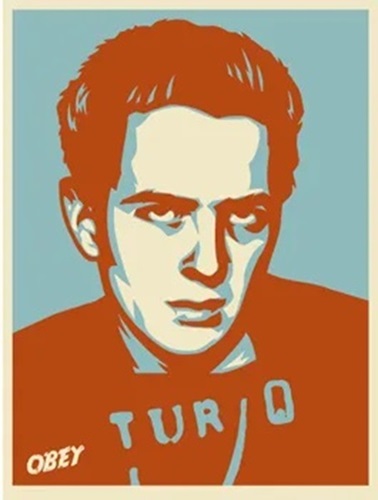
Viva La Revolucion (Marcos Profile) Screen Print 18 x 24 inches Edition of 300
Summary
Marcos Profile (Viva La Revolucion) is a 2002 screen print by Shepard Fairey, published by Obey Giant in a first edition of 300, measuring 18 x 24 inches. The work presents a profile portrait tied to revolutionary iconography, rendered in Fairey's high-contrast graphic style with bold flat fields and a propaganda-poster sensibility. The 'Viva La Revolucion' subtitle signals its revolutionary and protest framing, while the source assigns it a pop-culture and collaboration theme. With a defined run of 300 prints, it is a discrete early-2000s edition that joins Fairey's recurring Marcos imagery across several years.
Why It Matters
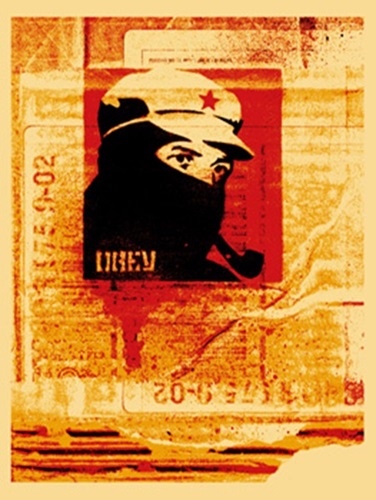
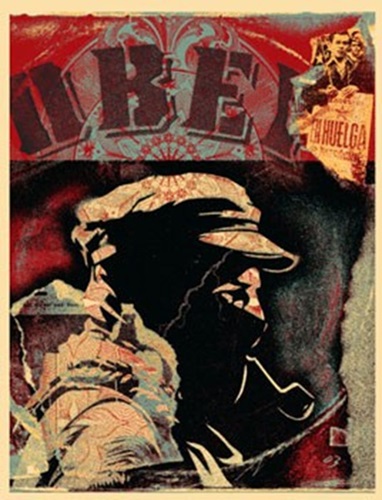
Marcos Profile is part of Fairey's recurring engagement with revolutionary iconography, specifically the Zapatista movement's masked figure, a subject he returned to in his Marcos Stencil and Marcos Collage prints. The 'Viva La Revolucion' subtitle places the work squarely in the tradition of protest and revolutionary poster art that Fairey drew on throughout his career. These Marcos prints matter because they show his interest in real-world insurgent movements rendered through the same propaganda-poster lens he applied to commercial and pop-culture imagery, blurring the line between activism and aesthetic. With a first edition of 300, Marcos Profile is a defined artifact of this revolutionary thread in his early-2000s catalog. For collectors, it connects Fairey's pop-culture appropriation to his more politically charged subjects, foreshadowing the activist imagery that would dominate his later work. As one of multiple Marcos treatments, it offers a way to trace how Fairey reworked a single revolutionary subject across different techniques and years, making it a meaningful node in understanding his approach to political iconography.
Collector Perspective
This print appeals to collectors interested in Fairey's revolutionary and protest imagery and those who want to assemble his multiple Marcos treatments across the early 2000s. At 18 x 24 inches it frames easily and pairs naturally with the Marcos Stencil and Marcos Collage prints for a focused subject grouping. The edition of 300 makes it a moderately limited piece, suitable for collectors who value defined-edition screen prints. Its revolutionary framing gives it strong placement in a politically themed collection, while its 2002 date and Obey Giant provenance make it an authentic early-catalog acquisition for those tracking the political roots of Fairey's later activist work.
Historical Context
Marcos Profile dates to 2002, within Fairey's posters-and-propaganda period and his prolific early-2000s screen-printing run, well before his 2008 Obama-era prominence. The Marcos subject references Subcomandante Marcos and the Zapatista movement, reflecting Fairey's longstanding interest in revolutionary and insurgent iconography. He revisited this subject in subsequent years through the Marcos Stencil and Marcos Collage prints, showing a sustained engagement with the figure. Within his arc, Marcos Profile documents how Fairey applied his propaganda-poster aesthetic to genuine political movements during a period otherwise dominated by music and pop-culture portraits, foreshadowing his later activist direction.
FAQ
Who is the subject of Marcos Profile?
The print depicts Marcos, referencing Subcomandante Marcos and the Zapatista revolutionary movement, rendered as a profile portrait. Its 'Viva La Revolucion' subtitle reinforces the revolutionary framing. It is one of several Marcos treatments Fairey produced in the early 2000s.
What are the dimensions and edition size?
Marcos Profile measures 18 x 24 inches and was released as a first edition of 300 screen prints by Obey Giant in 2002, making it a moderately limited early-catalog edition.
How does it relate to Fairey's other Marcos prints?
Fairey revisited the Marcos subject in 2003 with the Marcos Stencil and Marcos Collage prints. Marcos Profile is the early-2000s starting point, letting collectors trace how he reworked a single revolutionary figure across different techniques and years.
Where does it fit in Fairey's career?
It belongs to his posters-and-propaganda period before his 2008 breakthrough. The print shows him applying his propaganda-poster aesthetic to a genuine political movement, foreshadowing the activist imagery that later defined his work.
Related Works
About the Artist

Shepard Fairey (b. 1970, Charleston, South Carolina) is an American street artist, graphic designer, and activist, and a graduate of the Rhode Island School of Design. His 1989 “André the Giant Has a Posse” sticker grew into the global OBEY GIANT campaign — an ongoing experiment in propaganda, obedience, and visual culture. He reached worldwide recognition with the 2008 “Hope” portrait of Barack Obama, now held by the Smithsonian National Portrait Gallery. Across screen prints, stencils, murals, and collage, Fairey channels propaganda aesthetics toward themes of peace, justice, environmentalism, and civil rights. His work is in the collections of the Museum of Modern Art, the Victoria & Albert Museum, and LACMA.