Gauntlet Gallery
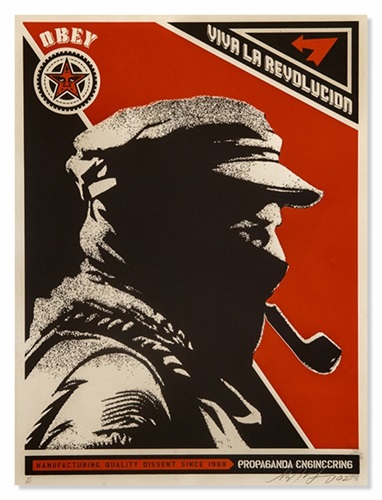
What is Shepard Fairey’s piece called “Marcos Stencil”?
Artist Statement
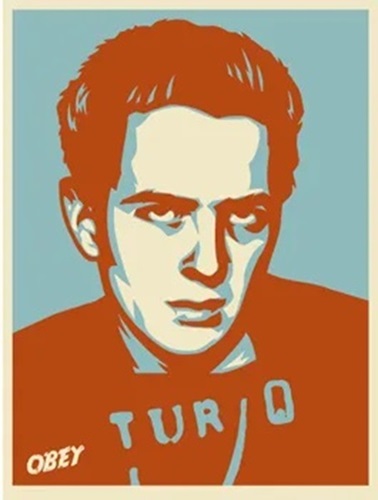
MARCOS STENCIL Screen Print 18 x 24 inches Edition of 300
Summary
Marcos Stencil is a 2003 screen print published by Obey Giant in a first edition of 300, measuring 18 x 24 inches. Per the source, the work is a stencil-style portrait, part of Fairey's recurring engagement with the figure of Subcomandante Marcos. The image applies Fairey's stripped-down graphic poster treatment to a counterculture and political subject. With only the title, medium, dimensions, and edition size supplied, the record offers limited descriptive detail beyond confirming it as a stencil-based screen print in his early-2000s portrait vocabulary.
Why It Matters
Marcos Stencil reflects Fairey's longstanding fascination with the imagery of revolutionary and resistance figures, here the masked Zapatista spokesperson Subcomandante Marcos. Across his early Obey Giant work, Fairey repeatedly returned to Marcos as a subject, and this stencil treatment connects to a broader cluster of related Marcos prints. The stencil aesthetic is foundational to Fairey's practice, descending from his street-poster and sticker origins, so a piece explicitly named for its stencil method foregrounds the technique at the heart of his style. For collectors, the print represents the politically engaged strand of Fairey's pop-icon portraiture, where the visual language of propaganda is turned toward a figure associated with grassroots resistance. The 300-piece edition situates it among his standard early-2000s runs. Because the source description is brief, the work is best understood through its place in the Marcos sub-series and Fairey's wider habit of canonizing resistance figures rather than through any documented narrative attached to this specific sheet.
Collector Perspective
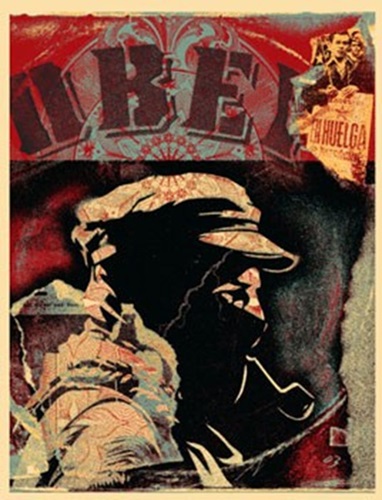
This print appeals to collectors drawn to Fairey's political and resistance imagery and to those building a set around his recurring Subcomandante Marcos subjects. The stencil treatment makes it attractive to admirers of his foundational street-art technique. At 18 x 24 inches it frames cleanly and pairs well with the Marcos Collage and Marcos Profile prints to form a focused thematic grouping. It suits a collection oriented toward Fairey's early-2000s output or toward graphic portraits of activist and revolutionary figures.
Historical Context
Marcos Stencil belongs to Fairey's productive early-2000s Obey Giant period, when he issued numerous screen-printed portraits of cultural and political figures. The Marcos subject ties the print to his repeated engagement with the Zapatista movement's masked spokesperson, a theme he revisited in collage and profile variants. The named stencil method links the work directly to the technique Fairey carried from his street-poster origins. The edition of 300 is consistent with his standard release sizes in this window.
FAQ
When was Marcos Stencil released?
It was released in 2003 and published by Obey Giant. The work is a screen print measuring 18 x 24 inches, produced as a first edition in Fairey's stencil-based portrait style of the period.
How large is the edition?
The source lists a first edition of 300. This is consistent with Fairey's standard early-2000s screen-print release sizes from his Obey Giant output.
Who is the subject?
The title and Fairey's related Marcos prints indicate the subject is Subcomandante Marcos, the masked Zapatista spokesperson Fairey returned to across collage, profile, and stencil treatments in this era.
Why is it called a stencil?
The title references the stencil technique central to Fairey's practice, descended from his street-poster and sticker origins. The source provides limited further description, so details beyond the medium and edition are not documented in the record.
Related Works
About the Artist

Shepard Fairey (b. 1970, Charleston, South Carolina) is an American street artist, graphic designer, and activist, and a graduate of the Rhode Island School of Design. His 1989 “André the Giant Has a Posse” sticker grew into the global OBEY GIANT campaign — an ongoing experiment in propaganda, obedience, and visual culture. He reached worldwide recognition with the 2008 “Hope” portrait of Barack Obama, now held by the Smithsonian National Portrait Gallery. Across screen prints, stencils, murals, and collage, Fairey channels propaganda aesthetics toward themes of peace, justice, environmentalism, and civil rights. His work is in the collections of the Museum of Modern Art, the Victoria & Albert Museum, and LACMA.