Gauntlet Gallery
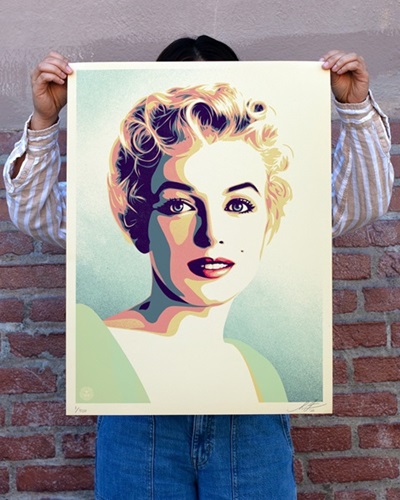
What is Shepard Fairey’s piece called “Marilyn Sunset”?
Artist Statement
Marilyn Monroe has fascinated me since I was a child. I was probably ten years old when I asked my dad, "Why is Marilyn Monroe so famous?" He answered something like "well, she was a symbol of American beauty and hope. She burned bright but tragically died young." I was intrigued and watched Marilyn's movies whenever they showed on cable. Seeing her on screen, I was mesmerized by her allure, her humor, and her vulnerability. I might not have been able to articulate it as a young person, but Marilyn had range and nuance that was magnetic, and I leaned in. Later in high school, I became interested in pop art, and one of the genre's most famous series of images is Andy Warhol's Marilyn portraits. Warhol's Marilyns are superb in their use of color and effectively achieve his goal of reducing her to a high-contrast iconic, but impersonal representation. However, iconic glamour is only one dimension of Marilyn. When I was presented with the opportunity to make art of Marilyn based on photos by Milton H. Greene from 1956, when she was at the height of her powers, I was struck by the images' intimacy and vulnerability. To me, these images called for a much more delicate approach compared to Warhol's in order to convey more nuance and humanity. Even though Marilyn showed courage and conviction fighting for civil rights, equality, and against McCarthyism, her mental health struggles are widely recognized. I felt it was important to depict her precarious dance between wide-eyed aspiration and shying away from the glare of the spotlight. I hope these images, "Marilyn Sunrise" and "Marilyn Sunset," inspire an empathetic look at Marilyn's complex humanity and remind us that we are all teetering between strength and fragility. -Shepard A portion of the proceeds from these prints will benefit The Marilyn Monroe Mental Health for the Arts Program PRINT DETAILS: Marilyn Sunset. 24" H x 18" W. Screen print on 80# cream Speckletone paper. Original illustration based on a photograph by Milton H. Greene. Signed by Shepard Fairey. Numbered edition of 500. Comes with a Digital Certificate of Authenticity provided by Verisart. $100.
Summary
Marilyn Sunset is a 2026 screen print by Shepard Fairey, published by Obey Giant in a signed, numbered first edition of 500. It measures 24 inches high by 18 inches wide, printed on 80# cream Speckletone paper, and ships with a Verisart digital Certificate of Authenticity. Listed at $100, the original illustration is based on a 1956 photograph of Marilyn Monroe by Milton H. Greene. Fairey describes a deliberately delicate approach, distinct from Warhol's iconic Marilyns, aimed at conveying Monroe's intimacy, vulnerability, and complex humanity. Released with companion print Marilyn Sunrise, a portion of proceeds benefits The Marilyn Monroe Mental Health for the Arts Program.
Why It Matters
Marilyn Sunset stands out in Fairey's catalog as a portrait that consciously departs from Andy Warhol's famous Pop-art Marilyns. In his statement, Fairey praises Warhol's high-contrast, iconic but impersonal treatment, then explains his own choice of a more delicate approach, based on Milton H. Greene's intimate 1956 photographs, to convey Monroe's vulnerability, nuance, and humanity. This positions the print as both an homage to and a deliberate counterpoint within the Pop-portrait tradition that shaped Fairey's own development. He frames Monroe as a figure who showed courage fighting for civil rights, equality, and against McCarthyism while struggling with her mental health, themes that ground the work in dignity and empathy rather than mere glamour. The release pairs with Marilyn Sunrise and supports The Marilyn Monroe Mental Health for the Arts Program, adding a cause-based dimension. For collectors, the appeal lies in this rare Fairey treatment of an iconic cultural figure, its dialogue with art history, and its accessible $100 price in an edition of 500 with Verisart authentication. Its significance is as a humanizing portrait that bridges Pop-art legacy, civil-rights context, and mental-health advocacy.
Collector Perspective
Marilyn Sunset appeals to collectors drawn to Fairey's portraits of cultural icons and to the dialogue with Warhol's Pop-art legacy. The intimate, delicate treatment based on Milton H. Greene's 1956 photograph offers a distinctive take that pairs naturally with companion print Marilyn Sunrise for those seeking the set. At $100 in a numbered edition of 500, it is accessible to mid-level collectors. The 24 x 18 inch format frames well as a portrait centerpiece. The stated benefit to The Marilyn Monroe Mental Health for the Arts Program adds cause-based appeal. With a signature and Verisart digital COA, it suits collections built around portraits, legacy figures, and Fairey's civil-rights-inflected imagery.
Historical Context
Marilyn Sunset connects Fairey's work to the Pop-art tradition that influenced him, explicitly engaging Andy Warhol's iconic Marilyn series while charting a more intimate, humanizing path drawn from Milton H. Greene's 1956 photographs. Published by Obey Giant, it sits in Fairey's contemporary period of portrait-and-legacy works that honor complex cultural figures. By framing Monroe's courage on civil rights, equality, and against McCarthyism alongside her mental-health struggles, the print extends Fairey's recurring interest in dignity and social context. Within his arc, this 2026 release, paired with Marilyn Sunrise and tied to a mental-health arts program, demonstrates his continued use of portraiture to reframe iconic figures with empathy and historical depth.
FAQ
What is Marilyn Sunset based on?
It is an original illustration based on a 1956 photograph of Marilyn Monroe by Milton H. Greene, from when Fairey notes she was at the height of her powers.
How does Fairey's approach differ from Warhol's?
Fairey describes choosing a more delicate approach than Warhol's high-contrast iconic Marilyns, aiming to convey Monroe's intimacy, vulnerability, nuance, and complex humanity rather than impersonal glamour.
What cause does the print support?
Fairey states that a portion of the proceeds from the Marilyn prints benefits The Marilyn Monroe Mental Health for the Arts Program.
What are the size, medium, and edition?
It is a screen print measuring 24 inches high by 18 inches wide on 80# cream Speckletone paper, issued as a signed, numbered first edition of 500 with a Verisart digital Certificate of Authenticity. It was priced at $100.
Related Works
About the Artist

Shepard Fairey (b. 1970, Charleston, South Carolina) is an American street artist, graphic designer, and activist, and a graduate of the Rhode Island School of Design. His 1989 “André the Giant Has a Posse” sticker grew into the global OBEY GIANT campaign — an ongoing experiment in propaganda, obedience, and visual culture. He reached worldwide recognition with the 2008 “Hope” portrait of Barack Obama, now held by the Smithsonian National Portrait Gallery. Across screen prints, stencils, murals, and collage, Fairey channels propaganda aesthetics toward themes of peace, justice, environmentalism, and civil rights. His work is in the collections of the Museum of Modern Art, the Victoria & Albert Museum, and LACMA.