Gauntlet Gallery
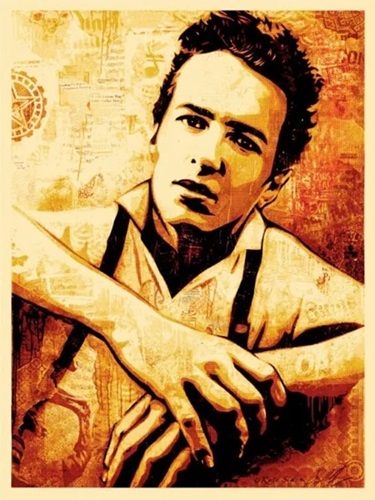
What is Shepard Fairey’s piece called “Joe Strummer”?
Artist Statement
STRUMMER POSTER Screen Print 18 x 24 inches Edition of 300
Summary
Joe Strummer is a 2003 screen print by Shepard Fairey, published by Obey Giant in an edition of 300 at 18 x 24 inches. The source description is brief, confirming the title, screen-print medium, dimensions, and edition size. The print honors Joe Strummer, the late frontman of The Clash, rendering him as a portrait within Fairey's high-contrast graphic style. As one of Fairey's music tributes, it celebrates a foundational punk figure and fits within his early-2000s run of musician portraits that elevate counterculture icons to poster-scale recognition.
Why It Matters
Joe Strummer holds particular weight in Fairey's catalog because Strummer and The Clash are touchstones of the politically engaged punk that shaped Fairey's own worldview. The Clash fused music with anti-authoritarian protest, a model that resonates throughout Fairey's street-art and propaganda-styled practice. Strummer's death in late 2002 cast a long shadow over the punk world, and Fairey's tribute portraits from this period read as part of a collective act of memorial. While the source description is sparse, the documented facts, a 2003 Obey Giant screen print in an edition of 300, place it squarely among his most personally meaningful music subjects. For collectors, the appeal is the combination of an iconic, beloved subject and Fairey's signature graphic treatment, honoring a musician whose blend of art and activism mirrors Fairey's own. The edition of 300 keeps it limited yet attainable. Its enduring interest comes from Strummer's stature in music history and from Fairey's evident affinity for artists who married creative work with political conviction.
Collector Perspective
This print appeals strongly to Clash and Joe Strummer fans, punk-music collectors, and Fairey enthusiasts assembling his music portraits. As a tribute to a revered, politically minded musician, it carries emotional resonance that makes it a meaningful display piece. At 18 x 24 inches it frames easily and groups well with Fairey's other early-2000s punk and music portraits. The edition of 300 offers limited but reasonable availability for collectors entering this part of his catalog, and a later canvas version exists for those wanting a different format. It fits a music-focused or counterculture-themed collection and rewards owners who value both the subject's legacy and Fairey's graphic style.
Historical Context
Dated 2003, the print arrives shortly after Joe Strummer's death in late 2002, situating it within Fairey's early-2000s wave of punk and music tributes. Strummer and The Clash embodied the politically charged punk that informed Fairey's anti-authoritarian image-making, making this an especially fitting subject. The print belongs to the body of musician portraits that bridge Fairey's street-poster origins and the larger-scale celebrity and political portraiture of his later career. Honoring a figure who united music and protest reflects a recurring pattern in his work of celebrating artists whose creativity carried a social or political charge.
FAQ
Who does this print honor?
The print honors Joe Strummer, the frontman of The Clash, a foundational and politically engaged punk band. Fairey renders him as a portrait in his signature graphic style, placing the work among his early-2000s tributes to influential musicians.
What is the edition size and format?
Joe Strummer is a screen print published by Obey Giant in an edition of 300, measuring 18 x 24 inches and dated 2003. The source confirms title, medium, dimensions, and edition but offers only a brief description.
Is there another format of this image?
A later Joe Strummer canvas print from 2010 also exists in Fairey's catalog. Collectors who prefer canvas or a different presentation of the subject sometimes seek that version alongside or instead of this 2003 screen print.
Related Works
About the Artist

Shepard Fairey (b. 1970, Charleston, South Carolina) is an American street artist, graphic designer, and activist, and a graduate of the Rhode Island School of Design. His 1989 “André the Giant Has a Posse” sticker grew into the global OBEY GIANT campaign — an ongoing experiment in propaganda, obedience, and visual culture. He reached worldwide recognition with the 2008 “Hope” portrait of Barack Obama, now held by the Smithsonian National Portrait Gallery. Across screen prints, stencils, murals, and collage, Fairey channels propaganda aesthetics toward themes of peace, justice, environmentalism, and civil rights. His work is in the collections of the Museum of Modern Art, the Victoria & Albert Museum, and LACMA.