Gauntlet Gallery
What is Shepard Fairey’s piece called “Castro Collage”?
Artist Statement
CASTRO COLLAGE Screen Print 36 x 48 inches Edition of 72 $350
Summary
Castro Collage is a 2003 screen print by Shepard Fairey, published by Obey Giant in an edition of 72 at a large 36 x 48 inches, listed at $350. The source description is brief, confirming the title, collage-based screen-print medium, dimensions, edition size, and price. As a collage work, it layers imagery and Fairey's graphic vocabulary around the figure of Castro, rendered at a substantial scale. The small edition of 72 and large format set it apart from his standard 18 x 24 inch prints, marking it as a more ambitious, limited piece within his early-2000s output.
Why It Matters
Castro Collage is notable for both its scale and its scarcity. At 36 x 48 inches in an edition of just 72, it is far more limited and physically imposing than Fairey's common 18 x 24 inch prints, which elevates its standing among collectors. The collage technique aligns it with a recognizable group of large Fairey collage works that build dense, layered compositions around a central figure, drawing on the visual language of revolutionary propaganda. Choosing Castro as a subject places the piece within Fairey's recurring engagement with iconic political and revolutionary imagery, deployed in his characteristically ambiguous, design-forward way. The small edition size makes it considerably scarcer than his typical releases, and the larger format gives it the presence of a statement work rather than a wall accent. For collectors, the combination of limited edition, large scale, collage construction, and a charged historical subject makes it a more serious acquisition. Its appeal rests on rarity and visual ambition as much as on the subject itself, anchoring the cluster of 2003 large-format collages in his catalog.
Collector Perspective
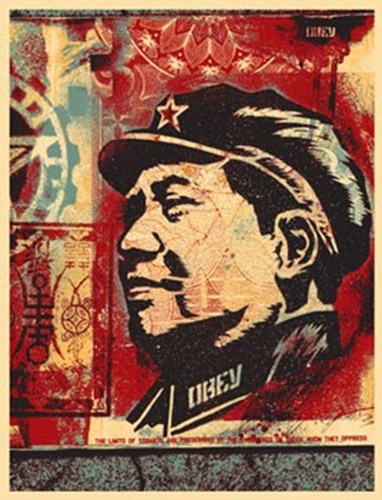
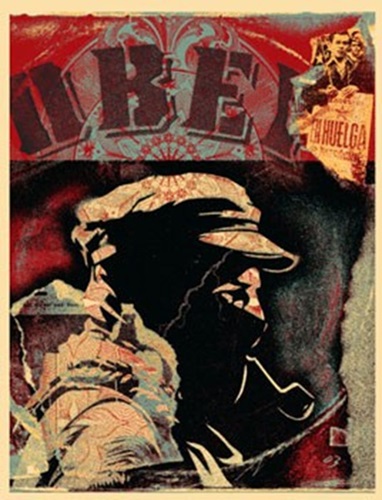
This print suits more advanced collectors who prioritize scale, scarcity, and Fairey's collage technique over accessible decorative prints. At 36 x 48 inches it is a commanding centerpiece rather than a grouping piece, demanding wall space and rewarding it with strong presence. The edition of 72 makes it markedly scarcer than his standard runs, appealing to buyers who value limited availability. It groups conceptually with his other large collage works (Marcos Collage, Mao Collage) for those assembling that family. The charged political subject and ambitious format make it a statement acquisition for collectors comfortable with provocative imagery and a higher commitment piece within a Fairey collection.
Historical Context
Dated 2003, Castro Collage belongs to a cluster of large-format collage works Fairey produced in the early 2000s, alongside Marcos Collage and Mao Collage. These pieces show him expanding from poster-scale screen prints into more ambitious, layered compositions built around revolutionary and political figures, mining the aesthetics of propaganda he had long referenced. Using Castro as a subject reflects his ongoing appropriation of iconic political imagery in a deliberately design-driven, ambiguous mode. The small edition and large scale mark this period as one where Fairey pushed toward more collectible, gallery-oriented works that complemented his street-poster practice.
FAQ
How limited is Castro Collage?
It was produced in an edition of just 72, far smaller than Fairey's common runs of 200 to 300. Combined with its large 36 x 48 inch format, the low edition size makes it one of the scarcer and more ambitious pieces in his early-2000s catalog.
What are the size and price details?
Castro Collage measures 36 x 48 inches and is a screen print dated 2003, published by Obey Giant. The source lists a price of $350 and an edition of 72. Its large scale sets it apart from his standard 18 x 24 inch prints.
How does it relate to other Fairey collages?
It is part of a group of 2003 large-format collages that includes Marcos Collage and Mao Collage. These works share a layered collage technique built around revolutionary and political figures, drawing on the visual language of propaganda.
Related Works

About the Artist

Shepard Fairey (b. 1970, Charleston, South Carolina) is an American street artist, graphic designer, and activist, and a graduate of the Rhode Island School of Design. His 1989 “André the Giant Has a Posse” sticker grew into the global OBEY GIANT campaign — an ongoing experiment in propaganda, obedience, and visual culture. He reached worldwide recognition with the 2008 “Hope” portrait of Barack Obama, now held by the Smithsonian National Portrait Gallery. Across screen prints, stencils, murals, and collage, Fairey channels propaganda aesthetics toward themes of peace, justice, environmentalism, and civil rights. His work is in the collections of the Museum of Modern Art, the Victoria & Albert Museum, and LACMA.