Gauntlet Gallery
What is Shepard Fairey’s piece called “Obey Van (First Edition)”?
Artist Statement
OBEY VAN Screen Print 18 x 24 inches
Summary
Obey Van is a 1997 screen print by Shepard Fairey, published by Obey Giant, measuring 18 x 24 inches on paper. The record does not list a numbered edition size. It is classified under collaborations/pop culture with a secondary consumerism/power theme, indicating it applies the OBEY brand to a vehicle motif. As an early Obey Giant print, it belongs to Fairey's late-1990s output that extended the OBEY identity across everyday objects and commercial imagery. Source detail is limited to title, medium, and dimensions, so the description stays close to those facts.
Why It Matters
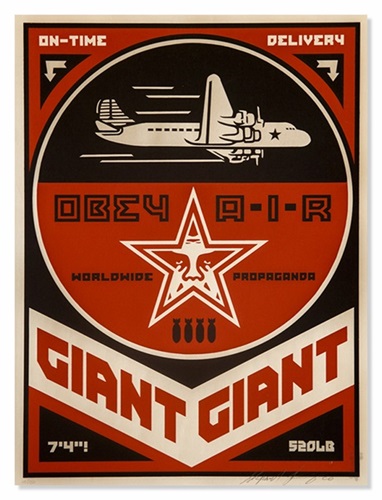
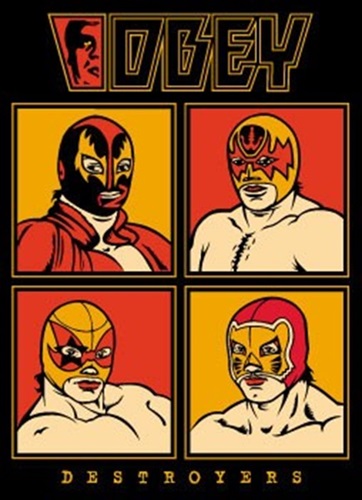
Obey Van sits in Fairey's 1997 Obey Giant output and reflects a recurring move in the early project: stamping the OBEY identity onto vehicles, signage, and commercial forms to mimic and parody the spread of branding through public space. The record's secondary consumerism/power theme underscores that the van is less a literal subject than a vector for the OBEY mark, echoing how Fairey treated trucks, poles, and other infrastructure as carriers of his propaganda experiment. Within the early catalog, the 'Obey [object]' prints form a recognizable family, and this one is among the earliest, predating the 2000-2001 Obey Air, Pole, and Destroyers works in its related set. Because the source omits an edition number and offers minimal description, scarcity and specific imagery should be treated cautiously; the firmly grounded facts are the 1997 date, the screen-print medium, and the 18 x 24 format. The print's significance lies in its role within this object-branding thread of the OBEY project, and its appeal rests on that thematic lineage and its early date rather than on any documented edition size or claim of rarity.
Collector Perspective
Obey Van appeals to collectors interested in the 'Obey [object]' family of prints and the early extension of the OBEY brand onto vehicles and commercial forms. It pairs naturally with later object-branding works like Obey Air, Obey Pole, and Obey Destroyers, making it a useful anchor for a thematic sub-collection. The 18 x 24 format frames and groups easily with other late-1990s OBEY prints. Because the record lists no edition number and little visual detail, buyers should treat scarcity as unconfirmed and lead with the 1997 date and the object-branding theme. It fits a chronological or thematic OBEY collection focused on how the brand colonized everyday imagery.
Historical Context
Published by Obey Giant in 1997, Obey Van belongs to Fairey's early studio-edition era, when the OBEY campaign was extending its mark across vehicles, signage, and commercial objects as a study in how branding propagates through public space. It anticipates the later 'Obey [object]' prints, Obey Air, Obey Pole, and Obey Destroyers, that appear in its related set from 2000-2001, marking this as an early entry in that recurring motif. Without a recorded edition size, its place is defined by chronology and theme rather than by a documented run, situating it among the formative works that built the OBEY object-branding vocabulary.
FAQ
What is Obey Van?
Obey Van is a 1997 screen print by Shepard Fairey, published by Obey Giant, measuring 18 x 24 inches on paper. It applies the OBEY brand to a vehicle motif and is classified under collaborations/pop culture with a consumerism/power secondary theme.
What is the edition size?
The record does not list a numbered edition size for Obey Van. Because no figure is provided, the edition size should be treated as unconfirmed rather than assumed.
What are its dimensions and medium?
It is a screen print on paper measuring 18 inches wide by 24 inches high, published by Obey Giant in 1997.
How does it relate to other OBEY prints?
It is an early entry in the 'Obey [object]' family, predating works like Obey Air, Obey Pole, and Obey Destroyers, in which Fairey applied the OBEY mark to vehicles and infrastructure as a study in branding.
Related Works




About the Artist

Shepard Fairey (b. 1970, Charleston, South Carolina) is an American street artist, graphic designer, and activist, and a graduate of the Rhode Island School of Design. His 1989 “André the Giant Has a Posse” sticker grew into the global OBEY GIANT campaign — an ongoing experiment in propaganda, obedience, and visual culture. He reached worldwide recognition with the 2008 “Hope” portrait of Barack Obama, now held by the Smithsonian National Portrait Gallery. Across screen prints, stencils, murals, and collage, Fairey channels propaganda aesthetics toward themes of peace, justice, environmentalism, and civil rights. His work is in the collections of the Museum of Modern Art, the Victoria & Albert Museum, and LACMA.