Gauntlet Gallery
What is Shepard Fairey’s piece called “Propaganda Industries”?
Artist Statement
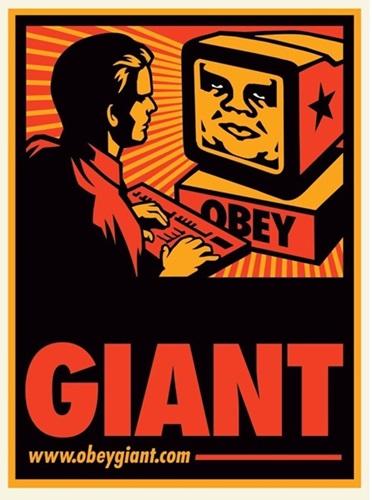
PROPAGANDA INDUSTRIES Screen Print 18 x 24 inches Edition of 200
Summary
Propaganda Industries is a 2001 Shepard Fairey screen print, published by Obey Giant in a first edition of 200, measuring 18 x 24 inches. The image fuses the OBEY visual language with the vocabulary of advertising and corporate branding, framing Fairey's own propaganda machine as an 'industry.' Built on bold typographic blocks, flat color fields, and the recurring OBEY star-and-icon system, the print presents commercial-poster aesthetics as a self-aware comment on consumerism and the manufacturing of influence. It is a mid-size early-period screen print typical of Fairey's Obey Giant studio output in this era.
Why It Matters
Propaganda Industries sits at the conceptual heart of Fairey's early OBEY project: the deliberate adoption of advertising and propaganda techniques to critique how images are used to command attention and obedience. By literally naming the work after an 'industry,' Fairey turns his own image-making apparatus into the subject, a self-referential move that distinguishes him from artists who simply borrow street-art style. For collectors, the 2001 dating places it within the formative Obey Giant studio period, when Fairey was codifying the typographic, propaganda-poster look that would later carry his political work. The source-stated edition of 200 makes it a relatively contained early run. Its themes of consumerism and power resonate across his catalog, connecting backward to late-1990s experiments and forward to the more overtly political screen prints of the mid-2000s. As a documented, numbered Obey Giant screen print it offers a clear, ownable piece of the methodology that defines Fairey's entire practice, valued less for shock and more for how cleanly it states his thesis about the business of influence.
Collector Perspective
This print appeals to collectors who focus on Fairey's early Obey Giant period and on the conceptual backbone of his work rather than on celebrity portraits. The advertising-and-branding subject makes it a natural anchor for a collection organized around consumerism, propaganda technique, and the OBEY iconography itself. At 18 x 24 inches it is an accessible, frame-friendly size that hangs well alongside other early-2000s screen prints, and its bold graphic blocks read strongly from across a room. Buyers building a thematic group around Fairey's critique of corporate power and image-marketing will find it complements pieces like Wreath and the other 2001 Obey Giant releases. With a stated edition of 200 it sits in a moderately scarce tier that suits collectors seeking depth in the formative era.
Historical Context
Propaganda Industries belongs to Fairey's early Obey Giant studio years, the period following the late-1990s sticker and poster campaigns when he was formalizing the propaganda-poster aesthetic into editioned screen prints. The 2001 dating places it among a dense cluster of Obey Giant releases that refined the typographic, flat-color, icon-driven look Fairey is known for. Where his earlier 1989 sticker work spread the OBEY image organically through public space, prints like this one translated that street vocabulary into the studio, packaging the critique of advertising and obedience as collectible editions. It functions as a connective work between the experimental late-'90s output and the more explicitly political screen prints Fairey produced as the decade progressed.
FAQ
When was Propaganda Industries made and who published it?
It was created in 2001 and published by Obey Giant, Shepard Fairey's own studio imprint. It belongs to the cluster of early-2000s OBEY screen prints in which Fairey adapted advertising and propaganda imagery into editioned works.
What is the edition size and how big is the print?
According to the source record it is a first edition of 200 and measures 18 x 24 inches. It was produced as a screen print, the medium Fairey used across most of his Obey Giant releases from this period.
What is the print about?
It draws on the language of advertising and corporate branding, framing Fairey's OBEY project as an 'industry.' The work reflects his recurring themes of consumerism and power, using propaganda-poster style to comment on how images manufacture influence.
How scarce is this print?
With a stated edition of 200, it falls in a moderately scarce tier. The source does not confirm current availability or sold-out status, so scarcity here reflects the documented edition size only, not market supply.
Related Works

About the Artist

Shepard Fairey (b. 1970, Charleston, South Carolina) is an American street artist, graphic designer, and activist, and a graduate of the Rhode Island School of Design. His 1989 “André the Giant Has a Posse” sticker grew into the global OBEY GIANT campaign — an ongoing experiment in propaganda, obedience, and visual culture. He reached worldwide recognition with the 2008 “Hope” portrait of Barack Obama, now held by the Smithsonian National Portrait Gallery. Across screen prints, stencils, murals, and collage, Fairey channels propaganda aesthetics toward themes of peace, justice, environmentalism, and civil rights. His work is in the collections of the Museum of Modern Art, the Victoria & Albert Museum, and LACMA.