Gauntlet Gallery
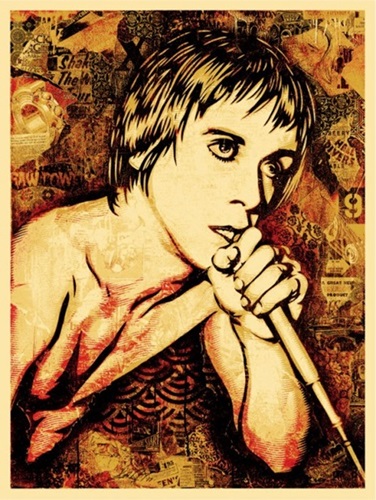
What is Shepard Fairey’s piece called “All Tomorrow's Parties”?
Artist Statement
All Tomorrow’s Parties is a great independent music festival that does events around the world. I attended one in LA a few years ago to catch great shows by Iggy and the Stooges and Mission of Burma. ATP has a great concept of asking people or bands to curate the festival. They have asked people like Jim Jarmusch, Matt Groening, Thurston Moore, The Melvins, and for this year’s festival, Portishead. I love Portishead, so I was happy to be asked to create the poster this year. The festival is happening in an amazing building on the boardwalk in Asbury Park NJ, so I incorporated the building into the design of the poster. I’ll be doing murals, an art show, and DJ’ing as part of the ATP festival, so I’m getting to indulge all my passions in a concentrated way this week. Oh, Public Enemy is performing their classic sonic thunderstorm of an album “Fear of a Black Planet”… shake your rump and pump your fist!!!! If you don’t know what I’m talking about, improve your life immediately and get that record. Or, get to Asbury Park and check it out. 18 x 24 inches screen print, Signed and Numbered Edition of 600. $50. Limit 1 per person/household. Release Date: 09-29-2011
Summary
All Tomorrow's Parties is a 2011 signed and numbered screen print by Shepard Fairey, published by Obey Giant in an edition of 600 measuring 18 x 24 inches and priced at $50. Fairey created the poster for the All Tomorrow's Parties music festival, curated that year by Portishead and held in a building on the boardwalk in Asbury Park, New Jersey, which he incorporated into the design. He participated in the festival with murals, an art show, and a DJ set. Released September 29, 2011, the print fuses Fairey's music fandom with site-specific architectural imagery in a poster format.
Why It Matters
All Tomorrow's Parties exemplifies the deep entanglement of Fairey's art practice with independent and punk music culture. The print was made for a festival he personally attended and admired, curated by Portishead, and his own multi-role participation, painting murals, mounting an art show, and DJing, shows how thoroughly his identity as a music fan informs his work. By incorporating the actual Asbury Park boardwalk building into the composition, Fairey grounds the poster in a specific place, a recurring strategy where architecture and locale become design elements. The festival's curatorial model, inviting figures like Jim Jarmusch, Matt Groening, Thurston Moore, and Portishead to program it, aligns with Fairey's own taste-making sensibility and counterculture affinities. As a music-poster edition of 600 at an accessible $50, it sits firmly in the tradition of the gig poster elevated to collectible fine art. For collectors, it connects Fairey's catalogue to a broader network of independent music history and the artists who shaped it. The work matters as a snapshot of Fairey operating across mediums at a single cultural event, reinforcing his role as a participant in, not just a chronicler of, music subculture.
Collector Perspective
This print appeals strongly to collectors at the crossroads of Fairey's art and independent music culture, especially fans of the All Tomorrow's Parties festival and its curators. The poster format and recognizable Asbury Park architecture give it a sense of place that music and travel collectors appreciate. At an accessible $50 release price and an 18 x 24 inch size, it is approachable for newer buyers while remaining a coherent piece in a music-themed Fairey grouping. Signed and numbered in an edition of 600, it offers the hand-finished qualities collectors value without the steep cost of his rarer works. It pairs naturally with his other gig posters and band portraits.
Historical Context
All Tomorrow's Parties fits within Fairey's extensive body of music-related posters and his long-standing engagement with punk and independent music. Created for the 2011 ATP festival curated by Portishead in Asbury Park, it reflects his practice of producing site-specific event art, here incorporating the festival's boardwalk venue into the design. His participation through murals, an art show, and a DJ set situates the print within a moment of total immersion in music culture rather than a standalone commission. Within his arc, it continues the gig-poster lineage that runs throughout his Obey Giant output and underscores how music fandom repeatedly shaped his subject matter and collaborations during this era.
FAQ
What was this poster created for?
Fairey created All Tomorrow's Parties as the official poster for the 2011 ATP music festival, an independent festival curated that year by Portishead and held in a building on the boardwalk in Asbury Park, New Jersey, which he incorporated into the design.
What is the edition size and price?
It is a signed and numbered screen print in an edition of 600, measuring 18 x 24 inches, released for $50 with a limit of one per person or household on September 29, 2011.
How was Fairey involved beyond the poster?
According to his own description, Fairey participated in the festival by painting murals, mounting an art show, and DJing, describing it as a chance to indulge all his passions at one concentrated event.
What inspired the design?
Fairey incorporated the festival's Asbury Park boardwalk venue building into the poster. He noted his long admiration for Portishead and the festival's model of inviting figures like Jim Jarmusch, Matt Groening, and Thurston Moore to curate.
Related Works
About the Artist
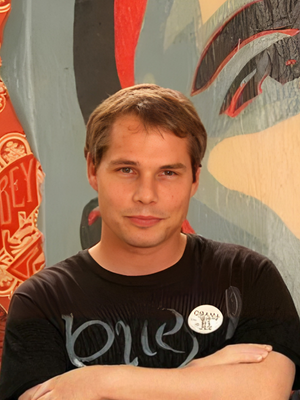
Shepard Fairey (b. 1970, Charleston, South Carolina) is an American street artist, graphic designer, and activist, and a graduate of the Rhode Island School of Design. His 1989 “André the Giant Has a Posse” sticker grew into the global OBEY GIANT campaign — an ongoing experiment in propaganda, obedience, and visual culture. He reached worldwide recognition with the 2008 “Hope” portrait of Barack Obama, now held by the Smithsonian National Portrait Gallery. Across screen prints, stencils, murals, and collage, Fairey channels propaganda aesthetics toward themes of peace, justice, environmentalism, and civil rights. His work is in the collections of the Museum of Modern Art, the Victoria & Albert Museum, and LACMA.